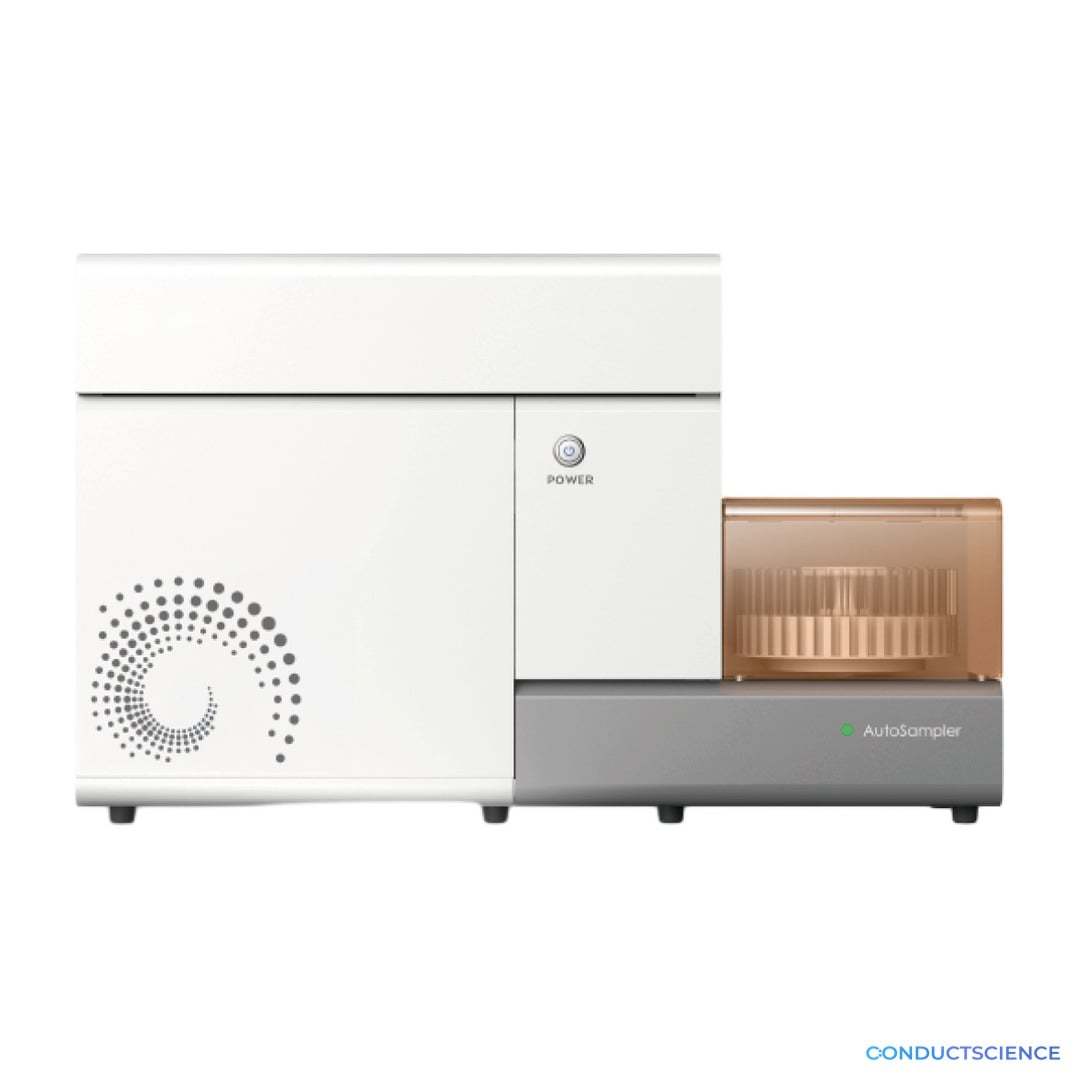
Research Flow Cytometer, 2 to 4 Lasers
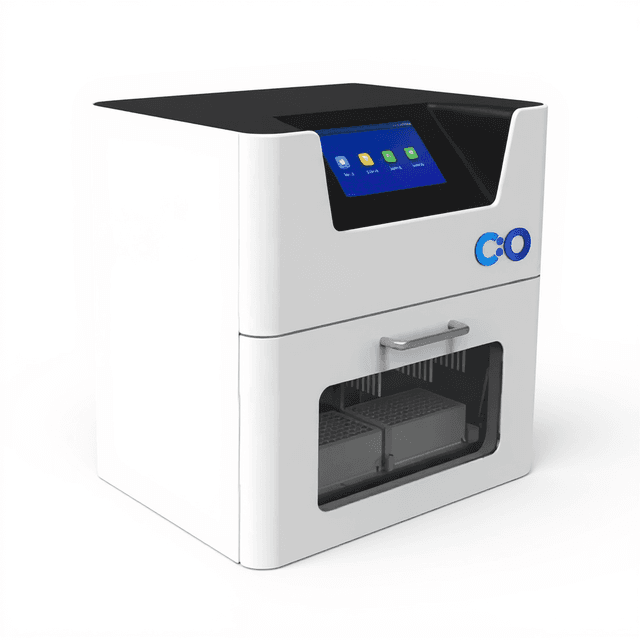
Research flow cytometer for multicolor immunophenotyping and cell analysis, with 2, 3 or 4 lasers for 8, 15 or 21 fluorescence channels and a tube or 96-well plate sampler.

Louise Corscadden, PhD
Director of Science · ConductScience
Ask Louise about Research Flow Cytometer, 2 to 4 Lasers fit, setup, configuration, or quote prep.
Already working with us? Sign in to connect this with My Scientist.
Key Specifications
Full details →- Lasers
- 2-Laser 8-Color: 488 nm blue + 638 nm red, 3-Laser 15-Color: 488 nm blue + 638 nm red + 405 nm violet, 4-Laser 21-Color: 488 nm blue + 638 nm red + 405 nm violet + 561 nm yellow
- Fluorescence Channels
- 2-Laser 8-Color: 8 (488 nm: 5; 638 nm: 3), 3-Laser 15-Color: 15 (488 nm: 5; 638 nm: 3; 405 nm: 7), 4-Laser 21-Color: 21 (488 nm: 5; 638 nm: 3; 405 nm: 7; 561 nm: 6)
- Detection Parameters
- 2-Laser 8-Color: FSC + BSC + 8 fluorescence, 3-Laser 15-Color: 18 (FSC + BSC + VSC + 15 fluorescence), 4-Laser 21-Color: 24 (FSC + BSC + VSC + 21 fluorescence)
- Sample Loading
- Single tube, 40-tube rotary autosampler, 96-well plate autosampler, Built-in mixing
- Optical Path
- Closed optical path with fiber-optic transmission
- Use
- Research Use Only
This research flow cytometer measures light scatter and fluorescence on single cells and particles, for immunophenotyping, cell cycle and apoptosis assays, stem cell and CAR-T studies, and absolute counts of cells, bacteria and algae. It comes in three laser configurations.
- 2-Laser 8-Color has a 488 nm blue laser (60 mW) with five fluorescence channels and a 638 nm red laser (80 mW) with three, plus forward scatter (FSC) and side scatter (BSC).
- 3-Laser 15-Color adds a 405 nm violet laser (100 mW) with seven more channels and a second side-scatter channel (VSC), for 18 detection parameters.
- 4-Laser 21-Color adds a 561 nm yellow laser with six more channels to the 3-laser layout, for 21 fluorescence channels and 24 detection parameters.
Every model has a closed optical path that carries light to the detectors through optical fibers, and a sampler that takes single tubes, a 40-tube rotary tray or a 96-well plate, with built-in mixing. You can switch between the formats freely. The software has Chinese and English interfaces, analyzes data while acquisition runs, and saves acquisition and compensation settings as one-click templates. Compensation runs online, offline, in a fast mode or automatically. Absolute counts use either the measured sample volume or counting beads.
The 2- and 3-laser models detect particles from 0.2 to 50 μm. They use avalanche photodiode (APD) fluorescence detectors and a plunger pump for continuous sampling, which also meters the volume for counts without beads. Their channels, filters and suggested dyes:
- 488 nm: BL1 525/40 (FITC, EGFP, Alexa Fluor 488); BL2 575/30 (PE, DsRed); BL3 620/30 (PE-Texas Red, PI, 7-AAD); BL4 697/60 (PerCP, PE-Cy5, PerCP-Cy5.5); BL5 780/60 (PE-Cy7).
- 638 nm: RL1 670/20 (APC, Cy5, Alexa Fluor 647); RL2 720/40 (APC-R700, Alexa Fluor 700); RL3 780/60 (APC-Cy7, APC-H7).
- 405 nm, 3-laser model: VL1 425/20 (BV421); VL2 460/40 (Pacific Blue, BV480); VL3 525/40 (BV510); VL4 605/40 (BV605); VL5 660/40 (BV650); VL6 720/40 (BV711); VL7 780/60 (BV786).
The 4-laser model's filter set, including its six 561 nm channels, comes with its quote. For research use only.
How It Works
A flow cytometer draws a stained cell suspension through a flow cell one particle at a time, where focused laser beams excite each cell. Forward scatter (FSC) reflects particle size, side scatter reflects internal complexity, and each fluorescence channel measures one dye bound to the cell. Every event becomes a row of measurements for dot plots, histograms and gates.
In this instrument the emitted light reaches the detectors through optical fibers inside a closed optical path. Each laser has its own channels. The 488 nm blue laser has five and the 638 nm red laser three. The 405 nm violet laser of the 3- and 4-laser models has seven, and the 561 nm yellow laser of the 4-laser model has six. On the 2- and 3-laser models a wavelength-division module splits each laser's emission into its channels with fewer filters and less light loss, and avalanche photodiodes detect the signal.
The sampler mixes each sample and takes single tubes, a 40-tube rotary tray or a 96-well plate. Absolute counts come from the measured sample volume or from counting beads. The software calculates compensation online, offline or automatically, and analyzes data while acquisition runs.
Features & Benefits
Research identifier
This ID comes from the Ontology for Biomedical Investigations (OBI). Use it in data records and methods sections.
- Device type
- Flow cytometer analyzer
OBI:0400008
Lasers
- 2-Laser 8-Color: 488 nm blue + 638 nm red
- 3-Laser 15-Color: 488 nm blue + 638 nm red + 405 nm violet
- 4-Laser 21-Color: 488 nm blue + 638 nm red + 405 nm violet + 561 nm yellow
Fluorescence Channels
- 2-Laser 8-Color: 8 (488 nm: 5; 638 nm: 3)
- 3-Laser 15-Color: 15 (488 nm: 5; 638 nm: 3; 405 nm: 7)
- 4-Laser 21-Color: 21 (488 nm: 5; 638 nm: 3; 405 nm: 7; 561 nm: 6)
Detection Parameters
- 2-Laser 8-Color: FSC + BSC + 8 fluorescence
- 3-Laser 15-Color: 18 (FSC + BSC + VSC + 15 fluorescence)
- 4-Laser 21-Color: 24 (FSC + BSC + VSC + 21 fluorescence)
Sample Loading
- Single tube
- 40-tube rotary autosampler
- 96-well plate autosampler
- Built-in mixing
Optical Path
- Closed optical path with fiber-optic transmission
Use
- Research Use Only
Laser Power
- 2-Laser 8-Color: 488 nm 60 mW + 638 nm 80 mW
- 3-Laser 15-Color: 488 nm 60 mW + 638 nm 80 mW + 405 nm 100 mW
Particle Size Range
- 2-Laser 8-Color and 3-Laser 15-Color: 0.2 to 50 μm
Resolution
- 2-Laser 8-Color and 3-Laser 15-Color: CV ≤2%
Carry-over
- 2-Laser 8-Color and 3-Laser 15-Color: ≤0.1%
Fluorescence Detector
- 2-Laser 8-Color and 3-Laser 15-Color: APD (avalanche photodiode)
Fluidics
- 2-Laser 8-Color and 3-Laser 15-Color: plunger pump with continuous sampling
Software
- Chinese and English interface
- Analysis during acquisition
- One-click templates for acquisition and compensation settings
Fluorescence Compensation
- Online
- Offline
- Fast
- Automatic
Absolute Counting
- Volume method
- Counting beads
Instrument Type
- Flow Cytometer
Automation Level
- automated
Brand
- ConductScience
Research Domain
- Cancer Research
- Cell Biology
- Developmental Biology
- Immunology
- Microbiology
- Pharmaceutical QC
Shipping weight
- 35.0 lb
Shipping box
- L: 45.1 cm
- W: 37.5 cm
- H: 30.0 cm
Data sharing
Ready for RO-Crate, the open standard for sharing data.
| Feature | This Product | Typical Alternative | Advantage |
|---|---|---|---|
| Laser configuration | 2, 3 or 4 lasers (488, 638, 405 and 561 nm) | Entry-level models often provide 1 or 2 lasers with fewer detection channels | Pick the laser count your panels need, on one platform. |
| Detection parameters | 8, 15 or 21 fluorescence channels plus FSC and BSC (and VSC on 3 and 4 lasers) | Basic systems typically offer 4 to 8 color detection | Larger panels in one tube reduce sample volume and repeat runs. |
| Sample loading | Single tube, 40-tube rotary tray or 96-well plate, with mixing | Some benchtop analyzers load single tubes only | Run batches automatically and switch formats freely. |
| Absolute counting | Volume method or counting beads | Bead-based counting adds a reagent to every tube | Count by volume when beads are not needed. |
| Application Scope | Research use only designation | Clinical systems have fixed protocols and regulatory constraints | Research designation allows protocol customization and experimental flexibility for novel applications and method development. |
This flow cytometer comes with 2, 3 or 4 lasers for 8, 15 or 21 fluorescence channels. Every model has a tube and 96-well plate sampler, volume or bead counting, and online, offline or automatic compensation.
| Model | SKU | Listed price | Status | Shipping box |
|---|---|---|---|---|
| 2-Laser 8-Color | BSN-0001-2L8C | $62,000.00 | Available | 45.1 × 37.5 × 30.0 cm |
| 3-Laser 15-Color | BSN-0001-3L15C | $106,000.00 | Available | 45.1 × 37.5 × 30.0 cm |
| 4-Laser 21-Color | BSN-0001-4L21C | $146,000.00 | Available | 45.1 × 37.5 × 30.0 cm |
Practical Tips
Run quality control beads at the beginning of each day to verify laser alignment and detector sensitivity across all channels.
Why: Daily QC ensures measurement consistency and identifies optical drift before sample analysis.
Perform weekly cleaning cycles with decontamination solution to prevent sample carryover and maintain fluidics integrity.
Why: Regular cleaning prevents protein buildup and bacterial contamination that can affect measurement accuracy.
Use single-stained compensation controls for each fluorophore in your panel to calculate accurate spectral overlap correction.
Why: Proper compensation is essential for accurate quantification in multi-color experiments with overlapping emission spectra.
Monitor sample flow rate and cell concentration to maintain optimal analysis conditions and prevent cell aggregation.
Why: Appropriate flow rates ensure single-cell analysis and prevent doublet formation that can skew population measurements.
Check sheath fluid levels and fluidics connections if you observe irregular flow patterns or pressure fluctuations.
Why: Fluidics problems are the most common cause of measurement instability and poor data quality.
Always wear appropriate PPE and handle samples in a biosafety cabinet when analyzing potentially hazardous biological materials.
Why: Flow cytometry involves aerosol generation that can pose exposure risks with infectious or toxic samples.
Store fluorescent reagents in darkness at appropriate temperatures and check for precipitation before use.
Why: Fluorophore degradation from light exposure or temperature fluctuations can reduce staining intensity and affect results.
Setup Guide
What’s in the Box
- Flow cytometer main unit with the lasers and channels of the model you choose
- Your quote lists any computer, sample racks and reagents that ship with it
Warranty
ConductScience provides a standard one-year manufacturer warranty covering parts and labor, with technical support for installation, training, and troubleshooting assistance during the warranty period.
Compliance
References
Background reading relevant to this product:
Datasheet
Specifications, models, materials, and operating envelopes
Which configuration should I choose?
Count the fluorochromes in your largest panel. The 2-laser model runs up to 8 colors on its 488 nm and 638 nm lasers. The 3-laser model adds a 405 nm violet laser for up to 15, and the 4-laser model adds a 561 nm yellow laser for up to 21.
What lasers does each model use?
The 2-laser model has a 488 nm blue laser (60 mW) and a 638 nm red laser (80 mW). The 3-laser model adds a 405 nm violet laser (100 mW). The 4-laser model has 488, 638, 405 and 561 nm lasers; its laser powers are stated in its quote.
Which filters and dyes do the channels use?
On the 2- and 3-laser models the 488 nm channels are BL1 525/40 (FITC), BL2 575/30 (PE), BL3 620/30 (PE-Texas Red, PI, 7-AAD), BL4 697/60 (PerCP, PE-Cy5.5) and BL5 780/60 (PE-Cy7). The 638 nm channels are RL1 670/20 (APC), RL2 720/40 (Alexa Fluor 700) and RL3 780/60 (APC-Cy7). The 3-laser model adds VL1 425/20 (BV421) to VL7 780/60 (BV786) on the 405 nm laser, and the description lists every channel.
Is it compatible with 96-well plates?
Yes. The sampler takes single tubes, a 40-tube rotary tray or a 96-well plate, you can switch between them freely, and it has built-in mixing.
Can it give absolute cell counts?
Yes. It counts by the volume method, from the measured sample volume, or by the bead method with counting beads.
What particle sizes can it detect?
Particles from 0.2 to 50 μm on the 2- and 3-laser models, with a resolution of CV ≤2% and carry-over of ≤0.1%.
How is fluorescence compensation handled?
The software compensates online during acquisition, offline afterwards, in a fast mode, or automatically from stored settings without changing the acquisition conditions. Single-stained controls for each fluorochrome remain the basis of an accurate compensation matrix.
Does the system require daily quality control?
Run fluorescent quality-control beads each day to check optical performance and detector stability before samples. How often to recalibrate depends on your usage and laboratory protocols.
Can it be used for clinical diagnostics?
No. It is sold for research use only.
Have a question about this product?
Have a question? Just ask.
Send it over and we'll email you a personalized answer, with no call or scheduling.
Prefer to talk it through?