Research Flow Cytometer — 3 Laser, 15-Color
Multi-parametric flow cytometer with 3 lasers and 15-color detection capability for comprehensive single-cell analysis in research applications.
| Instrument Type | Flow Cytometer |
| Lasers | 3 |
| Fluorescence Colors | 15 |
| Use | Research Use Only |
| Detection | Forward Scatter (FSC), Side Scatter (SSC), Fluorescence |
| Fluidics | Coaxial Hydrodynamic Focusing |

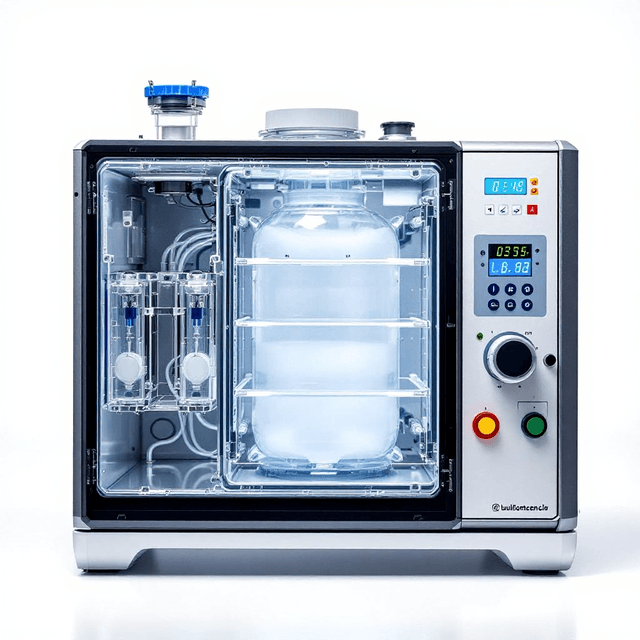
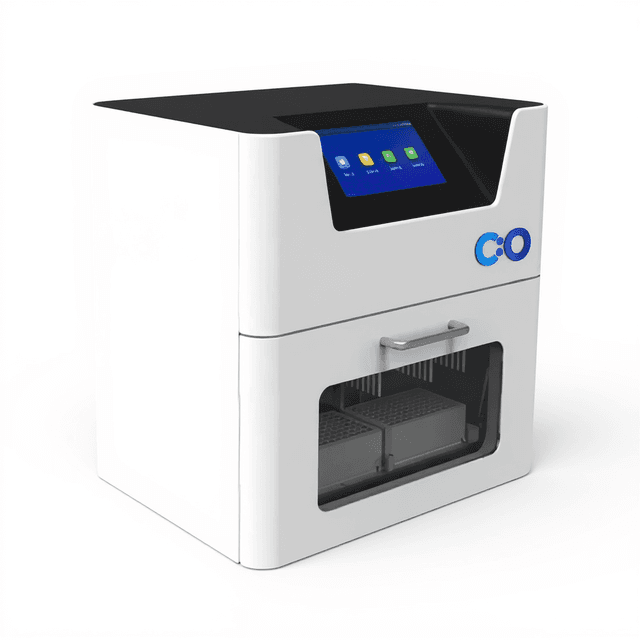
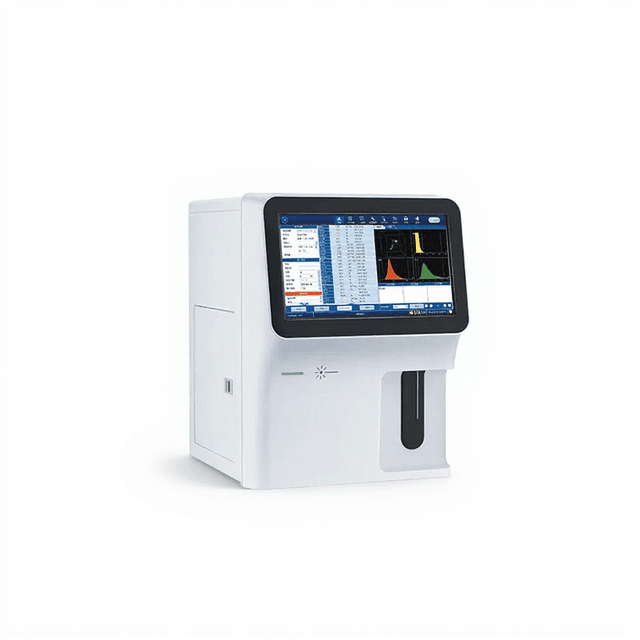
The Research Flow Cytometer — 3 Laser, 15-Color is a multi-parametric analytical instrument designed for single-cell analysis in research applications. This system employs three lasers to simultaneously excite up to 15 different fluorescent parameters, enabling comprehensive characterization of cellular populations through forward scatter (FSC), side scatter (SSC), and fluorescence detection. The coaxial hydrodynamic focusing fluidics system ensures stable particle alignment and consistent optical interrogation for reproducible measurements.
This flow cytometer supports complex immunophenotyping studies, cell cycle analysis, apoptosis detection, and functional assays requiring multi-color fluorescence analysis. The 15-color capability allows researchers to analyze multiple cellular markers simultaneously, reducing sample volume requirements and providing detailed phenotypic profiles of heterogeneous cell populations in a single measurement.
How It Works
Flow cytometry operates on the principle of hydrodynamic focusing combined with laser-based optical detection. The coaxial hydrodynamic focusing system creates a narrow sample stream within a sheath fluid, ensuring single-cell passage through the laser interrogation point. As individual cells pass through the focused laser beams, they scatter light and emit fluorescence signals that are detected by photomultiplier tubes and photodiodes.
The three-laser configuration enables excitation of fluorophores across the ultraviolet, visible, and near-infrared spectra. Forward scatter (FSC) provides information about cell size, while side scatter (SSC) indicates internal complexity and granularity. Fluorescence signals from up to 15 different channels allow simultaneous detection of multiple cellular markers, providing multi-dimensional data for each analyzed cell.
Signal processing electronics convert photon detection events into digital data, creating multi-parametric datasets that can be visualized as dot plots, histograms, and density plots. Compensation algorithms correct for spectral overlap between fluorophores, ensuring accurate quantification of individual fluorescent parameters.
Features & Benefits
Instrument Type
- Flow Cytometer
Lasers
- 3
Fluorescence Colors
- 15
Use
- Research Use Only
Detection
- Forward Scatter (FSC)
- Side Scatter (SSC)
- Fluorescence
Fluidics
- Coaxial Hydrodynamic Focusing
Automation Level
- semi-automated
Brand
- ConductScience
Research Domain
- Cancer Research
- Cell Biology
- Developmental Biology
- Immunology
- Microbiology
- Pharmaceutical QC
Weight
- 35.0 kg
Dimensions
- L: 45.1 mm
- W: 37.5 mm
- H: 30.0 mm
Comparison Guide
| Feature | This Product | Typical Alternative | Advantage |
|---|---|---|---|
| Laser Configuration | 3 lasers with 15-color detection | Entry-level models often provide 1-2 lasers with fewer detection channels | Broader spectral coverage enables more complex immunophenotyping panels and reduces the need for multiple sample runs. |
| Detection Parameters | 15 fluorescence colors plus FSC/SSC | Basic systems typically offer 4-8 color detection | Higher parameter count allows comprehensive cellular characterization in single measurements, reducing sample volume requirements. |
| Fluidics System | Coaxial hydrodynamic focusing | Some systems use acoustic or alternative focusing methods | Coaxial focusing provides stable, reproducible particle alignment for consistent optical analysis across diverse sample types. |
| Application Scope | Research use only designation | Clinical systems have fixed protocols and regulatory constraints | Research designation allows protocol customization and experimental flexibility for novel applications and method development. |
| Detection Types | Forward scatter, side scatter, and fluorescence detection | Some specialized systems focus only on fluorescence or light scattering | Combined detection modes provide both morphological and molecular information for comprehensive cellular analysis. |
This 3-laser, 15-color flow cytometer provides comprehensive multi-parametric analysis capability for research applications. The coaxial hydrodynamic focusing system and research-use designation offer experimental flexibility and reproducible performance for complex immunophenotyping and cellular analysis protocols.
Practical Tips
Run quality control beads at the beginning of each day to verify laser alignment and detector sensitivity across all channels.
Why: Daily QC ensures measurement consistency and identifies optical drift before sample analysis.
Perform weekly cleaning cycles with decontamination solution to prevent sample carryover and maintain fluidics integrity.
Why: Regular cleaning prevents protein buildup and bacterial contamination that can affect measurement accuracy.
Use single-stained compensation controls for each fluorophore in your panel to calculate accurate spectral overlap correction.
Why: Proper compensation is essential for accurate quantification in multi-color experiments with overlapping emission spectra.
Monitor sample flow rate and cell concentration to maintain optimal analysis conditions and prevent cell aggregation.
Why: Appropriate flow rates ensure single-cell analysis and prevent doublet formation that can skew population measurements.
Check sheath fluid levels and fluidics connections if you observe irregular flow patterns or pressure fluctuations.
Why: Fluidics problems are the most common cause of measurement instability and poor data quality.
Always wear appropriate PPE and handle samples in a biosafety cabinet when analyzing potentially hazardous biological materials.
Why: Flow cytometry involves aerosol generation that can pose exposure risks with infectious or toxic samples.
Store fluorescent reagents in darkness at appropriate temperatures and check for precipitation before use.
Why: Fluorophore degradation from light exposure or temperature fluctuations can reduce staining intensity and affect results.
Setup Guide
What’s in the Box
- Research Flow Cytometer main unit
- Sheath fluid reservoir and tubing (typical)
- Waste container and connections (typical)
- Sample injection system (typical)
- Power adapter and cables (typical)
- USB data cable (typical)
- User manual and software installation media (typical)
- Quality control beads for alignment verification (typical)
Warranty
ConductScience provides a standard one-year manufacturer warranty covering parts and labor, with technical support for installation, training, and troubleshooting assistance during the warranty period.
Compliance
References
Background reading relevant to this product:
What laser wavelengths are included in the 3-laser system?
Consult the product datasheet for specific laser wavelengths and power specifications. The 3-laser configuration is designed to provide broad spectral coverage for multi-color fluorescence applications.
What is the maximum sample acquisition rate?
Sample processing rates depend on cell concentration and analysis parameters. Consult the product datasheet for detailed flow rate specifications and throughput capabilities.
Does the system require daily calibration?
Daily quality control using alignment beads is recommended to verify optical performance and detector stability. Full calibration frequency depends on usage patterns and laboratory protocols.
What data formats are supported for export?
Consult the software documentation for supported file formats. Most flow cytometry systems support FCS (Flow Cytometry Standard) format for compatibility with analysis software.
Can the instrument analyze fixed cells and tissues?
The system can analyze single-cell suspensions prepared from various sample types. Sample preparation protocols should ensure appropriate particle size and concentration for flow cytometric analysis.
What maintenance procedures are required?
Regular maintenance includes daily startup procedures, weekly cleaning cycles, and periodic replacement of fluidics components. Consult the user manual for detailed maintenance schedules.
Is the system compatible with 96-well plate formats?
Sample loading capabilities depend on the specific sample injection system configuration. Consult product specifications for supported sample container formats.
Have a question about this product?
Upgrade Options