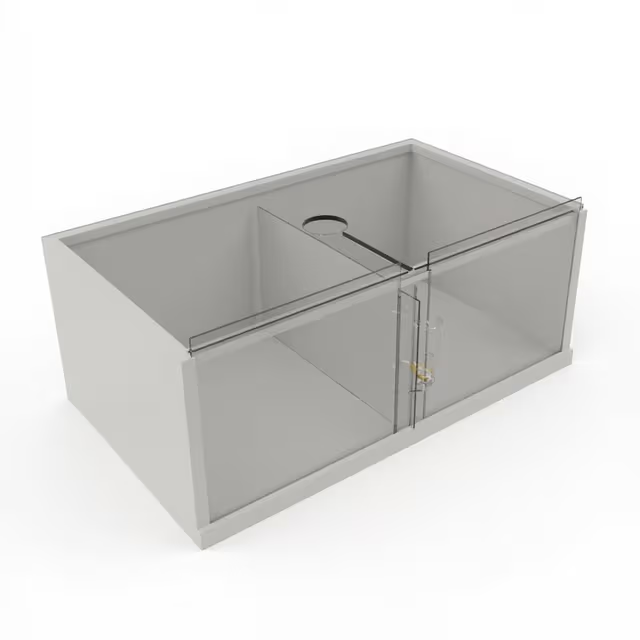
Resident Intruder
Standardized behavioral paradigm for assessing aggression, territorial behavior, and social stress responses through controlled resident-intruder interactions.
| Automation Level | manual |
| Species | Gerbil, Hamster, Mouse, Rat |

The Resident Intruder test is a standardized behavioral paradigm used to assess aggression, territorial behavior, and social stress responses in laboratory animals. This ethological assessment places a test animal (intruder) into the home cage of an established resident, allowing researchers to observe and quantify aggressive interactions, dominance behaviors, and stress-related responses under controlled conditions.
The paradigm provides a naturalistic approach to studying social aggression by leveraging the innate territorial instincts of the resident animal. Behavioral endpoints include attack latency, attack duration, frequency of aggressive encounters, and various defensive postures. The test generates quantifiable data on social dominance hierarchies, stress-induced behavioral changes, and pharmacological interventions targeting aggression pathways.
How It Works
The Resident Intruder paradigm exploits the natural territorial instincts of laboratory animals, particularly rodents. A resident animal is established in its home cage for several days to weeks, allowing it to develop territorial behavior and scent marking. An unfamiliar intruder animal is then introduced into the resident's territory, triggering a predictable sequence of social behaviors.
The behavioral response follows an ethologically relevant pattern: initial investigation, threat displays, physical attacks, and establishment of dominance hierarchy. The resident typically displays territorial aggression including lateral attacks, biting, and chasing behaviors, while the intruder exhibits defensive postures such as freezing, submission, and escape attempts. These interactions activate the hypothalamic-pituitary-adrenal axis and release stress hormones, making the paradigm useful for studying both behavioral and physiological stress responses.
Data collection focuses on temporal and frequency measurements of specific behaviors: attack latency (time to first aggressive contact), total attack time, number of attacks, and duration of various social behaviors. Video recording allows for detailed ethological analysis and post-hoc behavioral scoring using standardized criteria.
Features & Benefits
Behavioral Construct
- Aggression
- Territorial Behavior
- Social Dominance
- Stress Response
- Social Interaction
Automation Level
- manual
Research Domain
- Addiction Research
- Anxiety and Depression
- Behavioral Pharmacology
- Neuroscience
- Social Behavior
Species
- Gerbil
- Hamster
- Mouse
- Rat
Weight
- 6.06 kg
Dimensions
- L: 65.0 mm
- W: 36.0 mm
- H: 27.0 mm
Comparison Guide
| Feature | This Product | Typical Alternative | Advantage |
|---|---|---|---|
| Behavioral Relevance | Ethologically natural territorial aggression assessment | Artificial aggression models often use shock-induced fighting | Natural territorial behavior provides better translational validity to real-world aggressive interactions. |
| Equipment Requirements | Basic housing and video recording setup | Other behavioral tests may require specialized chambers or shock delivery systems | Minimal equipment needs make the test accessible across diverse research settings. |
| Testing Duration | Rapid behavioral response within 10-20 minute sessions | Chronic social stress paradigms may require weeks of interaction | Efficient data collection enables higher throughput screening of experimental conditions. |
| Behavioral Endpoints | Multiple simultaneous measures including latency, duration, and frequency | Some aggression tests focus on single behavioral measures | Comprehensive behavioral profiling provides detailed characterization of aggressive phenotypes. |
The Resident Intruder paradigm offers a standardized approach to aggression assessment that balances ethological relevance with experimental control. The test provides rapid, quantifiable behavioral data using minimal specialized equipment while maintaining translational validity through natural territorial behavior activation.
Practical Tips
Conduct testing during the animal's active phase (dark cycle for nocturnal species) to maximize territorial behavior expression.
Why: Territorial aggression follows circadian patterns and is most pronounced during natural activity periods.
Use unfamiliar intruders for each test session to prevent habituation and maintain consistent territorial responses.
Why: Repeated exposure to the same intruder reduces territorial aggression through social recognition and habituation.
Record multiple camera angles or use mirror systems to capture behaviors that may be obscured by cage features.
Why: Complete behavioral observation is essential for accurate scoring of rapid aggressive interactions and defensive postures.
Establish predetermined intervention criteria and have separation tools readily available during testing.
Why: Excessive aggression can cause serious injury and must be controlled while maintaining experimental validity.
If residents show low aggression, verify territorial establishment through scent marking observation and extend housing period.
Why: Insufficient territorial behavior development is the most common cause of reduced aggressive responding.
Clean cages between testing sessions but preserve resident scent marks by partial cleaning protocols.
Why: Scent marking is crucial for territorial behavior, but excessive odors can confound behavioral responses.
Validate behavioral scoring criteria through inter-rater reliability testing with experienced observers.
Why: Consistent behavioral definitions across scorers are essential for reproducible aggression quantification.
Setup Guide
What’s in the Box
- Testing protocol documentation (typical)
- Behavioral scoring sheets (typical)
- Video recording setup guidelines (typical)
- Safety monitoring procedures (typical)
- Data analysis templates (typical)
Warranty
ConductScience provides comprehensive protocol support and technical consultation for implementing standardized resident-intruder testing procedures. Documentation and training materials are updated to reflect current best practices in behavioral assessment.
Compliance
References
Background reading relevant to this product:
What is the optimal duration for establishing territorial behavior in resident animals?
Residents typically require 7-14 days of individual housing to develop strong territorial behavior and scent marking. Longer establishment periods may increase territorial aggression but must be balanced against housing stress effects.
How do you control for size differences between resident and intruder animals?
Match animals within 10-15% body weight when possible. Significant size differences can confound aggression measures, as larger animals may display dominance through physical advantage rather than territorial behavior.
What behavioral measures are most reliable for quantifying aggression?
Attack latency and total attack duration provide the most consistent measures. Frequency counts can be affected by brief, repeated contacts, while sustained aggressive interactions better reflect territorial dominance.
How do you minimize injury risk while maintaining experimental validity?
Establish clear intervention criteria such as prolonged pinning, visible injury, or extreme defensive postures. Brief aggressive encounters are normal, but continuous attacking requires separation to prevent harm.
Can the paradigm be adapted for different species beyond rodents?
The basic principles apply to other territorial species, but behavioral endpoints and timing parameters require species-specific validation. Social structure and territorial displays vary significantly across species.
What environmental factors can influence test results?
Room lighting, noise levels, handling stress, and cage cleaning schedules all affect territorial behavior. Standardize these variables and conduct testing at consistent times to minimize confounding factors.
Have a question about this product?
Accessories
Enhance your setup with compatible accessories

Frequently Bought Together
Upgrade Options