Primary Assay — Axolotl
Prey Capture / Feeding Strike
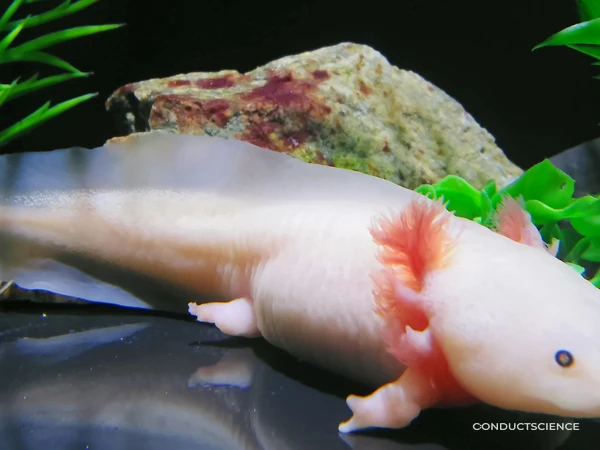
Ambystoma mexicanum
Axolotls use suction feeding to capture prey, with high-speed strike latency, capture success, and prey handling time providing quantifiable measures of sensorimotor coordination and functional recovery after regeneration.

Quantitative Output
Measured Parameters
Every parameter is automatically tracked frame-by-frame in the ConductVision pipeline for Ambystoma mexicanum.
| Parameter | Unit | Description |
|---|---|---|
| Strike latency | ms | Time from prey detection to strike |
| Capture success rate | % | Proportion of successful strikes |
| Suction distance | mm | Effective range |
| Prey handling time | s | Post-capture processing |
References
Citations for Prey Capture / Feeding Strike
- Voss SR, et al. (2015). Gene expression during the first 28 days of axolotl limb regeneration. Regeneration, 2(3), 120-136. PMID: 27499872
Compatible Equipment
Hardware for Axolotl Research
Feeding Strike Chamber
High-speed prey capture recording
Walking/Swimming Arena
Dual-mode locomotion tracking
Shelter Choice Apparatus
Preference and anxiety testing
Regeneration Monitoring System
Long-term behavioral recovery
Infrared Camera System
Activity tracking
Related Assays
Other Axolotl Primary Assays
03
Locomotion (Walking + Swimming Gait)
Ambystoma mexicanum
Axolotls exhibit dual locomotor modes — terrestrial-style walking and aquatic undulatory swimming. Gait parameters inclu…
03
Shelter Seeking
Ambystoma mexicanum
Shelter-seeking behavior reflects anxiety-like states in axolotls. Shelter occupancy time, latency to seek cover, and sh…
03
Regeneration-Coupled Behavioral Recovery
Ambystoma mexicanum
Tracking behavioral recovery alongside tissue regeneration is uniquely possible in axolotls. Days to locomotor recovery,…
Run Prey Capture / Feeding Strike on ConductVision
Our team will configure the protocol, camera rig, and analysis pipeline for your axolotl facility.