Primary Assay — Axolotl
Regeneration-Coupled Behavioral Recovery
Ambystoma mexicanum
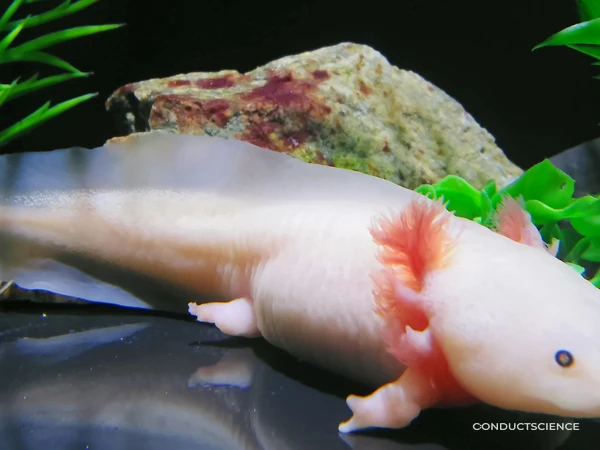
Tracking behavioral recovery alongside tissue regeneration is uniquely possible in axolotls. Days to locomotor recovery, limb coordination scores, and behavioral symmetry between regenerated and intact limbs reveal functional outcomes of regeneration.

Quantitative Output
Measured Parameters
Every parameter is automatically tracked frame-by-frame in the ConductVision pipeline for Ambystoma mexicanum.
| Parameter | Unit | Description |
|---|---|---|
| Days to locomotor recovery | days | Motor function return post-amputation |
| Limb coordination score | 0-5 | Gait quality assessment |
| Behavioral symmetry index | ratio | Regenerated vs intact limb use |
References
Citations for Regeneration-Coupled Behavioral Recovery
- Voss SR, et al. (2015). Gene expression during the first 28 days of axolotl limb regeneration. Regeneration, 2(3), 120-136. PMID: 27499872
Compatible Equipment
Hardware for Axolotl Research
Feeding Strike Chamber
High-speed prey capture recording
Walking/Swimming Arena
Dual-mode locomotion tracking
Shelter Choice Apparatus
Preference and anxiety testing
Regeneration Monitoring System
Long-term behavioral recovery
Infrared Camera System
Activity tracking
Related Assays
Other Axolotl Primary Assays
03
Prey Capture / Feeding Strike
Ambystoma mexicanum
Axolotls use suction feeding to capture prey, with high-speed strike latency, capture success, and prey handling time pr…
03
Locomotion (Walking + Swimming Gait)
Ambystoma mexicanum
Axolotls exhibit dual locomotor modes — terrestrial-style walking and aquatic undulatory swimming. Gait parameters inclu…
03
Shelter Seeking
Ambystoma mexicanum
Shelter-seeking behavior reflects anxiety-like states in axolotls. Shelter occupancy time, latency to seek cover, and sh…
Run Regeneration-Coupled Behavioral Recovery on ConductVision
Our team will configure the protocol, camera rig, and analysis pipeline for your axolotl facility.