Behavioral Tracking for Axolotl
Ambystoma mexicanum
ConductVision delivers automated tracking of axolotl prey capture, locomotion gaits, and regeneration-coupled behavioral recovery. Quantify feeding strikes, walking/swimming transitions, and functional recovery in Ambystoma mexicanum.

Why Axolotl in Behavioral Research
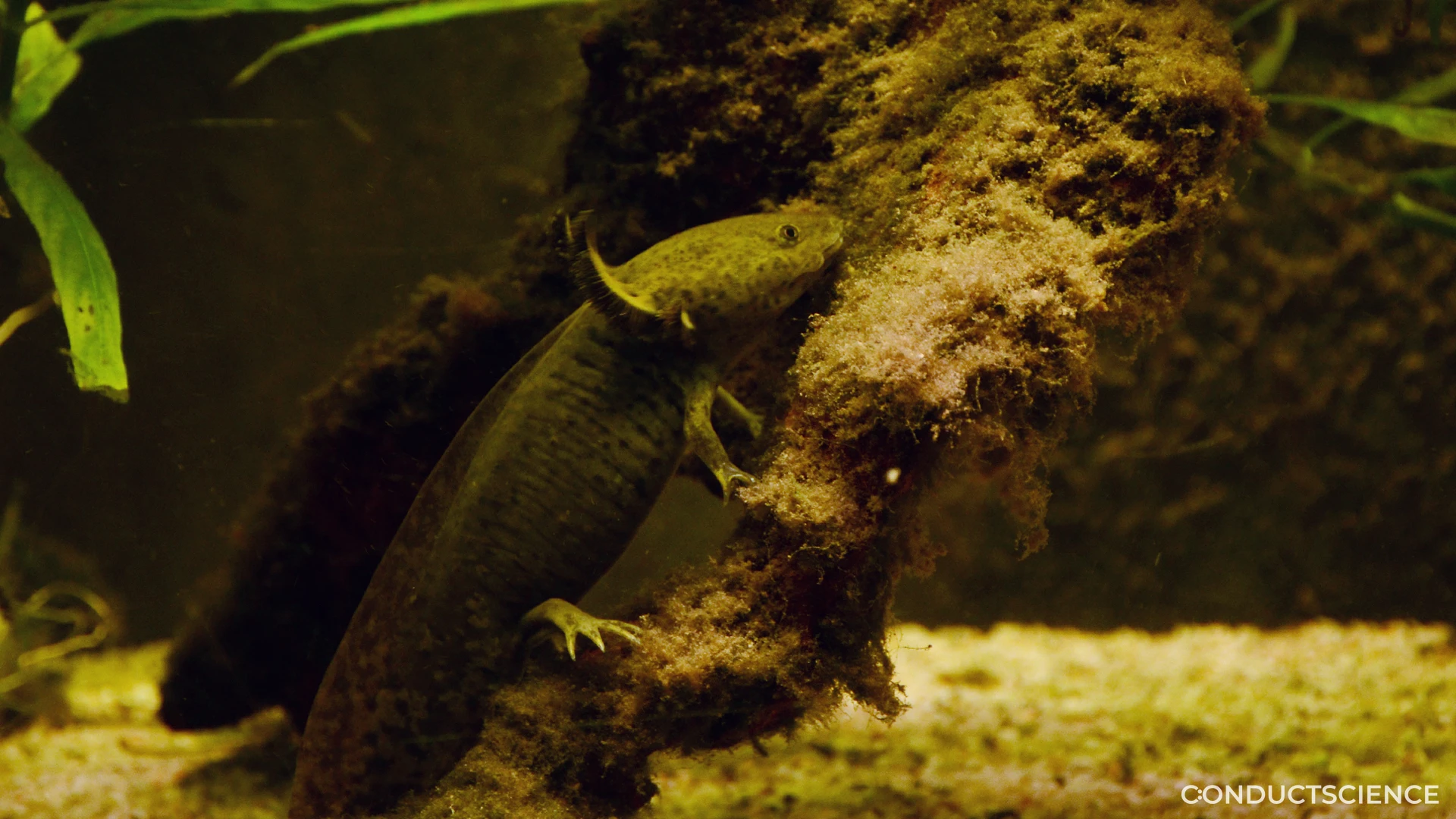
The axolotl (Ambystoma mexicanum) is renowned for its remarkable regenerative abilities, capable of regrowing entire limbs, heart tissue, and spinal cord. This makes them uniquely valuable for studying how behavioral function recovers alongside tissue regeneration. Their dual locomotor modes (walking and swimming), suction-feeding prey capture, and shelter-seeking behavior provide quantifiable behavioral endpoints linking regeneration to functional recovery.
Voss SR, et al. (2015). Gene expression during the first 28 days of axolotl limb regeneration. Regeneration, 2(3), 120-136. PMID: 27499872
What We Measure in Axolotl
Validated assays with quantitative parameter tracking for Ambystoma mexicanum.
Axolotls use suction feeding to capture prey, with high-speed strike latency, capture success, and prey handling time providing quantifiable measures of sensorimotor coordination and functional recovery after regeneration.
| Parameter | Unit | Description |
|---|---|---|
| Strike latency | ms | Time from prey detection to strike |
| Capture success rate | % | Proportion of successful strikes |
| Suction distance | mm | Effective range |
| Prey handling time | s | Post-capture processing |
Voss SR, et al. (2015). Gene expression during the first 28 days of axolotl limb regeneration. Regeneration, 2(3), 120-136. PMID: 27499872
Axolotls exhibit dual locomotor modes — terrestrial-style walking and aquatic undulatory swimming. Gait parameters including speed, stride length, and transition frequency serve as functional readouts for limb and spinal cord regeneration studies.
| Parameter | Unit | Description |
|---|---|---|
| Walking speed | mm/s | Terrestrial gait velocity |
| Swimming speed | mm/s | Aquatic undulatory speed |
| Gait transition frequency | events/min | Walk-swim switches |
| Stride length | mm | Step distance |
Voss SR, et al. (2015). Gene expression during the first 28 days of axolotl limb regeneration. Regeneration, 2(3), 120-136. PMID: 27499872
Shelter-seeking behavior reflects anxiety-like states in axolotls. Shelter occupancy time, latency to seek cover, and shelter preference provide measures of stress responsivity and behavioral recovery post-injury.
| Parameter | Unit | Description |
|---|---|---|
| Shelter occupancy time | % | Time under cover |
| Latency to seek shelter | s | Stress-induced hiding |
| Shelter choice preference | ratio | Dark vs light shelter |
Voss SR, et al. (2015). Gene expression during the first 28 days of axolotl limb regeneration. Regeneration, 2(3), 120-136. PMID: 27499872
Tracking behavioral recovery alongside tissue regeneration is uniquely possible in axolotls. Days to locomotor recovery, limb coordination scores, and behavioral symmetry between regenerated and intact limbs reveal functional outcomes of regeneration.
| Parameter | Unit | Description |
|---|---|---|
| Days to locomotor recovery | days | Motor function return post-amputation |
| Limb coordination score | 0-5 | Gait quality assessment |
| Behavioral symmetry index | ratio | Regenerated vs intact limb use |
Voss SR, et al. (2015). Gene expression during the first 28 days of axolotl limb regeneration. Regeneration, 2(3), 120-136. PMID: 27499872
ConductScience Hardware for Axolotl Research
Feeding Strike Chamber
High-speed prey capture recording
Walking/Swimming Arena
Dual-mode locomotion tracking
Shelter Choice Apparatus
Preference and anxiety testing
Regeneration Monitoring System
Long-term behavioral recovery
Infrared Camera System
Activity tracking
Citations & Further Reading
- Voss SR, et al. (2015). Gene expression during the first 28 days of axolotl limb regeneration. Regeneration, 2(3), 120-136. PMID: 27499872
Other Model Systems
Discuss Your Axolotl Research
Tell us about your models, assays, and experimental goals — we’ll show you how ConductVision fits your workflow.