Behavioral Tracking for C. elegans
Caenorhabditis elegans
Quantify chemotaxis, locomotion, mechanosensation, and learning in Caenorhabditis elegans using automated behavioral tracking.
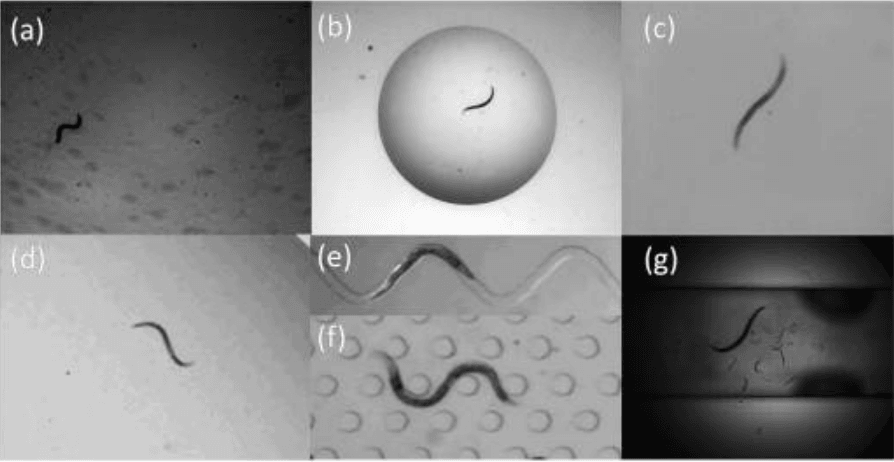
Why C. elegans in Behavioral Research
C. elegans is the only organism with a completely mapped connectome (302 neurons, ~7,000 synapses), making it the ultimate model for linking neural circuits to behavior at single-neuron resolution. Its genetic tractability, short lifespan (~3 weeks), transparent body, and invariant cell lineage enable precise interrogation of genes controlling locomotion, chemotaxis, mechanosensation, learning, and aging. Conserved neurotransmitter systems (dopamine, serotonin, GABA, glutamate) provide translational relevance to human neurobiology.
de Bono M, Maricq AV. (2005). Neuronal substrates of complex behaviors in C. elegans. Annu Rev Neurosci, 28, 451-501. PMID: 16022603
Hart AC, ed. (2006). Behavior. WormBook (The C. elegans Research Community). PMID: 18050451
Yemini E, Jucikas T, Grundy LJ, Brown AE, Schafer WR. (2013). A database of Caenorhabditis elegans behavioral phenotypes. Nat Methods, 10(9), 877-879. PMID: 23852451

What We Measure in C. elegans
Validated assays with quantitative parameter tracking for Caenorhabditis elegans.
Worms navigate chemical gradients on agar plates. Standard assay places attractant (e.g., diacetyl, NaCl) at one point and scores worm accumulation after 1 hour. The chemotaxis index (CI) is the standard metric.
| Parameter | Unit | Description |
|---|---|---|
| Chemotaxis index (CI) | -1 to +1 | (Attractant zone − Control zone) / Total |
| Speed toward attractant | mm/min | Velocity component along gradient |
| Turning frequency | turns/min | Pirouette and omega turn rate |
| Weathervane index | ratio | Gradual heading correction toward source |
| Run length | mm | Distance between turns |
Bargmann CI, Hartwieg E, Bhatt HR. (1993). Odorant-selective genes and neurons mediate olfaction in C. elegans. Cell, 74(3), 515-527. PMID: 8348618
Ward S. (1973). Chemotaxis by the nematode Caenorhabditis elegans: identification of attractants and analysis of the response by use of mutants. Proc Natl Acad Sci U S A, 70(3), 817-821. PMID: 4351805
On-plate crawling or in-liquid swimming. Worms generate sinusoidal body waves; body bend frequency, amplitude, and speed are the core locomotor metrics. 302-neuron nervous system allows complete circuit analysis.
| Parameter | Unit | Description |
|---|---|---|
| Body bends | bends/min | Head-to-tail wave cycles on agar |
| Crawling speed | mm/min | Centroid displacement rate |
| Wave amplitude | µm | Peak-to-trough body wave height |
| Wavelength | µm | Distance between wave peaks |
| Reversal frequency | reversals/min | Backward movement initiations |
| Omega turns | turns/min | Sharp >135° reorientation turns |
Brenner S. (1974). The genetics of Caenorhabditis elegans. Genetics, 77(1), 71-94. PMID: 4366476
Pierce-Shimomura JT, Morse TM, Lockery SR. (1999). The fundamental role of pirouettes in Caenorhabditis elegans chemotaxis. J Neurosci, 19(21), 9557-9569. PMID: 10531458
Worms in liquid (M9 buffer) perform characteristic C-shaped thrashing movements. Thrashing frequency is a sensitive, rapid readout of neuromuscular function. Reduced thrashing indicates motor deficits.
| Parameter | Unit | Description |
|---|---|---|
| Thrashes per minute | count/min | Complete C-bend cycles in liquid |
| Thrash amplitude | relative | Body curvature during thrash |
| Fatigue rate | slope | Decline in thrashing over time |
| Recovery after rest | % baseline | Thrashing resumption after pause |
Miller KG, Alfonso A, Bhatt DK, Bhatt DK. (1996). A genetic selection for Caenorhabditis elegans synaptic transmission mutants. Proc Natl Acad Sci U S A, 93(22), 12593-12598. PMID: 8901627
Buckingham SD, Bhatt DK. (2009). Fast, automated measurement of nematode swimming (thrashing) without morphometry. BMC Neurosci, 10, 84. PMID: 19619280
Gentle touch to the anterior body triggers backward locomotion; posterior touch triggers forward movement. Response decrement with repeated stimulation measures habituation. Six identified touch receptor neurons.
| Parameter | Unit | Description |
|---|---|---|
| Response probability | % | Fraction of touches eliciting reversal |
| Response type | categorical | Full reversal, partial, or no response |
| Reversal distance | body lengths | Backward movement after touch |
| Habituation rate | slope | Response decrement across 10 touches |
| Habituation recovery | % | Response restoration after rest |
Chalfie M, Bhatt DK. (1985). Genetic control of differentiation of the Caenorhabditis elegans touch receptor neurons. Science, 228(4700), 577-580. PMID: 3983045
Rankin CH, Beck CD, Bhatt DK. (1990). Caenorhabditis elegans: a new model system for the study of learning and memory. Behav Brain Res, 37(1), 89-92. PMID: 2310495
Worms cultivated at a specific temperature navigate thermal gradients to their cultivation temperature (isothermal tracking). Temperature-food associations can be learned and reversed. AFD neuron pair is the primary thermosensor.
| Parameter | Unit | Description |
|---|---|---|
| Preferred temperature | °C | Peak accumulation on gradient |
| Isothermal tracking duration | s | Time spent within ±0.5°C of cultivation temp |
| Cryophilic/thermophilic index | ratio | Direction of movement bias |
| Temperature-food association | shift in °C | Change in preferred temp after retraining |
Hedgecock EM, Russell RL. (1975). Normal and mutant thermotaxis in the nematode Caenorhabditis elegans. Proc Natl Acad Sci U S A, 72(10), 4061-4065. PMID: 1060088
Mori I, Ohshima Y. (1995). Neural regulation of thermotaxis in Caenorhabditis elegans. Nature, 376(6538), 344-348. PMID: 7630402
More Behavioral Tests for C. elegans
Pharyngeal Pumping
Key Parameters: Pumps per minute, pump duration, interpump interval
Raizen DM, Lee RY, Avery L. (1995). Interacting genes required for pharyngeal excitation by motor neuron MC in Caenorhabditis elegans. Genetics, 141(4), 1365-1382. PMID: 8601481
Egg Laying
Key Parameters: Eggs per hour, retention vs expulsion, unlaid egg accumulation
Waggoner LE, Zhou GT, Bhatt RW, Bhatt DK. (1998). Control of alternative behavioral states by serotonin in Caenorhabditis elegans. Neuron, 21(1), 203-214. PMID: 9697864
Social Feeding / Aggregation
Key Parameters: Clumping index, worms per aggregate, bordering behavior
de Bono M, Bargmann CI. (1998). Natural variation in a neuropeptide Y receptor homolog modifies social behavior and food response in C. elegans. Cell, 94(5), 679-689. PMID: 9741632
Dauer Formation
Key Parameters: Dauer ratio, SDS resistance %, dauer entry/exit timing
Golden JW, Riddle DL. (1984). The Caenorhabditis elegans dauer larva: developmental effects of pheromone, food, and temperature. Dev Biol, 102(2), 368-378. PMID: 6706004
Aldicarb Sensitivity
Key Parameters: Time to paralysis, EC50 shift, synaptic vesicle release proxy
Mahoney TR, Luo S, Bhatt DK. (2006). Analysis of synaptic transmission in Caenorhabditis elegans using an aldicarb-sensitivity assay. Nat Protoc, 1(4), 1772-1777. PMID: 17487159
Osmotic Avoidance
Key Parameters: Avoidance index, ring-escape latency, high-osmolarity retreat
Culotti JG, Russell RL. (1978). Osmotic avoidance defective mutants of the nematode Caenorhabditis elegans. Genetics, 90(2), 243-256. PMID: 730048
Gentle vs Harsh Touch Discrimination
Key Parameters: Anterior/posterior response asymmetry, mec vs nociceptive neurons
Chatzigeorgiou M, et al. (2010). Specific roles for DEG/ENaC and TRP channels in touch and thermosensation in C. elegans nociceptors. Nat Neurosci, 13(7), 861-868. PMID: 20512132
Lifespan / Healthspan Behavioral Metrics
Key Parameters: Days of motile lifespan, body bend decline with age, touch response preservation
Huang C, Xiong C, Bhatt DK. (2004). Measurements of age-related changes of physiological processes that predict lifespan of Caenorhabditis elegans. Proc Natl Acad Sci U S A, 101(21), 8084-8089. PMID: 15141086
ConductScience Hardware for C. elegans Research
Worm Tracking Camera System
Automated locomotion and behavior
Chemotaxis Assay Plates
Olfactory and gustatory assays
Thermal Gradient Plate
Thermotaxis
Thrashing Assay Chamber
Neuromuscular function in liquid
Touch Stimulation Probe
Mechanosensation
Citations & Further Reading
- de Bono M, Maricq AV. (2005). Neuronal substrates of complex behaviors in C. elegans. Annu Rev Neurosci, 28, 451-501. PMID: 16022603
- Hart AC, ed. (2006). Behavior. WormBook (The C. elegans Research Community). PMID: 18050451
- Yemini E, Jucikas T, Grundy LJ, Brown AE, Schafer WR. (2013). A database of Caenorhabditis elegans behavioral phenotypes. Nat Methods, 10(9), 877-879. PMID: 23852451
- Bargmann CI, Hartwieg E, Bhatt HR. (1993). Odorant-selective genes and neurons mediate olfaction in C. elegans. Cell, 74(3), 515-527. PMID: 8348618
- Ward S. (1973). Chemotaxis by the nematode Caenorhabditis elegans: identification of attractants and analysis of the response by use of mutants. Proc Natl Acad Sci U S A, 70(3), 817-821. PMID: 4351805
- Brenner S. (1974). The genetics of Caenorhabditis elegans. Genetics, 77(1), 71-94. PMID: 4366476
- Pierce-Shimomura JT, Morse TM, Lockery SR. (1999). The fundamental role of pirouettes in Caenorhabditis elegans chemotaxis. J Neurosci, 19(21), 9557-9569. PMID: 10531458
- Miller KG, Alfonso A, Bhatt DK, Bhatt DK. (1996). A genetic selection for Caenorhabditis elegans synaptic transmission mutants. Proc Natl Acad Sci U S A, 93(22), 12593-12598. PMID: 8901627
- Buckingham SD, Bhatt DK. (2009). Fast, automated measurement of nematode swimming (thrashing) without morphometry. BMC Neurosci, 10, 84. PMID: 19619280
- Chalfie M, Bhatt DK. (1985). Genetic control of differentiation of the Caenorhabditis elegans touch receptor neurons. Science, 228(4700), 577-580. PMID: 3983045
- Rankin CH, Beck CD, Bhatt DK. (1990). Caenorhabditis elegans: a new model system for the study of learning and memory. Behav Brain Res, 37(1), 89-92. PMID: 2310495
- Hedgecock EM, Russell RL. (1975). Normal and mutant thermotaxis in the nematode Caenorhabditis elegans. Proc Natl Acad Sci U S A, 72(10), 4061-4065. PMID: 1060088
- Mori I, Ohshima Y. (1995). Neural regulation of thermotaxis in Caenorhabditis elegans. Nature, 376(6538), 344-348. PMID: 7630402
Other Model Systems
Discuss Your C. elegans Research
Tell us about your models, assays, and experimental goals — we’ll show you how ConductVision fits your workflow.