Primary Assay — C. elegans
Locomotion / Body Bends
Caenorhabditis elegans
On-plate crawling or in-liquid swimming. Worms generate sinusoidal body waves; body bend frequency, amplitude, and speed are the core locomotor metrics. 302-neuron nervous system allows complete circuit analysis.
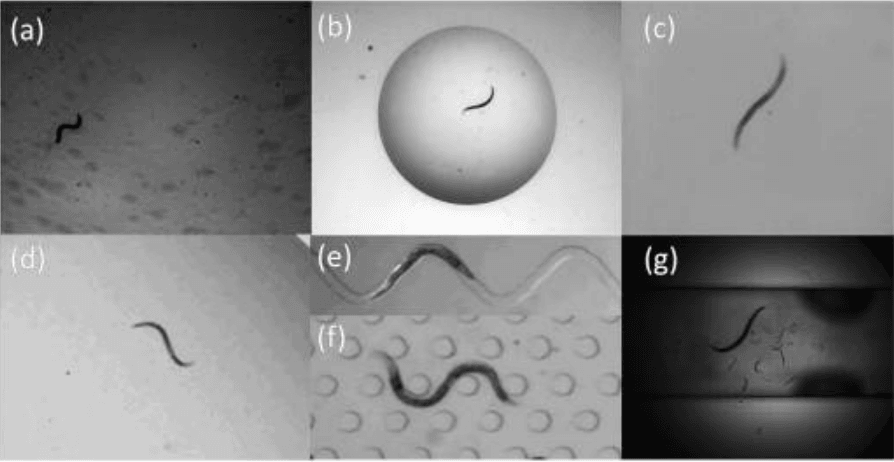
Quantitative Output
Measured Parameters
Every parameter is automatically tracked frame-by-frame in the ConductVision pipeline for Caenorhabditis elegans.
| Parameter | Unit | Description |
|---|---|---|
| Body bends | bends/min | Head-to-tail wave cycles on agar |
| Crawling speed | mm/min | Centroid displacement rate |
| Wave amplitude | µm | Peak-to-trough body wave height |
| Wavelength | µm | Distance between wave peaks |
| Reversal frequency | reversals/min | Backward movement initiations |
| Omega turns | turns/min | Sharp >135° reorientation turns |
References
Citations for Locomotion / Body Bends
- Brenner S. (1974). The genetics of Caenorhabditis elegans. Genetics, 77(1), 71-94. PMID: 4366476
- Pierce-Shimomura JT, Morse TM, Lockery SR. (1999). The fundamental role of pirouettes in Caenorhabditis elegans chemotaxis. J Neurosci, 19(21), 9557-9569. PMID: 10531458
Compatible Equipment
Hardware for C. elegans Research
Worm Tracking Camera System
Automated locomotion and behavior
Chemotaxis Assay Plates
Olfactory and gustatory assays
Thermal Gradient Plate
Thermotaxis
Thrashing Assay Chamber
Neuromuscular function in liquid
Touch Stimulation Probe
Mechanosensation
Related Assays
Other C. elegans Primary Assays
05
Chemotaxis Assay
Caenorhabditis elegans
Worms navigate chemical gradients on agar plates. Standard assay places attractant (e.g., diacetyl, NaCl) at one point a…
05
Thrashing Assay
Caenorhabditis elegans
Worms in liquid (M9 buffer) perform characteristic C-shaped thrashing movements. Thrashing frequency is a sensitive, rap…
05
Touch Response (Mechanosensation)
Caenorhabditis elegans
Gentle touch to the anterior body triggers backward locomotion; posterior touch triggers forward movement. Response decr…
Run Locomotion / Body Bends on ConductVision
Our team will configure the protocol, camera rig, and analysis pipeline for your c. elegans facility.