Behavioral Tracking for Starlet Sea Anemone
Nematostella vectensis
ConductVision delivers automated tracking of Nematostella phototaxis, burrowing, tentacle retraction, and feeding responses. Quantify cnidarian behavioral complexity in Nematostella vectensis.

Why Starlet Sea Anemone in Behavioral Research
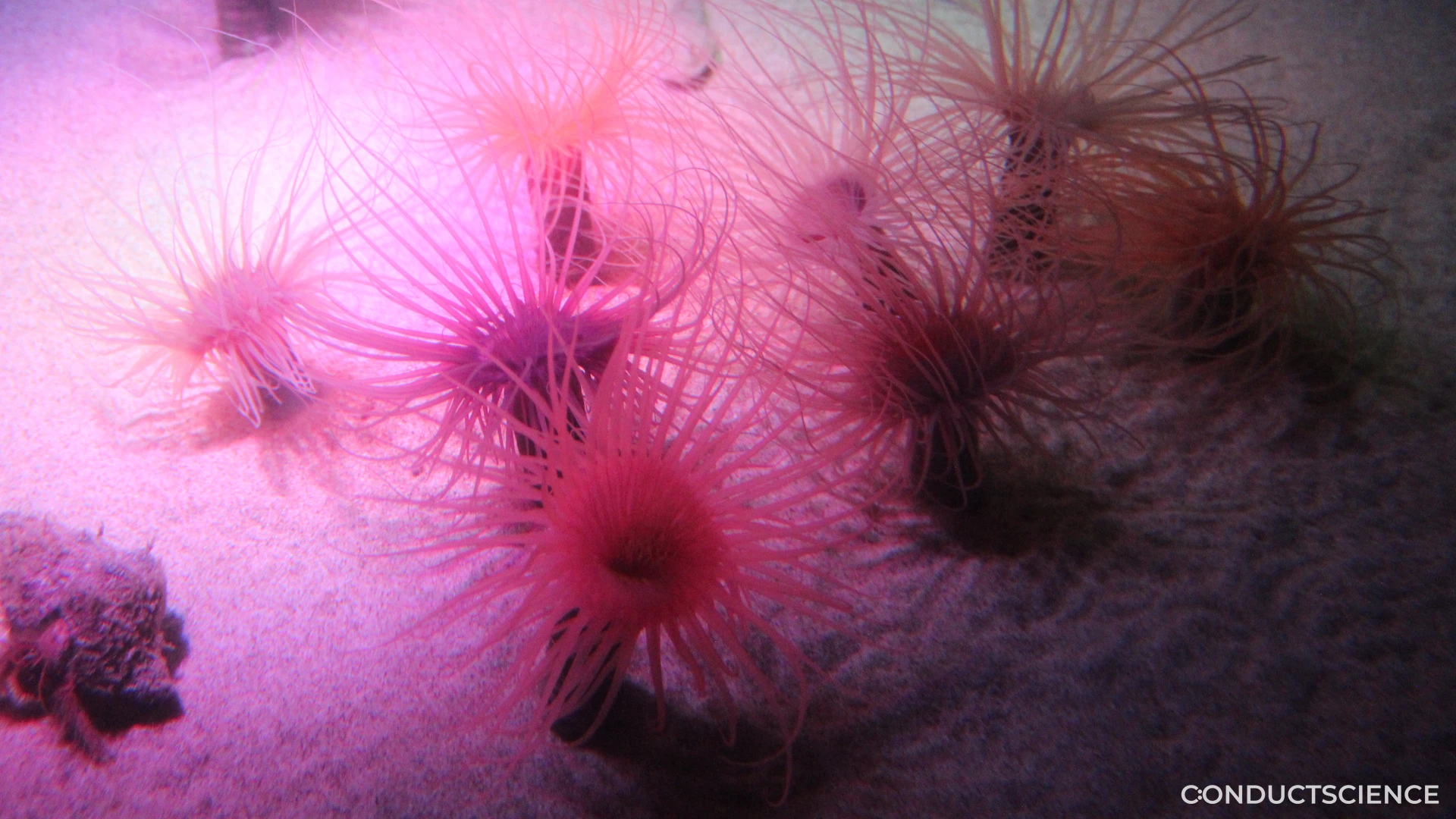
Nematostella vectensis is the leading cnidarian model, occupying a phylogenetic position that illuminates the evolutionary origins of nervous system function. Despite lacking a centralized brain, they exhibit quantifiable behaviors including phototaxis, burrowing, tentacle retraction with habituation, and feeding responses — providing a window into how behavioral complexity arose from simple neural architectures. Their fully sequenced genome and genetic tractability make them uniquely suited for dissecting the molecular roots of behavior.
Layden MJ, et al. (2016). Nematostella vectensis achaete-scute homolog NvashA regulates neural cell fate specification. Dev Biol, 415(2), 230-241. PMID: 27173373
What We Measure in Starlet Sea Anemone
Validated assays with quantitative parameter tracking for Nematostella vectensis.
Nematostella exhibits light-responsive behavior despite lacking eyes. Light avoidance, response latency, and body contraction provide measures of sensory processing in a brainless organism.
| Parameter | Unit | Description |
|---|---|---|
| Light avoidance index | -1 to +1 | Direction relative to light |
| Response latency | s | Time to initiate movement |
| Body contraction with light | % shortening | Defensive photo-response |
Layden MJ, et al. (2016). Nematostella vectensis achaete-scute homolog NvashA regulates neural cell fate specification. Dev Biol, 415(2), 230-241. PMID: 27173373
Nematostella burrows into sandy substrate using peristaltic body movements. Burrowing latency, depth, duration, and substrate preference characterize this ecologically essential behavior.
| Parameter | Unit | Description |
|---|---|---|
| Burrowing latency | min | Time to begin digging |
| Burial depth | mm | How deep in substrate |
| Burrowing duration | min | Total digging time |
| Substrate preference | categorical | Sand grain size preference |
Layden MJ, et al. (2016). Nematostella vectensis achaete-scute homolog NvashA regulates neural cell fate specification. Dev Biol, 415(2), 230-241. PMID: 27173373
Tentacle retraction is a rapid defensive response that shows habituation — a fundamental form of learning in this brainless organism. Retraction parameters and habituation rate probe neural circuit function in the nerve net.
| Parameter | Unit | Description |
|---|---|---|
| Retraction latency | ms | Response speed |
| Retraction amplitude | % length | Degree of withdrawal |
| Habituation rate | slope | Response decrement |
| Recovery time | s | Return to extended state |
Layden MJ, et al. (2016). Nematostella vectensis achaete-scute homolog NvashA regulates neural cell fate specification. Dev Biol, 415(2), 230-241. PMID: 27173373
Nematostella captures prey with nematocyst-bearing tentacles and opens its mouth in response to glutathione — a chemical signal from damaged prey tissue. Capture time, handling duration, and GSH threshold quantify feeding behavior.
| Parameter | Unit | Description |
|---|---|---|
| Tentacle capture time | s | Time to ensnare prey |
| Prey handling duration | s | Ingestion processing |
| Feeding response threshold | µM GSH | Glutathione concentration for mouth opening |
| Mouth opening duration | min | Time mouth stays open |
Layden MJ, et al. (2016). Nematostella vectensis achaete-scute homolog NvashA regulates neural cell fate specification. Dev Biol, 415(2), 230-241. PMID: 27173373
ConductScience Hardware for Starlet Sea Anemone Research
Nematostella Observation Chamber
Behavior recording
Light Stimulus Array
Phototaxis testing
Sand Substrate System
Burrowing behavior
Mechanosensory Stimulus Probe
Tentacle retraction
Feeding Stimulus Delivery
Glutathione-triggered feeding
Citations & Further Reading
- Layden MJ, et al. (2016). Nematostella vectensis achaete-scute homolog NvashA regulates neural cell fate specification. Dev Biol, 415(2), 230-241. PMID: 27173373
Other Model Systems
Discuss Your Sea Anemone Research
Tell us about your models, assays, and experimental goals — we’ll show you how ConductVision fits your workflow.