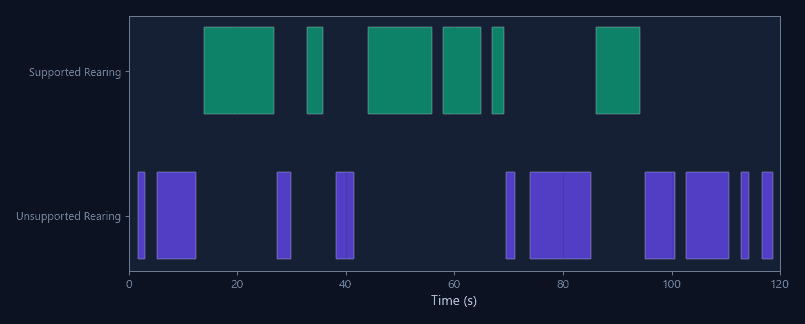
Rearing event log
Every rearing event with onset time, offset time, duration, and classification (wall-supported vs. unsupported).
CSVJSON
Automated vertical activity detection from standard video
Quantify rearing frequency, duration, and type — wall-supported versus unsupported — without manual scoring or specialized side-view cameras.
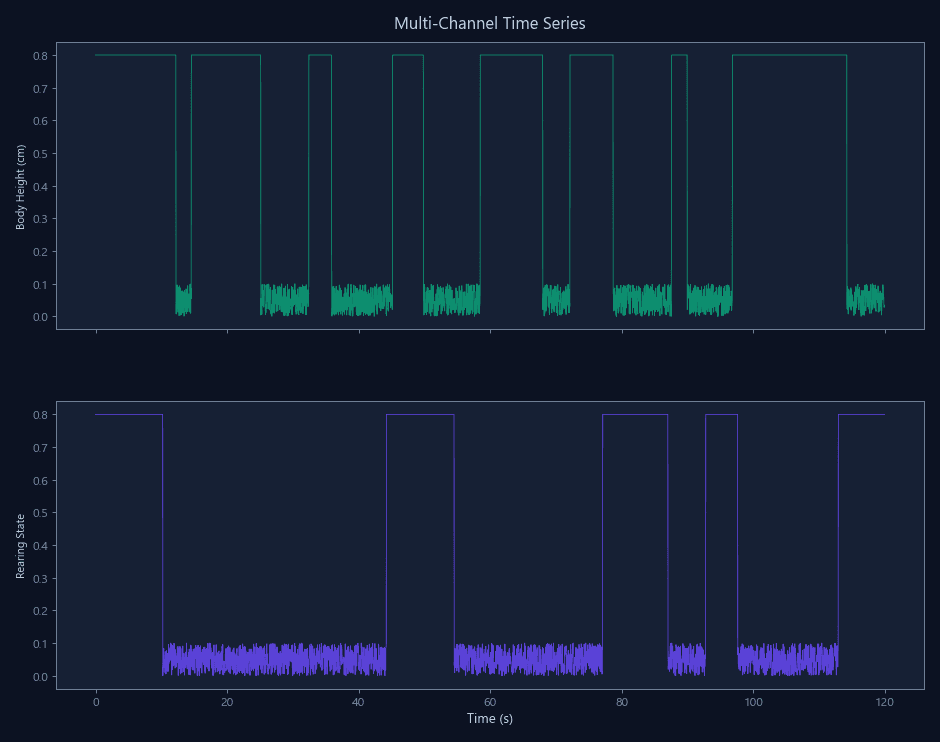
Rearing frequency is a primary indicator of exploration, anxiety, and dopaminergic function. Yet most labs still rely on manual scoring — a trained observer watches video and counts events, introducing fatigue bias and inter-rater variability.
ConductVision uses body posture features from pose estimation to detect rearing events automatically. The system distinguishes wall-supported rears (forepaws on wall) from unsupported rears (free-standing), and reports onset, offset, and duration for each event.
Every rearing event with onset time, offset time, duration, and classification (wall-supported vs. unsupported).
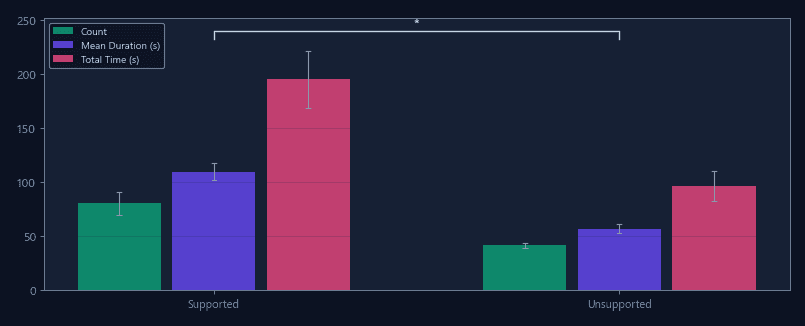
Total rearing count, mean bout duration, wall-supported ratio, and time-binned rearing frequency across the session.
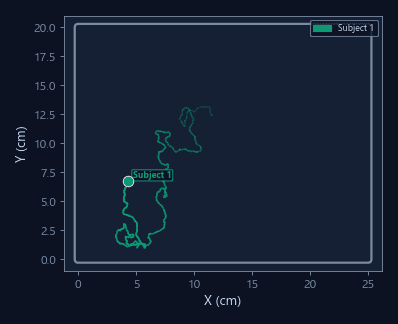
Original video with rearing events highlighted — bounding box color indicates rearing subtype.
Rearing frequency in the open field is a standard measure of exploratory drive. Unsupported rears indicate higher exploration motivation than wall-supported rears.
Rearing in open arms versus closed arms of the EPM provides an additional anxiety index beyond arm entry counts.
Rearing is dose-dependently affected by dopamine agonists and antagonists. Automated counting enables high-throughput dose-response curves.
Declining rearing frequency across time bins within a session indexes habituation to novelty — a learning measure independent of locomotion.
| Feature | ConductVision | Typical systems |
|---|---|---|
| Automated rearing detection | Yes — pose-based, no side camera | Manual scoring or side-view camera required |
| Wall-supported vs. unsupported | Classified automatically | Rarely distinguished |
| Temporal resolution | Frame-level (33 ms) | Event-level (observer reaction time ~500 ms) |
| Inter-rater variability | Zero — deterministic algorithm | 10-15% typical inter-rater disagreement |
| Throughput | Real-time, unlimited sessions | 2-3x real time per session per scorer |
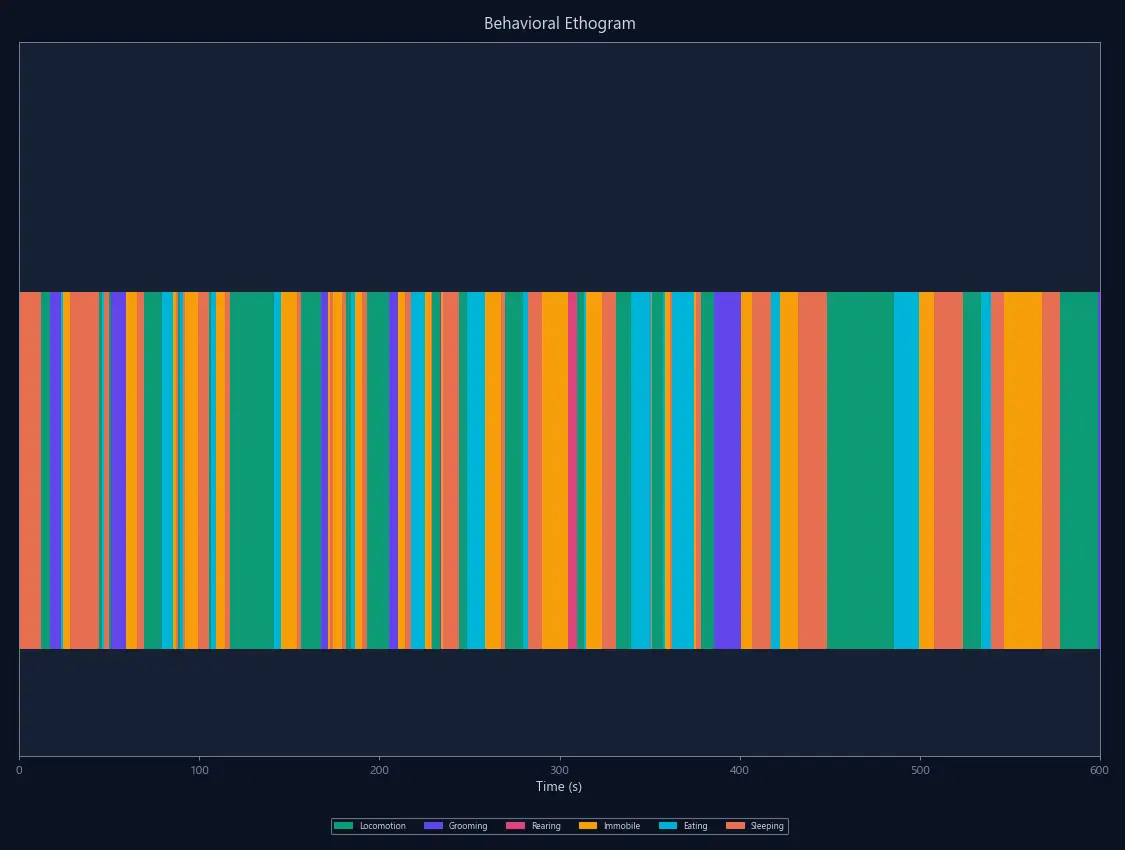
ML-powered frame-level behavioral classification with temporal smoothing and custom classifier training.
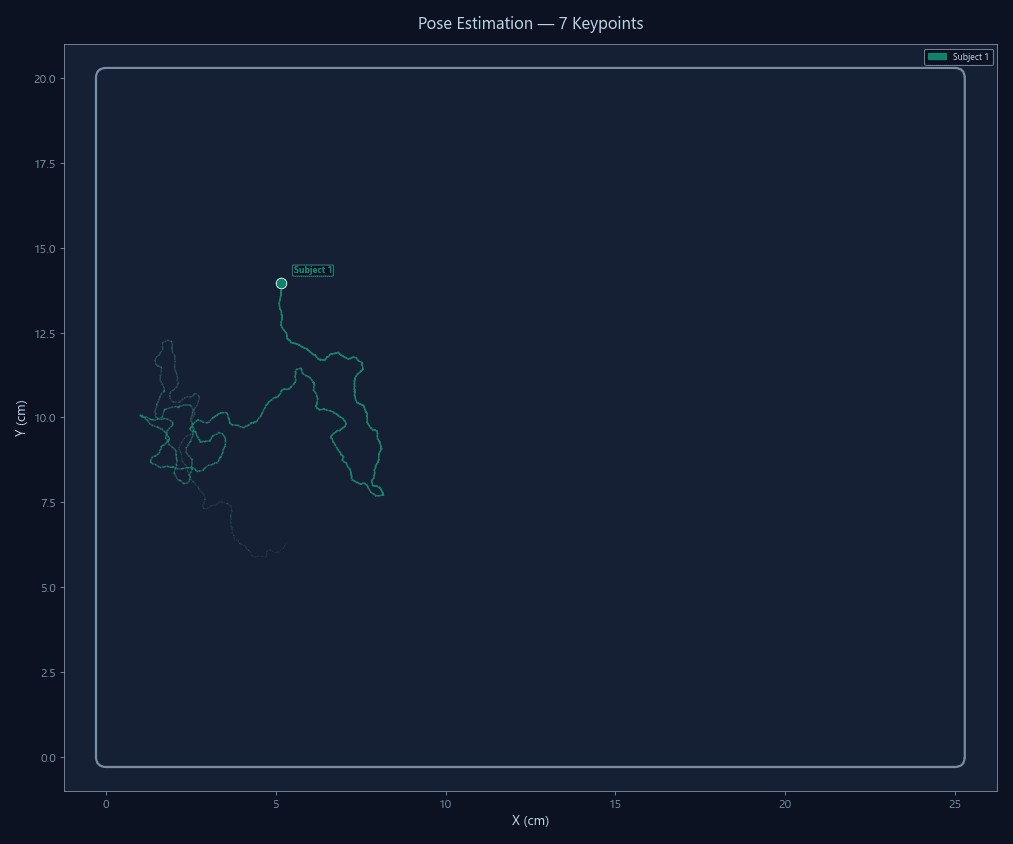
Multi-keypoint body part tracking — head, paws, tail, body center — with pretrained and custom model support.
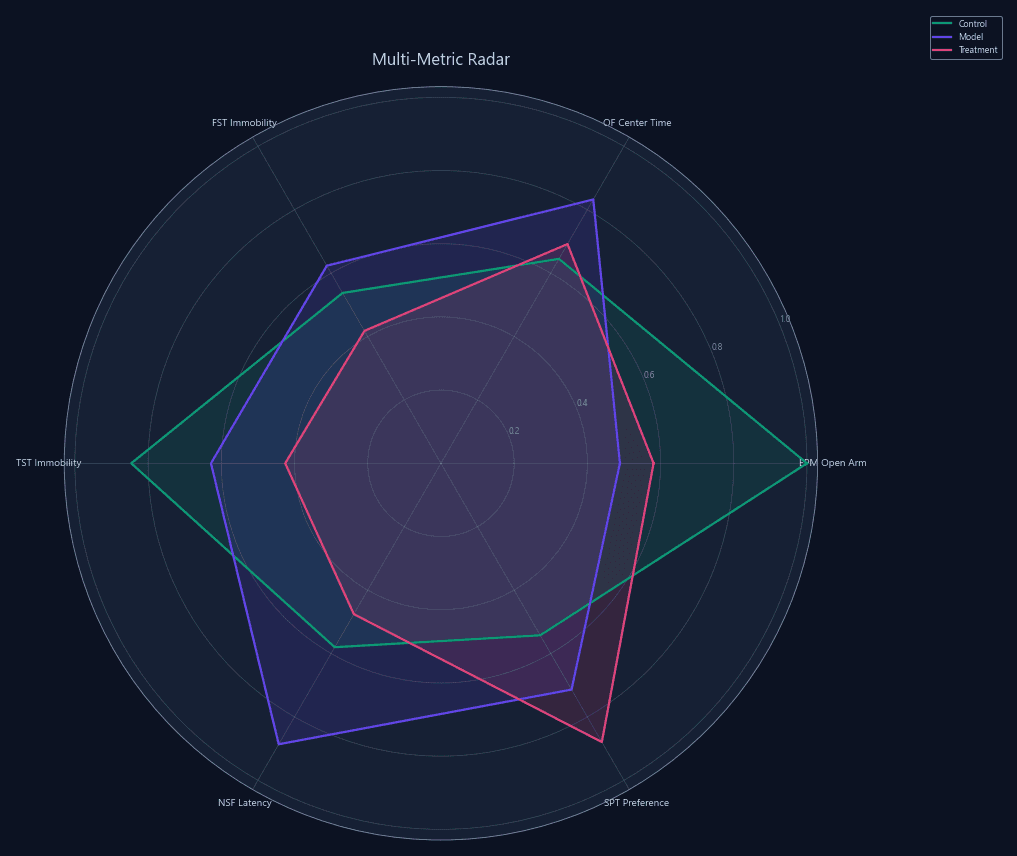
Composite behavioral indices with Z-score normalization across anxiety and depression test batteries.
Run a pilot recording through ConductVision and compare automated rearing counts against your manual scores.