Class 100 Laminar Flow Hood HEPA H14
ISO Class 5 vertical flow laminar cabinet with HEPA H14 filtration for sterile microbiological work, featuring adjustable airflow and dual UV sterilization.

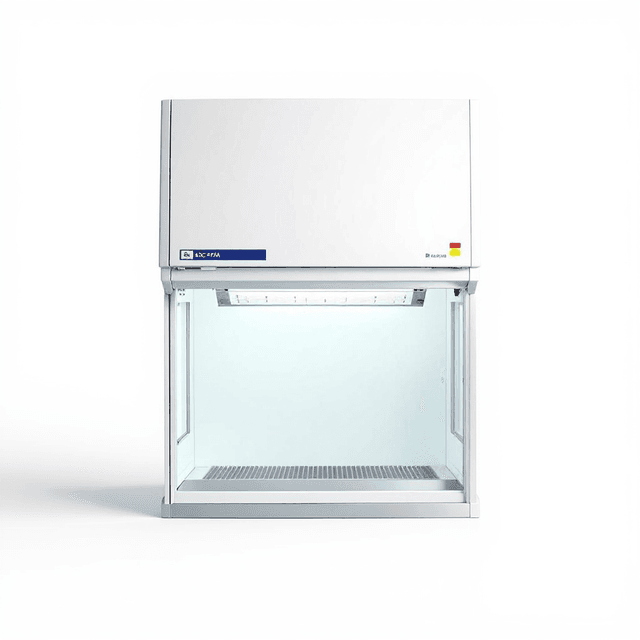
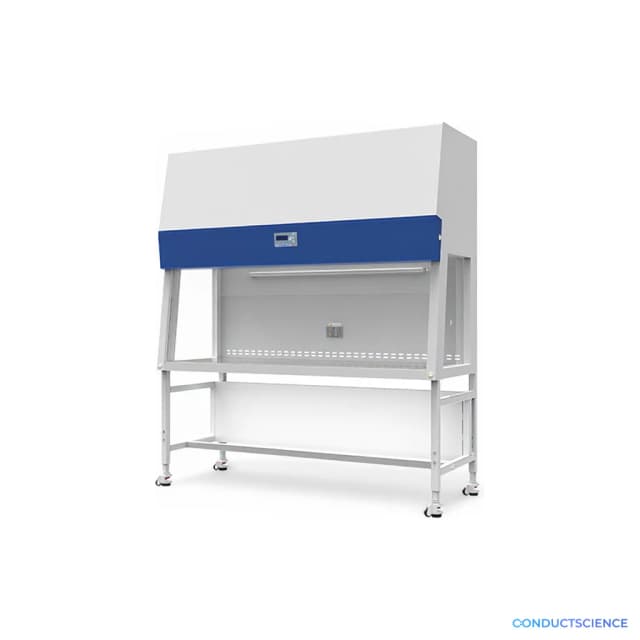
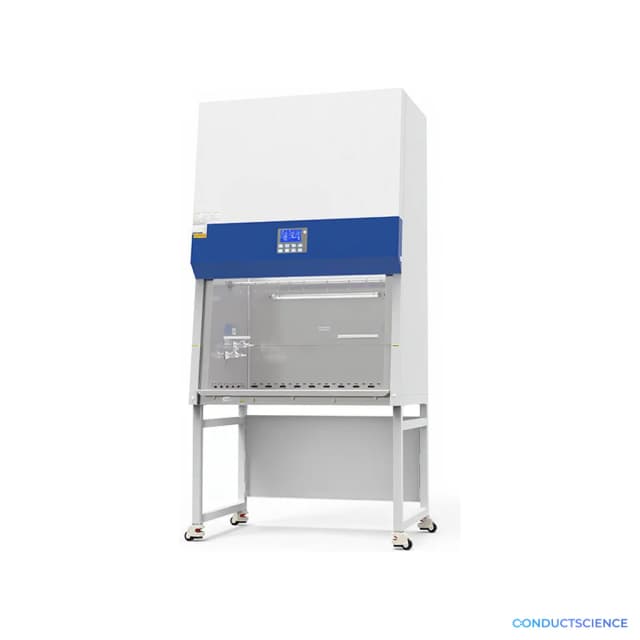
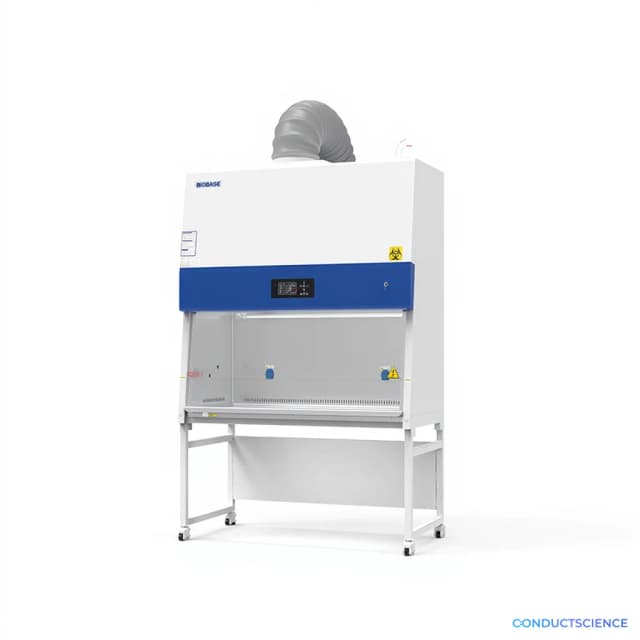
The ConductScience Laminar Flow Cabinet (BIO-0897) is a Class II vertical flow biological safety cabinet designed for single-user applications requiring sterile work environments. The unit provides ISO level 5 (Class 100) cleanliness through HEPA H14 filtration, achieving ≥99.995% filtration efficiency for 0.3 μm particles. With adjustable airflow velocity from 0.2-0.45 m/s and colony count performance ≤0.5 CFU/30 min, the cabinet maintains consistent sterile conditions for microbiological procedures.
The cabinet features a 200 mm front window safety height with maximum opening of 260 mm, providing ergonomic access while maintaining containment. Standard equipment includes LED illumination (≥300 lx) and dual UV sterilization lamps. Operating at ≤65 dB(A) with minimal vibration (≤5 μm rms), the unit supports precision work requiring stable, quiet conditions. The 620VA power system accommodates both 220V/50Hz and 110V/60Hz configurations.
How It Works
The laminar flow cabinet operates on the principle of unidirectional vertical airflow to create a sterile working environment. Room air enters through the top of the cabinet and passes through a pre-filter before reaching the HEPA H14 high-efficiency filter. The HEPA filter removes particles ≥0.3 μm with ≥99.995% efficiency, creating a continuous downward laminar airflow across the work surface.
The vertical flow design ensures that filtered air moves uniformly downward at 0.2-0.45 m/s, preventing turbulent mixing with contaminated ambient air. The front window maintains a 200 mm safety height, creating a physical barrier while allowing access to the work area. This configuration provides ISO Class 5 cleanliness (≤3,520 particles ≥0.5 μm per cubic meter) within the working zone.
Dual UV-C lamps provide surface sterilization when the cabinet is not in use, while LED lighting ensures adequate illumination (≥300 lx) for detailed work. The cabinet maintains colony count performance of ≤0.5 CFU per 30 minutes, demonstrating effective biological containment and sterility maintenance.
Features & Benefits
Weight
- 45.0 kg
Dimensions
- L: 89.0 mm
- W: 74.0 mm
- H: 60.0 mm
Comparison Guide
| Feature | This Product | Typical Alternative | Advantage |
|---|---|---|---|
| Filtration Efficiency | HEPA H14 filter with ≥99.995% efficiency at 0.3 μm | Entry-level models often use HEPA H13 filters with lower efficiency ratings | Higher filtration efficiency provides superior particulate control for critical sterile procedures |
| Airflow Control | Adjustable velocity from 0.2-0.45 m/s | Fixed airflow velocity without user adjustment capability | Allows optimization for different procedures while maintaining laminar flow characteristics |
| Sterilization Features | Dual UV sterilization lamps included | Single UV lamp or no UV sterilization capability | Enhanced surface decontamination reduces risk of carryover contamination between procedures |
| Performance Specification | Colony count ≤0.5 CFU/30 min, vibration ≤5 μm rms | Higher colony counts and vibration levels in basic models | Lower bioburden and vibration support more demanding sterility requirements and precision work |
| Power Options | Dual voltage capability (220V/110V) with 500VA work area capacity | Single voltage configuration with limited electrical capacity | Greater installation flexibility and ability to power laboratory equipment within work area |
This cabinet offers HEPA H14 filtration, adjustable airflow control, and dual UV sterilization in a compact single-user design. The combination of low colony count performance, minimal vibration, and dual voltage capability provides versatility for demanding sterile work applications.
Practical Tips
Verify airflow velocity across multiple points on the work surface using a calibrated anemometer, adjusting to maintain uniform flow within 0.2-0.45 m/s range.
Why: Uniform airflow ensures consistent sterile conditions across the entire work area.
Replace HEPA filters when differential pressure exceeds manufacturer specifications or when visual inspection shows damage to filter media.
Why: Compromised filters reduce filtration efficiency and can introduce contaminants into the sterile workspace.
Allow 15-30 minutes of continuous operation before beginning work to establish stable airflow patterns and flush residual contaminants.
Why: Startup time ensures the cabinet reaches optimal performance conditions before introducing sterile materials.
Never block airflow patterns with large equipment or materials, and keep work area clear of unnecessary items during operation.
Why: Airflow obstruction creates turbulent zones that can compromise sterile conditions and operator protection.
If noise levels exceed 65 dB(A), check for loose panels, worn bearings, or objects interfering with fan operation.
Why: Excessive noise often indicates mechanical issues that can affect airflow performance and cabinet longevity.
Document airflow velocity, colony count testing, and UV lamp usage hours to maintain performance records and schedule preventive maintenance.
Why: Performance documentation ensures compliance with quality standards and enables predictive maintenance scheduling.
Position the cabinet away from high-traffic areas and air handling system outlets to minimize external airflow disruption.
Why: External air currents can disrupt laminar flow patterns and reduce the effectiveness of containment.
Setup Guide
What’s in the Box
- Laminar flow cabinet main unit
- LED illumination lamp (1)
- UV sterilization lamps (2)
- Power cord
- User manual and installation guide
- Filter certification documentation (typical)
- Airflow calibration certificate (typical)
Warranty
ConductScience provides a standard one-year manufacturer warranty covering defects in materials and workmanship, with technical support for installation and operation guidance.
Compliance
References
Background reading relevant to this product:
What particle size range does the HEPA filter effectively remove?
The HEPA H14 filter achieves ≥99.995% filtration efficiency for particles ≥0.3 μm. This covers most bacterial cells, fungal spores, and airborne contaminants encountered in microbiological work.
How do I verify the cabinet is maintaining sterile conditions?
Monitor colony count performance, which should remain ≤0.5 CFU per 30 minutes. Additionally, verify airflow velocity stays within 0.2-0.45 m/s range and conduct periodic settle plate testing.
Can the airflow velocity be adjusted for different procedures?
Yes, airflow velocity is adjustable from 0.2-0.45 m/s. Lower velocities minimize sample disturbance for delicate procedures, while higher velocities provide enhanced protection for hazardous materials.
What is the maximum opening height for the front window?
The front window opens to a maximum of 260 mm while maintaining the 200 mm safety height. This provides adequate access while preserving containment effectiveness.
How often should the UV lamps be used for sterilization?
Run UV sterilization cycles between work sessions and overnight when the cabinet is not in use. Replace UV lamps according to manufacturer specifications to maintain sterilization effectiveness.
What power requirements does the cabinet have?
Standard configuration requires 220V±10%, 50Hz power supply. Optional 110V±10%, 60Hz configuration available. Total power consumption is 620VA including 500VA for work area electrical outlets.
How does this compare to horizontal flow laminar cabinets?
Vertical flow provides better operator protection since airflow moves away from the user, while horizontal flow primarily protects the product. Vertical flow is preferred for biological safety applications.
Have a question about this product?
Accessories
Enhance your setup with compatible accessories