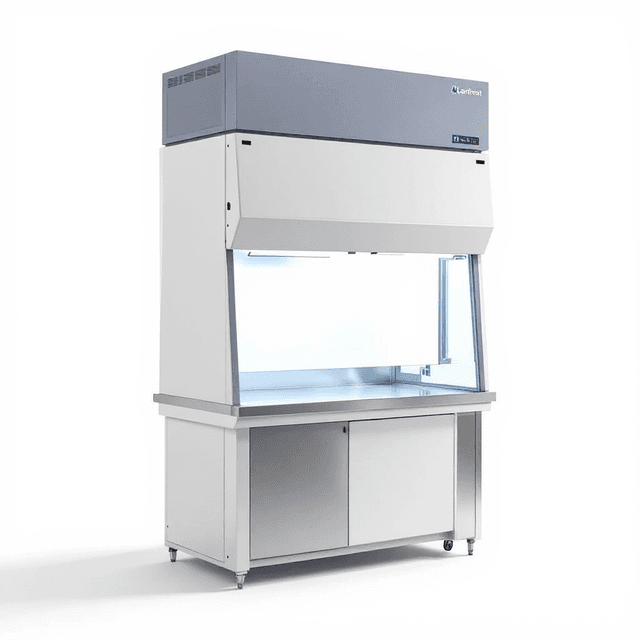
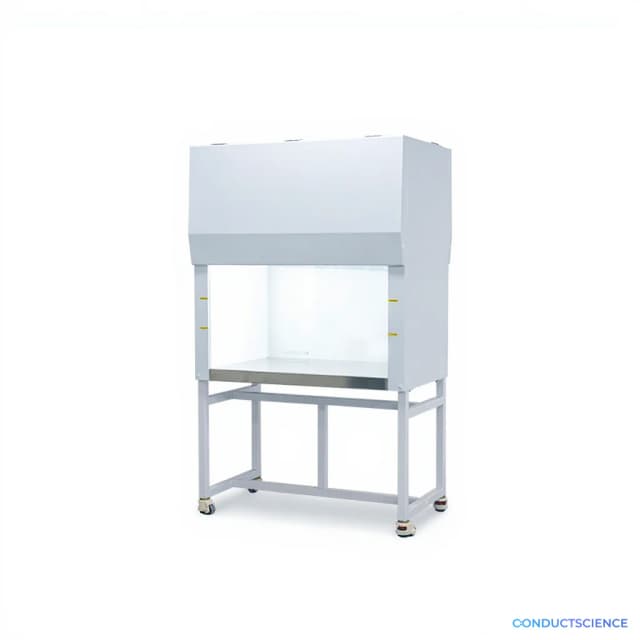
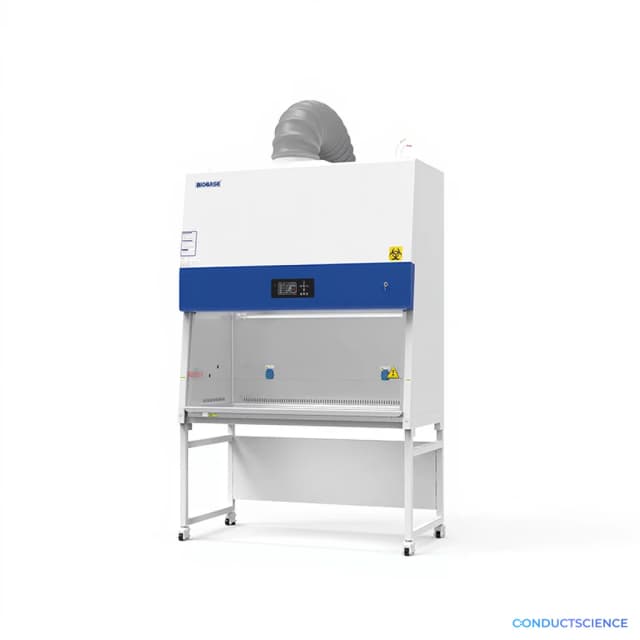
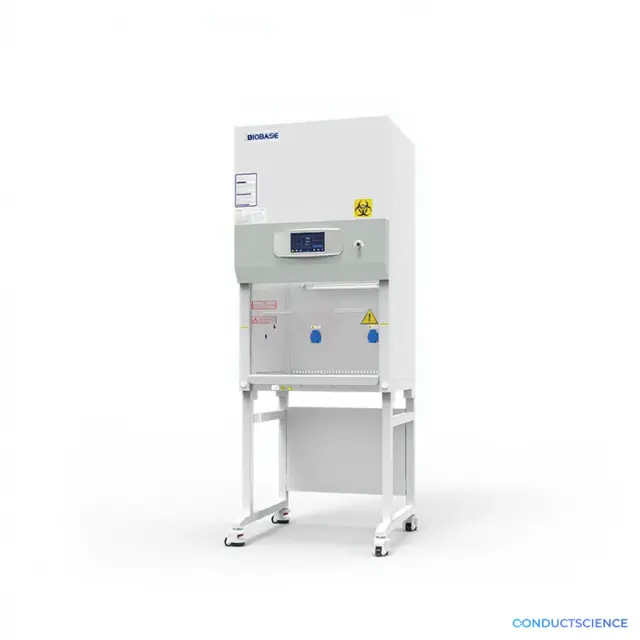
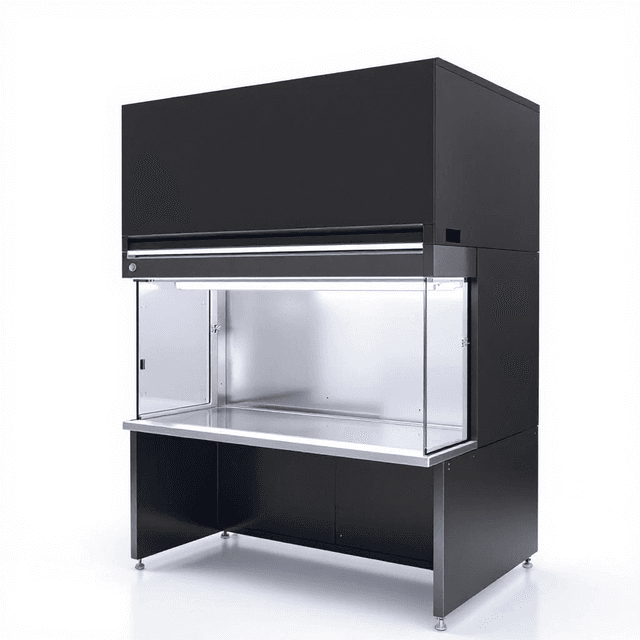
ETL Certified Vertical Laminar Flow Cabinet
ETL certified vertical laminar flow cabinet with 304 stainless steel work surface, adjustable height 760-1010mm, and 80-99 fpm airflow velocity for sterile laboratory work.

Louise Corscadden, PhD
Director of Science · ConductScience
Ask Louise about ETL Certified Vertical Laminar Flow Cabinet fit, setup, configuration, or quote prep.
Already working with us? Sign in to connect this with My Scientist.
Key Specifications
Full details →- Model fit
- Configured during quote
- SKU family
- BIO-0034
- Shipping box
- 62.5 x 70.0 x 57.5 cm
- Ordering
- Online checkout and quote request available
- Category
- Clean Benches & Fume Hoods
- Build notes
- Working Area: 304 stainless Steel
The ETL Certified Vertical Laminar Flow Cabinet provides Class II biological safety cabinet functionality for sterile work environments. This vertical laminar flow design utilizes HEPA-filtered air circulation to maintain aseptic conditions for cell culture, microbiology work, and sterile product preparation. The cabinet features 304 stainless steel work surfaces, adjustable working height from 760-1010mm, and LCD display monitoring for airflow parameters.
The system maintains airflow velocity between 80-99 fpm with polyester fiber pre-filtration before HEPA filtration. Available in multiple work area configurations from 700×575×625mm to 1700×575×625mm internal dimensions, the cabinet accommodates varied experimental setups while maintaining sterile conditions. The 480mm maximum opening height provides ergonomic access while preserving containment integrity.
How It Works
Vertical laminar flow cabinets operate on the principle of unidirectional airflow to create a sterile work environment. Room air is drawn into the cabinet through the front opening and passes through a polyester fiber pre-filter to remove larger particulates. The pre-filtered air then passes through a HEPA filter system that removes 99.97% of particles 0.3 micrometers and larger.
The filtered air flows vertically downward across the work surface at a controlled velocity of 80-99 feet per minute, creating a laminar flow pattern that sweeps contaminants away from the work area. This downward airflow design prevents contaminated air from the work surface from reaching the filter system, making it suitable for work with non-hazardous materials. The 304 stainless steel work surface provides chemical resistance and easy decontamination between uses.
The LCD display continuously monitors airflow parameters to ensure proper operation. The adjustable work surface height (760-1010mm) accommodates different user requirements and experimental setups while maintaining optimal ergonomics and airflow characteristics.
Features & Benefits
Automation Level
- semi-automated
BBS-V1100
- BBS-V1300
BBS-V1500
- BBS-V1800
External Size(W*D*H)
- 800*700*(2090~2340)mm
1100*700*(2090~2340)mm
- 1300*700*(2090~2340)mm
1500*700*(2090~2340)mm
- 1800*700*(2090~2340)mm
Internal Size(W*D*H)
- 700*575*625mm
1000*575*625mm
- 1200*575*625mm
1400*575*625mm
- 1700*575*625mm
Work Surface Height
- 760~1010mm
Max Opening
- 480mm
Airflow Velocity
- 80~99fpm
Pre-Filter
- Polyester fiber
Brand
- ConductScience
Research Domain
- Analytical Chemistry
- Cell Biology
- Clinical Diagnostics
- Food Science
- Microbiology
- Pharmaceutical QC
Display Type
- LCD display
Material
- Working Area: 304 stainless Steel
Shipping weight
- 190.0 lb
Shipping box
- L: 62.5 cm
- W: 70.0 cm
- H: 57.5 cm
| Feature | This Product | Typical Alternative | Advantage |
|---|---|---|---|
| Work Surface Material | 304 stainless steel | Entry-level models often use powder-coated steel or plastic surfaces | Stainless steel provides superior chemical resistance and easier decontamination for sterile techniques. |
| Height Adjustment Range | 760-1010mm adjustable | Many models offer fixed height or limited adjustment | 250mm adjustment range accommodates different user heights and experimental setups for optimal ergonomics. |
| Airflow Monitoring | LCD display with real-time monitoring | Basic models may have analog gauges or no monitoring | Digital display provides precise airflow feedback for consistent sterile conditions verification. |
| Size Configuration Options | Five different internal work area sizes available | Many manufacturers offer fewer size options | Multiple configurations allow selection of optimal work area for specific experimental requirements and lab space. |
| Pre-filtration System | Polyester fiber pre-filter included | Some models rely solely on HEPA filtration | Pre-filtration extends HEPA filter life by removing larger particulates before final filtration stage. |
| Safety Certification | ETL certified | Varies by model | Third-party safety verification ensures compliance with electrical and mechanical safety standards for laboratory use. |
This cabinet offers 304 stainless steel work surfaces, adjustable height from 760-1010mm, and LCD airflow monitoring across five size configurations. The polyester fiber pre-filtration system and ETL certification provide operational reliability and safety verification for sterile laboratory applications.
Practical Tips
Verify airflow velocity reads 80-99 fpm on LCD display after each filter change or maintenance procedure.
Why: Proper airflow velocity is critical for maintaining sterile conditions and effective contamination control.
Replace polyester fiber pre-filter when differential pressure increases or every 3-6 months depending on usage.
Why: Pre-filter maintenance extends HEPA filter life and maintains consistent airflow performance.
Allow 15-minute warm-up period before beginning sterile work to establish stable airflow patterns.
Why: Stable airflow conditions ensure consistent contamination control throughout the work session.
Work at least 6 inches inside the cabinet opening to stay within the protective airflow zone.
Why: Working too close to the opening reduces contamination protection and compromises sterile technique effectiveness.
Keep the 480mm opening height partially closed when not actively manipulating materials inside.
Why: Reduced opening height improves airflow stability and energy efficiency while maintaining access for monitoring.
Document airflow velocity readings and any deviations from 80-99 fpm range in laboratory records.
Why: Airflow documentation provides quality control records and helps identify maintenance needs before sterile conditions are compromised.
If airflow velocity drops below 80 fpm, check pre-filter loading and verify no obstructions block air intake areas.
Why: Reduced airflow typically indicates filter loading or airflow obstruction requiring attention before sterile work continues.
Clean 304 stainless steel work surface with appropriate laboratory disinfectant after each use session.
Why: Regular surface decontamination prevents cross-contamination between different experiments and maintains sterile conditions.
Setup Guide
What’s in the Box
- Vertical laminar flow cabinet main unit
- LCD display control panel
- Polyester fiber pre-filter (typical)
- HEPA filter assembly (typical)
- Power cord
- Installation and operation manual
- ETL certification documentation
Warranty
ConductScience provides standard one-year manufacturer warranty covering parts and labor for manufacturing defects. Technical support includes installation guidance and operational troubleshooting assistance.
Compliance
What airflow velocity range does the cabinet maintain and how is it monitored?
The cabinet maintains airflow velocity between 80-99 fpm with real-time monitoring displayed on the integrated LCD panel for continuous verification of proper operating conditions.
What are the available internal work area dimensions?
Internal dimensions range from 700×575×625mm in the smallest configuration to 1700×575×625mm in the largest model, accommodating different experimental scales and equipment requirements.
How does the work surface height adjustment accommodate different users?
The work surface adjusts from 760-1010mm height, providing 250mm of adjustment range to optimize ergonomics for different user heights while maintaining proper airflow characteristics.
What filtration system removes airborne contaminants?
The system uses polyester fiber pre-filtration followed by HEPA filtration to remove particles, with the pre-filter extending HEPA filter life by capturing larger particulates first.
What work surface material is used and why?
The work surface is constructed from 304 stainless steel, providing chemical resistance for various disinfectants and easy decontamination between different experimental procedures.
What is the maximum opening height for accessing the work area?
The cabinet provides 480mm maximum opening height, balancing ergonomic access for manipulations with maintenance of proper containment and airflow patterns.
What safety certifications does this cabinet carry?
The cabinet carries ETL certification, providing third-party verification that electrical and mechanical safety standards are met for laboratory use applications.
How does vertical laminar flow design differ from horizontal flow cabinets?
Vertical laminar flow creates downward airflow across the work surface, preventing contaminated air from reaching the filter system, making it suitable for sterile work with non-hazardous materials.
Have a question about this product?
Have a question? Just ask.
Send it over and we'll email you a personalized answer — no call, no scheduling.
Prefer to talk it through?
Accessories
Enhance your setup with compatible accessories
Replacement Parts & Consumables
Frequently Bought Together