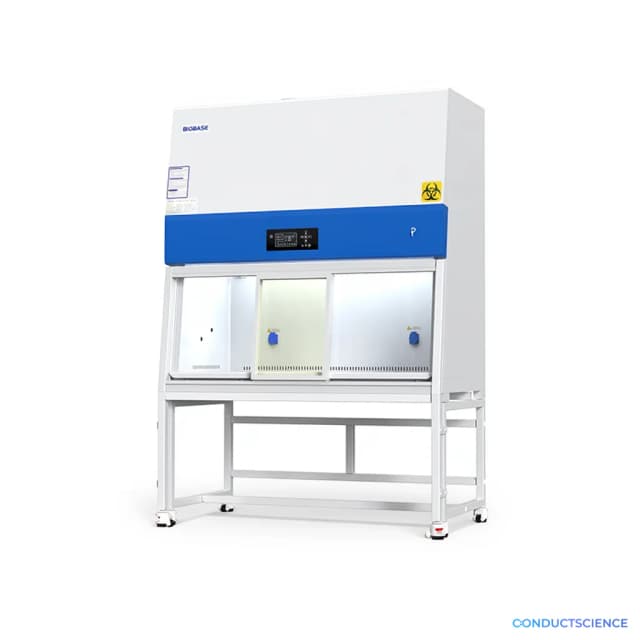
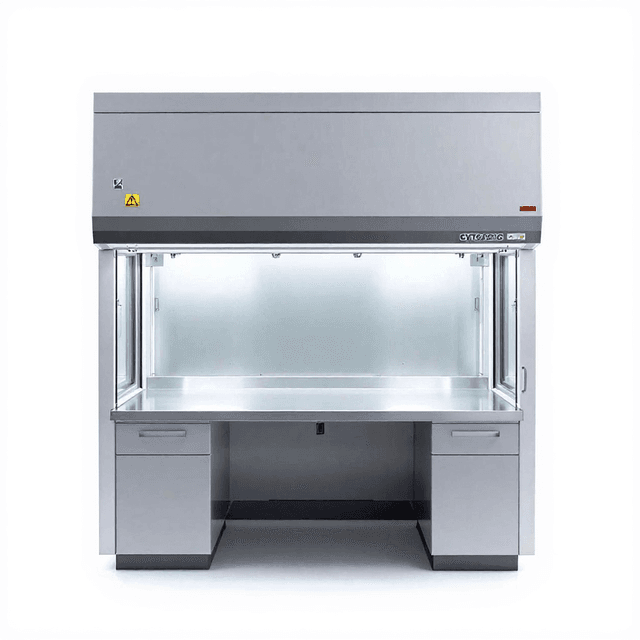
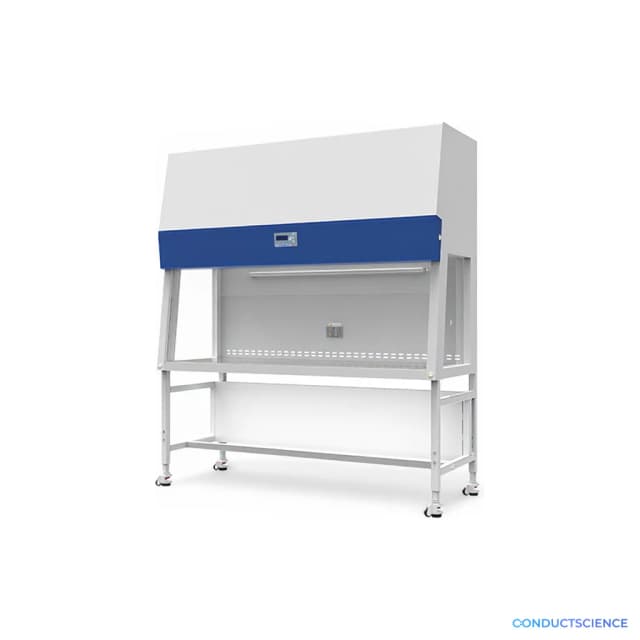
Class II Biological Safety Cabinet 11231 BBC 86-Pro
Class II biological safety cabinet with dual ULPA filtration (99.9995% at 0.12μm), 7-inch touchscreen control, and 600×500×530mm work chamber for sterile biological material handling.

Louise Corscadden, PhD
Director of Science · ConductScience
Ask Louise about Class II Biological Safety Cabinet 11231 BBC 86-Pro fit, setup, configuration, or quote prep.
Already working with us? Sign in to connect this with My Scientist.
Key Specifications
Full details →- Model fit
- Configured during quote
- SKU family
- BIO-0887
- Shipping box
- 23.62 x 20.87 x 19.69 cm
- Ordering
- Online checkout and quote request available
- Category
- Clean Benches & Fume Hoods
- Build notes
- Confirm accessories, station layout, and support needs before purchase
The Class II Biological Safety Cabinet 11231 BBC 86-Pro provides sterile work environment protection for handling biological materials through advanced HEPA/ULPA filtration and controlled airflow patterns. This cabinet features dual ULPA filters with 99.9995% efficiency at 0.12μm particles, maintaining precise inflow velocity of 0.53±0.025 m/s and downflow velocity of 0.33±0.025 m/s for containment of airborne contaminants.
The unit incorporates a 7-inch touchscreen interface for system monitoring and control, with integrated LED illumination providing ≥1000 Lux work surface lighting. The 600×500×530mm internal work chamber accommodates standard laboratory equipment while maintaining biosafety protocols. Double-sided laminated glass front window provides clear visibility with adjustable opening from safety height of 200mm to maximum 370mm for equipment access.
How It Works
The biological safety cabinet operates on the principle of laminar airflow containment, where room air is drawn through the front opening at precisely controlled velocity (0.53±0.025 m/s) to prevent escape of airborne particles from the work chamber. This inflow air, along with recirculated cabinet air, passes through dual ULPA filters that remove 99.9995% of particles 0.12μm and larger through mechanical filtration.
Filtered air is directed downward through the work chamber at 0.33±0.025 m/s, creating a sterile laminar flow environment that sweeps particles away from the work surface and toward the front air intake. The cabinet maintains negative pressure containment while providing product protection through the sterile downflow air pattern. Continuous monitoring of airflow velocities and filter integrity ensures maintenance of proper containment and sterility throughout operation.
Features & Benefits
Automation Level
- semi-automated
External Size(W*D*H)
- 700*640*1920mm
Internal Size(W*D*H)
- 600*500*530mm
Tested Opening
- Safety height 200mm(8)
Max Opening
- 370mm(15)
Inflow Velocity
- 0.53±0.025m/s
Down Flow Velocity
- 0.33±0.025m/s
ULPA Filter
- Two, 99.9995% efficiency at 0.12μm., filter life indicator
Front Window
- Double-sided laminated glass
Noise
- ≤67dB
LED Lamp
- 8W*2
Illumination
- ≥1000Lux
Consumption
- 500W
Socket
- Two, total load of two sockets: 500W
Brand
- ConductScience
Research Domain
- Analytical Chemistry
- Cell Biology
- Clinical Diagnostics
- Immunology
- Microbiology
- Pharmaceutical QC
Display Type
- 7 inch large touch screen
Shipping weight
- 157.74 lb
Shipping box
- L: 23.62 cm
- W: 20.87 cm
- H: 19.69 cm
| Feature | This Product | Typical Alternative | Advantage |
|---|---|---|---|
| Filtration Efficiency | 99.9995% at 0.12μm (dual ULPA) | Entry-level models typically use HEPA filters with 99.97% efficiency at 0.3μm | Superior particle removal enables work with smaller aerosols and provides enhanced sterility assurance. |
| Control Interface | 7-inch touchscreen display | Basic models often feature analog gauges and simple LED indicators | Digital interface provides comprehensive system monitoring and documentation capabilities. |
| Work Chamber Size | 600×500×530mm internal dimensions | Compact units may offer smaller work areas | Adequate space accommodates standard laboratory equipment while maintaining proper airflow patterns. |
| Airflow Precision | ±0.025 m/s velocity tolerance | Standard models typically maintain broader tolerance ranges | Precise airflow control ensures consistent containment performance for validated procedures. |
| Filter Monitoring | Integrated filter life indicator | Basic units require manual pressure gauge monitoring | Automated monitoring prevents unexpected filter failure and supports preventive maintenance scheduling. |
This cabinet offers enhanced ULPA filtration efficiency and digital monitoring capabilities compared to basic Class II models. The touchscreen interface and precise airflow control provide advanced features for research applications requiring documented sterile conditions and validated containment performance.
Practical Tips
Perform airflow velocity verification every 6 months using calibrated anemometer at multiple points across the work opening.
Why: Ensures containment performance remains within specification for biological safety.
Clean work surfaces with appropriate disinfectant between procedures and perform deep cleaning weekly with cabinet running.
Why: Maintains sterile environment and prevents cross-contamination between experiments.
Allow 5-minute airflow stabilization before beginning work and avoid rapid arm movements that disrupt laminar flow.
Why: Proper technique maintains sterile conditions and prevents contamination of cultures or specimens.
Never block the front air intake or place items directly over downflow areas during operation.
Why: Blocked airflow compromises containment effectiveness and reduces operator protection.
Document airflow readings and filter status in laboratory records for regulatory compliance tracking.
Why: Provides verification that sterile conditions were maintained during critical procedures.
If airflow alarm occurs, check for obstructions and verify sash position before contacting service.
Why: Simple corrections can restore proper operation without interrupting laboratory workflow.
Setup Guide
What’s in the Box
- Class II Biological Safety Cabinet main unit
- Power cord and electrical connections
- User manual and operation guide
- Filter certification documentation (typical)
- Airflow calibration certificate (typical)
Warranty
ConductScience provides standard one-year manufacturer warranty covering parts and technical support. Extended service agreements available for critical laboratory applications.
Compliance
What particle size efficiency does the ULPA filtration provide?
The dual ULPA filters achieve 99.9995% efficiency at 0.12μm particles, providing superior filtration compared to standard 0.3μm HEPA specifications.
How do I verify airflow velocities meet specifications?
Use calibrated anemometer to measure inflow velocity (0.53±0.025 m/s) at front opening and downflow velocity (0.33±0.025 m/s) at work surface during routine certification.
What is the recommended filter replacement schedule?
Replace ULPA filters when filter life indicator shows degradation or when airflow velocities cannot be maintained within specification limits, typically every 3-5 years depending on usage.
Can the cabinet accommodate a microscope for sterile work?
Yes, the 600×500×530mm internal chamber and 370mm maximum opening height can accommodate standard laboratory microscopes for sterile observation procedures.
What electrical requirements are needed for installation?
The unit requires 500W power consumption with standard electrical connection. Two internal outlets provide 500W total load for equipment inside the cabinet.
How does the touchscreen interface support operation monitoring?
The 7-inch display provides real-time airflow status, filter condition indicators, and system alarms for continuous operational verification.
Have a question about this product?
Have a question? Just ask.
Send it over and we'll email you a personalized answer — no call, no scheduling.
Prefer to talk it through?