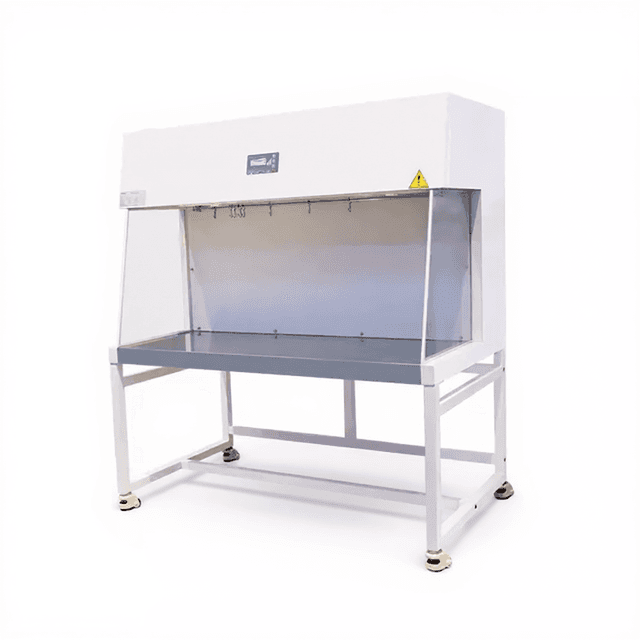
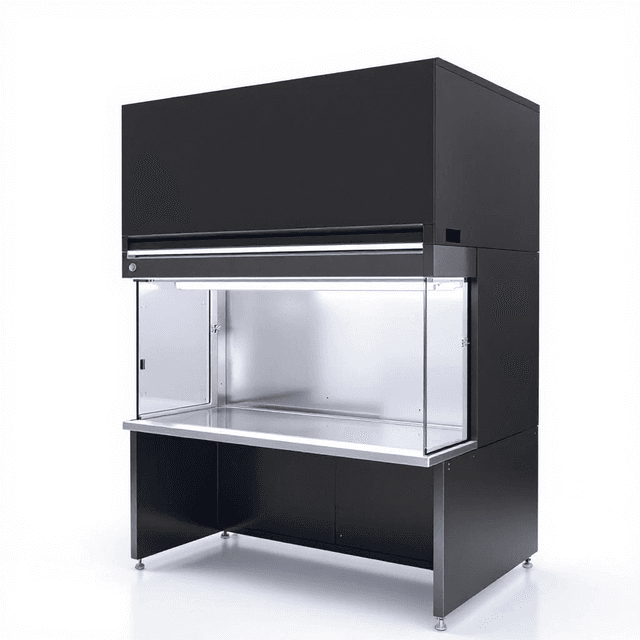
Radiation Protection Biological Safety Cabinet
Class II biological safety cabinet with dual ULPA filtration system providing sterile workspace for microbiological research and cell culture applications with personnel and environmental protection.

Louise Corscadden, PhD
Director of Science · ConductScience
Ask Louise about Radiation Protection Biological Safety Cabinet fit, setup, configuration, or quote prep.
Already working with us? Sign in to connect this with My Scientist.
Key Specifications
Full details →- Model fit
- Configured during quote
- SKU family
- BIO-0012
- Shipping box
- 220.0 x 150.0 x 84.0 cm
- Ordering
- Online checkout and quote request available
- Category
- Clean Benches & Fume Hoods
- Build notes
- Confirm accessories, station layout, and support needs before purchase
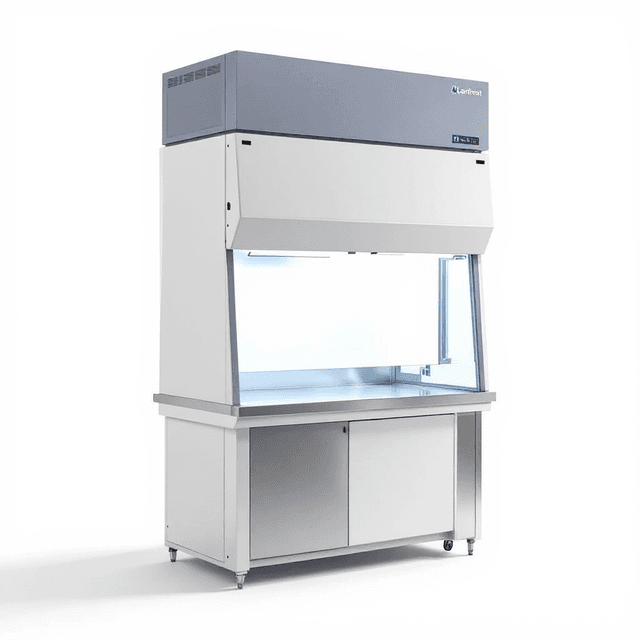
The Radiation Protection Biological Safety Cabinet provides Class II sterile working environment for microbiological research and cell culture applications requiring personnel, product, and environmental protection. This unit combines HEPA filtration with laminar airflow patterns to maintain sterile conditions while protecting operators from potentially hazardous biological materials.
The cabinet features dual ULPA filters achieving 99.9995% efficiency at 0.12μm particles, motorized front window with two-layer laminated safety glass, and controlled inflow/downflow velocities. The 1350×600×660mm internal workspace accommodates standard laboratory equipment and procedures while maintaining specified airflow parameters essential for biosafety containment.
How It Works
The biological safety cabinet operates through a combination of laminar airflow and high-efficiency particulate filtration to create a sterile work environment. Room air is drawn into the cabinet and passes through ULPA filters, creating a downflow curtain of sterile air at 0.33±0.025m/s across the work surface. Simultaneously, inflow air at 0.53±0.025m/s creates a protective barrier at the window opening.
The dual ULPA filter system removes 99.9995% of particles at 0.12μm, including bacteria, spores, and other contaminants. The motorized front window maintains proper airflow balance while allowing operator access. Internal air recirculation ensures continuous filtration, while exhaust air passes through additional filtration before environmental discharge.
UV sterilization capability provides surface decontamination between uses, while LED illumination at ≥1000 lux ensures adequate visibility for precise laboratory work. The contained airflow pattern protects both the work materials from contamination and the operator from exposure to potentially hazardous biological materials.
Features & Benefits
Automation Level
- semi-automated
External Size(W*D*H)
- 1500*840*2200mm
Internal Size(W*D*H)
- 1350*600*660mm
Tested Opening
- Safety height 200mm(8)
Max Opening
- 440mm
Inflow Velocity
- 0.53±0.025m/s
Downflow Velocity
- 0.33±0.025m/s
ULPA Filter
- Two, 99.9995% efficiency at 0.12μm, filter life indicator
Front Window
- Motorized. Two-layer laminated toughened glass≥6mm. Anti UV
Noise
- ≤65dB
UV Lamp
- 40W*1
LED Lamp
- 16W*2
Illumination
- ≥1000Lux
Consumption
- 1600W
Waterproof Socket
- Two, total load of two sockets: 500W
Brand
- ConductScience
Research Domain
- Cell Biology
- Clinical Diagnostics
- Environmental Monitoring
- Immunology
- Microbiology
- Pharmaceutical QC
Shipping weight
- 350.0 lb
Shipping box
- L: 220.0 cm
- W: 150.0 cm
- H: 84.0 cm
| Feature | This Product | Typical Alternative | Advantage |
|---|---|---|---|
| Filtration Efficiency | 99.9995% at 0.12μm with dual ULPA filters | Entry-level models often use HEPA filters at 99.97% efficiency for 0.3μm particles | Superior removal of smaller biological particles including viruses and bacterial spores for enhanced containment. |
| Airflow Control Precision | Controlled velocities within ±0.025m/s tolerance | Basic models may have wider velocity tolerances affecting containment performance | Precise airflow control ensures consistent containment barrier and sterile environment maintenance. |
| Window Operation | Motorized front window with safety glass ≥6mm | Manual window adjustment is common in lower-cost units | Automated window control reduces contamination risk and ensures proper sash positioning for optimal airflow. |
| Internal Power Supply | Two waterproof sockets with 500W total capacity | Many units lack internal electrical outlets for equipment | Enables operation of essential laboratory equipment within the sterile environment without external connections. |
| UV Sterilization | Integrated 40W UV lamp for surface decontamination | UV sterilization is optional or absent in many competing models | Built-in decontamination capability reduces cleaning time and enhances sterility between work sessions. |
| Work Area Dimensions | 1350×600×660mm internal workspace | Compact models often provide smaller work areas limiting experimental capacity | Generous workspace accommodates larger equipment and multiple simultaneous procedures. |
This biological safety cabinet combines ULPA-level filtration with precise airflow control and automated safety features. The motorized window, internal power supply, and integrated UV sterilization provide enhanced functionality compared to basic biological safety cabinets, while maintaining the containment performance required for critical microbiological applications.
Practical Tips
Verify airflow velocities monthly using a calibrated thermal anemometer, measuring at multiple points across the window opening and work surface.
Why: Airflow verification ensures containment barrier integrity and sterile environment maintenance.
Monitor filter life indicators weekly and schedule ULPA filter replacement before pressure differential reaches maximum specification.
Why: Proactive filter maintenance prevents sudden filtration failure and maintains consistent containment performance.
Allow the cabinet to operate for 15 minutes before beginning work and avoid rapid movements that could disrupt airflow patterns.
Why: Proper warm-up time ensures stable airflow establishment while gentle movements maintain containment barrier integrity.
Keep the UV lamp covered during normal operation and ensure no personnel exposure during sterilization cycles.
Why: UV exposure protection prevents harmful radiation exposure while maintaining effective surface sterilization capability.
Document airflow measurements and filter life readings to establish performance trends and predict maintenance needs.
Why: Performance trending enables proactive maintenance scheduling and ensures consistent experimental conditions.
If airflow alarms occur, check for obstructions in the work area and verify the motorized window is at proper operating height.
Why: Airflow disruptions compromise containment effectiveness and may indicate equipment malfunction requiring immediate attention.
Position equipment and materials at least 6 inches from the front and back walls to maintain proper airflow patterns.
Why: Adequate clearance prevents airflow disruption and ensures uniform sterile air distribution across the work surface.
Clean internal surfaces with appropriate disinfectants compatible with stainless steel construction and UV lamp operation.
Why: Proper cleaning maintains sterile conditions while preserving equipment surfaces and optical components.
Setup Guide
What’s in the Box
- Biological safety cabinet main unit
- Power cable and electrical connections
- ULPA filters (pre-installed)
- User manual and operation guide
- Filter life indicator documentation
- Safety and maintenance instructions
- Performance certification documentation (typical)
- UV lamp replacement guide (typical)
Warranty
ConductScience provides a standard one-year manufacturer warranty covering parts and technical support. Extended warranty options and on-site service agreements are available for facilities requiring comprehensive maintenance coverage.
Compliance
What is the difference between ULPA and HEPA filtration for biological safety applications?
This unit uses ULPA filters achieving 99.9995% efficiency at 0.12μm particles, compared to HEPA filters which typically achieve 99.97% at 0.3μm. ULPA provides superior removal of smaller particles including viruses and bacterial spores critical for high-containment applications.
How do I verify the airflow velocities are within specification?
Use a calibrated thermal anemometer to measure inflow velocity at the window opening (should be 0.53±0.025m/s) and downflow velocity across the work surface (should be 0.33±0.025m/s). Measurements should be taken at multiple points according to NSF protocols.
Can I use this cabinet for work with volatile chemicals or radioactive materials?
This unit is designed specifically for biological containment. For chemical work, consult product datasheet for chemical compatibility. For radioactive materials, additional shielding and exhaust modifications would be required.
What equipment can I safely operate inside the cabinet?
The two waterproof sockets provide 500W total capacity for equipment like microscopes, small centrifuges, or heating blocks. Ensure equipment does not obstruct airflow patterns and is compatible with the sterile environment.
How often do the ULPA filters need replacement?
Filter life depends on usage and particulate load. The integrated filter life indicator monitors pressure differential to indicate when replacement is needed, typically every 2-5 years in normal laboratory use.
What is the UV lamp sterilization cycle time?
The 40W UV lamp provides surface sterilization capability. Consult product datasheet for specific exposure time recommendations based on the type of decontamination required.
Can the cabinet be connected to building exhaust systems?
This unit can operate as either recirculating or connected to external exhaust. External connection requires proper ductwork sizing and balancing to maintain specified airflow velocities.
What maintenance is required beyond filter replacement?
Regular maintenance includes UV lamp replacement, cleaning of internal surfaces, verification of airflow velocities, and annual certification testing. The motorized window mechanism should be inspected periodically for proper operation.
Have a question about this product?
Have a question? Just ask.
Send it over and we'll email you a personalized answer — no call, no scheduling.
Prefer to talk it through?
Replacement Parts & Consumables