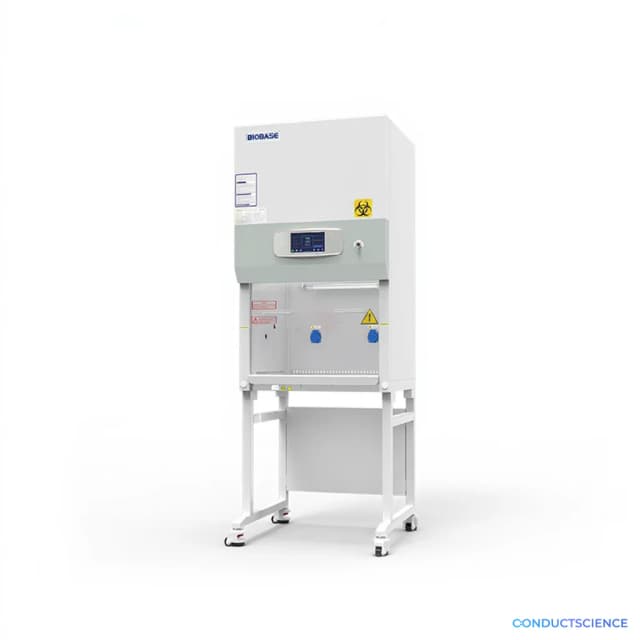
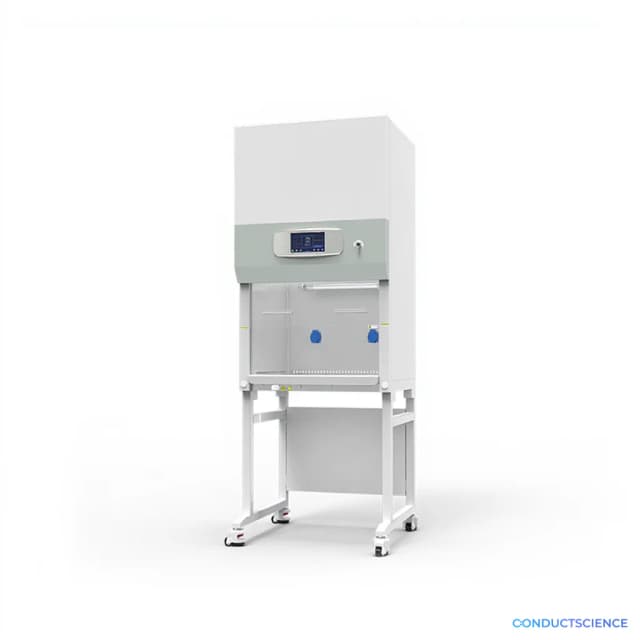
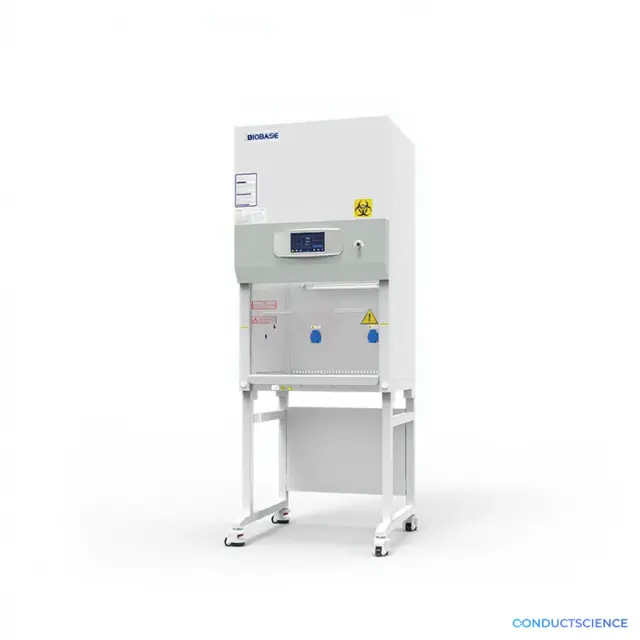
Biological Clean Bench for Animal Work
ISO 5 clean bench with HEPA filtration (99.99% at 0.3 micron) providing laminar airflow protection for sterile animal handling, cage preparation, and transfer procedures in research facilities.
A laminar flow clean bench protects only the sample. It blows filtered air toward the user, so it is not for infectious or toxic work.

Louise Corscadden, PhD
Director of Science · ConductScience
Ask Louise about Biological Clean Bench for Animal Work fit, setup, configuration, or quote prep.
Already working with us? Sign in to connect this with My Scientist.
Key Specifications
Full details →- Model fit
- Configured during quote
- SKU family
- PTY-0035
- Shipping box
- 65.0 x 32.0 x 82.0 cm
- Ordering
- Online checkout and quote request available
- Category
- Clean Benches & Fume Hoods
- Build notes
- Confirm accessories, station layout, and support needs before purchase
The Biological Clean Bench for Animal Work delivers ISO 5 class laminar airflow protection for sterile animal handling procedures in research environments. The unit incorporates HEPA filtration at 99.99% efficiency for 0.3 micron particles, establishing a controlled workspace that maintains sterile conditions during cage preparation, animal transfers, and experimental procedures requiring particulate contamination control.
The laminar flow design creates unidirectional airflow across the work surface, minimizing cross-contamination and maintaining the sterile field essential for in vivo research protocols. This clean bench supports critical workflows in laboratory animal facilities, vivariums, and research institutions conducting studies that require aseptic technique and environmental control during animal manipulation.
How It Works
The biological clean bench operates on laminar airflow principles to create a sterile working environment. Room air is drawn into the unit through pre-filtration, then passes through HEPA filters that remove 99.99% of particles 0.3 micrometers and larger through mechanical filtration mechanisms including impaction, interception, and diffusion.
The filtered air is delivered in a unidirectional laminar flow pattern across the work surface at controlled velocity. This constant downward or horizontal airflow sweeps away airborne contaminants generated during procedures, preventing particle settlement on work surfaces and materials. The laminar flow design ensures that contaminated air downstream of one operation does not affect upstream work areas, maintaining isolation between different procedures performed simultaneously within the workspace.
The ISO 5 classification indicates that the work zone maintains particle concentrations below 3,520 particles per cubic meter (0.5 micrometers and larger), providing the clean environment necessary for sterile animal handling procedures and sensitive research applications.
Features & Benefits
Airflow
- Laminar flow
Filtration
- HEPA (99.99% at 0.3 micron)
Clean Class
- ISO 5
Automation Level
- manual
Brand
- ConductScience
Research Domain
- Analytical Chemistry
- Cell Biology
- Environmental Monitoring
- Industrial Hygiene
- Microbiology
- Pharmaceutical QC
Shipping weight
- 70.0 lb
Shipping box
- L: 65.0 cm
- W: 32.0 cm
- H: 82.0 cm
| Feature | This Product | Typical Alternative | Advantage |
|---|---|---|---|
| Filtration Efficiency | HEPA filtration at 99.99% for 0.3 micron particles | Entry-level units often provide lower efficiency or larger particle size specifications | Superior particulate removal ensures sterile conditions for sensitive animal research procedures. |
| Clean Class Rating | ISO 5 class laminar airflow environment | Basic models may achieve ISO 6 or ISO 7 classifications | Higher cleanliness standard reduces contamination risk in critical research applications. |
| Application Focus | Specifically designed for animal handling and research procedures | General-purpose clean benches may lack animal research optimizations | Purpose-built design addresses specific requirements of laboratory animal facility workflows. |
| Construction Quality | 70 kg unit weight indicating robust construction | Lighter units may compromise stability and durability | Heavy-duty construction provides stability during animal handling procedures and long-term reliability. |
| Control System | Manual operation controls | Some models offer automated controls with programmed settings | Direct manual control allows researchers to adjust conditions immediately based on specific procedure requirements. |
This unit combines ISO 5 cleanliness standards with HEPA filtration specifically optimized for animal research applications. The robust construction and manual controls provide researchers with reliable sterile conditions and direct operational management for demanding laboratory animal facility requirements.
Practical Tips
Verify airflow patterns monthly using smoke sticks or ribbons to ensure laminar flow remains unidirectional across the entire work surface.
Why: Airflow disruptions can compromise sterile conditions and lead to experimental contamination.
Clean work surfaces with laboratory-grade disinfectant between different procedures and allow complete drying before use.
Why: Residual contamination can transfer between procedures and compromise experimental results.
Allow the unit to operate for at least 15 minutes before beginning sterile procedures to stabilize airflow patterns.
Why: Stabilized airflow ensures consistent contamination protection throughout the procedure.
Position materials and equipment to work from clean to dirty areas within the laminar flow field.
Why: This technique prevents contaminated air from flowing over sterile materials and maintains procedure sterility.
If contamination occurs during procedures, check for airflow disruptions caused by rapid movements or blocked air intakes.
Why: Disrupted laminar flow is the most common cause of contamination in clean bench environments.
Never use the clean bench for procedures involving hazardous biological agents that require operator protection.
Why: Clean benches protect the work area but do not provide operator protection like biological safety cabinets.
Document unit operation parameters and maintenance activities to establish traceability for research documentation.
Why: Proper documentation supports research reproducibility and regulatory compliance requirements.
Monitor HEPA filter differential pressure indicators regularly to determine when filter replacement is necessary.
Why: Clogged filters reduce airflow velocity and compromise the sterile environment effectiveness.
Setup Guide
What’s in the Box
- Biological clean bench main unit
- HEPA filter assembly (pre-installed)
- Power cord and electrical connections (typical)
- Operation manual and safety instructions (typical)
- Installation hardware (typical)
- Performance verification certificate (typical)
Warranty
ConductScience provides standard manufacturer warranty coverage including technical support for operational questions and replacement of defective components during the warranty period.
Compliance
References
Background reading relevant to this product:
What particle size range does the HEPA filtration effectively remove?
The HEPA filters achieve 99.99% efficiency for particles 0.3 micrometers and larger, effectively removing bacteria, spores, and fine particulates that could compromise sterile conditions.
How does this unit maintain ISO 5 class conditions during active use?
The laminar airflow design provides unidirectional air movement that continuously sweeps contaminants away from the work surface, maintaining particle concentrations below 3,520 particles per cubic meter for 0.5 micrometer particles.
What types of animal procedures can be performed in this unit?
The unit accommodates cage preparation, animal transfers, sterile injections, tissue sample handling, and other procedures requiring contamination control, with work surface designed for typical animal research manipulations.
How should the unit be maintained for consistent performance?
Regular HEPA filter monitoring, work surface disinfection between uses, and periodic airflow verification ensure continued sterile conditions. Consult product datasheet for specific maintenance intervals.
Can multiple researchers work simultaneously in the unit?
The laminar flow design allows multiple work areas within the sterile field, with airflow patterns preventing cross-contamination between different procedures performed concurrently.
What installation requirements should be considered?
The unit requires stable mounting surface, appropriate electrical supply, and positioning away from air currents that could disrupt laminar flow patterns. The 70 kg weight requires substantial support structure.
How does this compare to biological safety cabinets for animal work?
Clean benches provide product protection through laminar flow but do not offer operator protection like biosafety cabinets. Choose based on whether procedures require operator protection from hazardous materials.
Have a question about this product?
Have a question? Just ask.
Send it over and we'll email you a personalized answer — no call, no scheduling.
Prefer to talk it through?
Accessories
Enhance your setup with compatible accessories