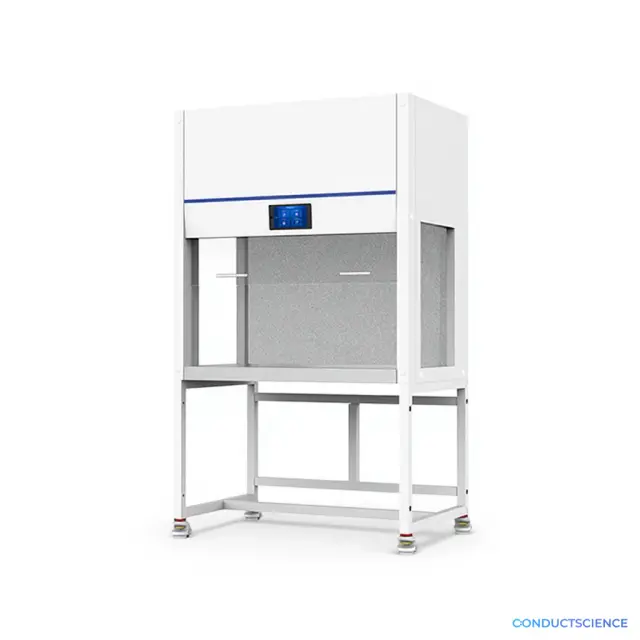
Vertical Flow Clean Booth
Portable clean booth delivering ISO Class 5 environment with HEPA-filtered vertical laminar airflow for contamination-sensitive laboratory work.

Louise Corscadden, PhD
Director of Science · ConductScience
Ask Louise about Vertical Flow Clean Booth fit, setup, configuration, or quote prep.
Already working with us? Sign in to connect this with My Scientist.
Key Specifications
Full details →- Model fit
- Configured during quote
- SKU family
- BIO-CB-1200
- Shipping box
- 42.0 x 43.6 x 38.0 cm
- Ordering
- Online checkout and quote request available
- Category
- Clean Benches & Fume Hoods
- Build notes
- Confirm accessories, station layout, and support needs before purchase
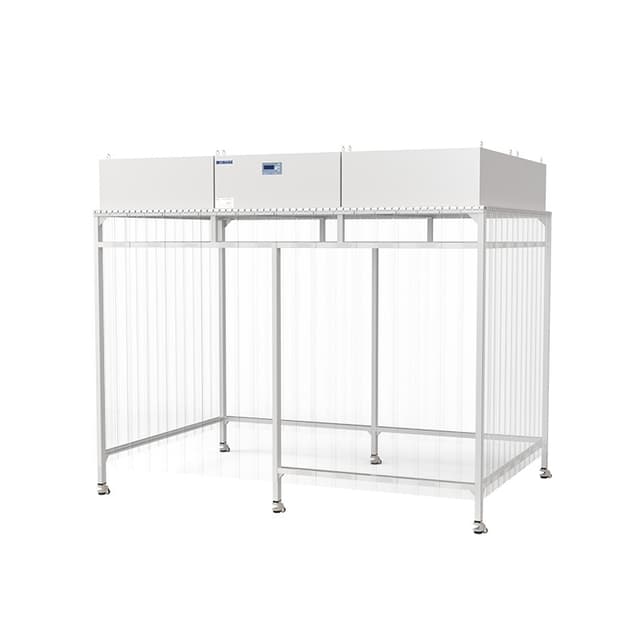
The Vertical Flow Clean Booth provides a controlled environment with ISO Class 5 (Class 100) cleanliness levels through HEPA-filtered vertical laminar airflow. This portable contamination control system creates a particle-free workspace using a 99.99% efficient HEPA filter at 0.3 micrometers, delivering unidirectional airflow from ceiling to work surface.
The system features transparent PVC curtain walls that maintain containment while allowing visual access to work areas. Variable fan speed control enables airflow optimization for different applications, while low-noise operation maintains laboratory comfort. This cost-effective alternative to permanent cleanroom construction provides localized contamination control for sensitive procedures requiring particulate-free conditions.
How It Works
The vertical flow clean booth operates on the principle of unidirectional laminar airflow to maintain particulate cleanliness. Air enters the system through a pre-filter stage before passing through a HEPA filter rated at 99.99% efficiency for 0.3-micrometer particles. The filtered air flows vertically downward across the work surface in parallel streamlines at uniform velocity.
This laminar airflow pattern continuously sweeps particles away from the work area, preventing accumulation and cross-contamination. The transparent PVC curtain walls create a physical barrier that maintains the controlled environment while allowing operator access and visual monitoring. Variable fan speed adjustment enables optimization of airflow velocity to balance contamination control requirements with operational comfort.
The downward airflow design ensures that any particles generated within the work area are immediately carried away from sensitive materials rather than circulating within the workspace. This vertical flow configuration is particularly effective for applications involving powders or materials that may generate particulates during handling.
Features & Benefits
Automation Level
- manual
Research Domain
- Analytical Chemistry
- Cell Biology
- Environmental Monitoring
- Materials Science
- Microbiology
- Pharmaceutical QC
Shipping weight
- 390.0 lb
Shipping box
- L: 42.0 cm
- W: 43.6 cm
- H: 38.0 cm
| Feature | This Product | Typical Alternative | Advantage |
|---|---|---|---|
| Cleanliness Classification | ISO Class 5 (Class 100) | Many portable units offer ISO Class 6 or 7 performance | Higher cleanliness level enables use in applications requiring stringent particulate control specifications |
| HEPA Filter Efficiency | 99.99% at 0.3μm | Standard units may use 99.97% efficiency filters | Enhanced filtration removes more submicron particles that could compromise sensitive procedures |
| Airflow Pattern | Vertical laminar downflow | Some units use horizontal flow or non-laminar circulation | Vertical flow continuously sweeps contaminants away from work surface without recirculation patterns |
| Curtain Wall Design | Transparent PVC curtains | Fixed glass panels or rigid acrylic walls | Flexible access allows handling of larger items while maintaining visual monitoring of work area |
| Fan Speed Control | Adjustable variable speed | Many units operate at single fixed speed | Airflow optimization accommodates different materials and procedures without compromising cleanliness performance |
This vertical flow clean booth combines ISO Class 5 cleanliness performance with flexible access design and adjustable airflow control. The high-efficiency HEPA filtration and vertical laminar flow pattern provide stringent contamination control comparable to permanent cleanroom installations in a portable configuration.
Practical Tips
Perform airflow visualization using smoke tubes or ribbons quarterly to verify uniform vertical flow patterns across the work surface.
Why: Non-uniform airflow creates dead zones where particles can accumulate and compromise contamination control.
Monitor HEPA filter differential pressure monthly and replace when pressure drop exceeds manufacturer specifications.
Why: Clogged filters reduce airflow velocity and can allow particle breakthrough that degrades cleanliness levels.
Allow 15-20 minutes of operation before beginning work to achieve steady-state airflow and purge residual particles.
Why: Initial air changes are required to establish ISO Class 5 conditions after system startup or disturbance.
Position materials toward the upstream edge of work surface and avoid blocking airflow paths with large equipment.
Why: Proper material placement maintains laminar flow characteristics and prevents particle accumulation in flow shadows.
If particle counts increase, check for gaps in curtain seals and verify fan operation at specified speed settings.
Why: Air leaks or reduced airflow velocity allow environmental contamination to enter the controlled workspace.
Ensure electrical connections are appropriate for laboratory environment and fan motor is properly grounded.
Why: Electrical safety prevents equipment damage and operator hazards in laboratory settings with potential liquid spills.
Document airflow measurements and particle count verification to maintain records of system performance over time.
Why: Performance documentation supports quality assurance requirements and identifies trends that indicate maintenance needs.
Setup Guide
What’s in the Box
- Vertical flow clean booth main unit (typical)
- HEPA filter assembly (typical)
- Transparent PVC curtain walls (typical)
- Power cord and electrical components (typical)
- User manual and operating instructions (typical)
- Installation hardware and mounting brackets (typical)
Warranty
ConductScience provides standard one-year manufacturer warranty covering defects in materials and workmanship. Technical support includes installation guidance, operational troubleshooting, and maintenance recommendations for optimal performance.
Compliance
What maintenance is required for the HEPA filter system?
HEPA filters typically require replacement every 1-2 years depending on usage and environmental conditions. Monitor differential pressure across filter or use particle counting to assess filter performance. Pre-filters may need more frequent replacement to extend HEPA filter life.
How do I verify the booth maintains ISO Class 5 performance?
Use a calibrated particle counter to measure particles ≥0.5μm at multiple locations within the work area. ISO Class 5 requires ≤3,520 particles per cubic meter. Perform verification after installation, filter changes, or if contamination control appears compromised.
Can this booth be used for chemical applications or just particulate control?
This vertical flow booth is designed for particulate contamination control only. It does not provide chemical fume extraction or vapor containment. Use appropriate chemical fume hoods for applications involving volatile solvents or hazardous vapors.
What is the recommended airflow velocity for optimal performance?
Consult product datasheet for specific airflow specifications. Typical vertical laminar flow systems operate at 0.3-0.5 m/s face velocity. Use smoke visualization or anemometer measurements to verify uniform flow across the work surface.
How does this compare to a traditional laminar flow cabinet?
This booth provides similar airflow principles but with flexible curtain walls rather than fixed glass sash. The open design allows larger item access while maintaining cleanliness levels comparable to Class II biosafety cabinets for particle control applications.
What cleaning protocols should be followed for the work surface and curtains?
Clean work surfaces with appropriate disinfectants based on application (70% isopropanol for general use, 10% bleach for microbiology). PVC curtains can be wiped with compatible cleaning agents. Allow complete drying and air purging before resuming operations.
Can multiple operators work simultaneously within the booth?
Work area dimensions determine operator capacity. Multiple operators may disrupt laminar airflow patterns and increase particulate generation. Design work procedures to minimize personnel movement and maintain proper airflow characteristics.
Have a question about this product?
Have a question? Just ask.
Send it over and we'll email you a personalized answer — no call, no scheduling.
Prefer to talk it through?
Accessories
Enhance your setup with compatible accessories