Vertical Laminar Flow Cabinet
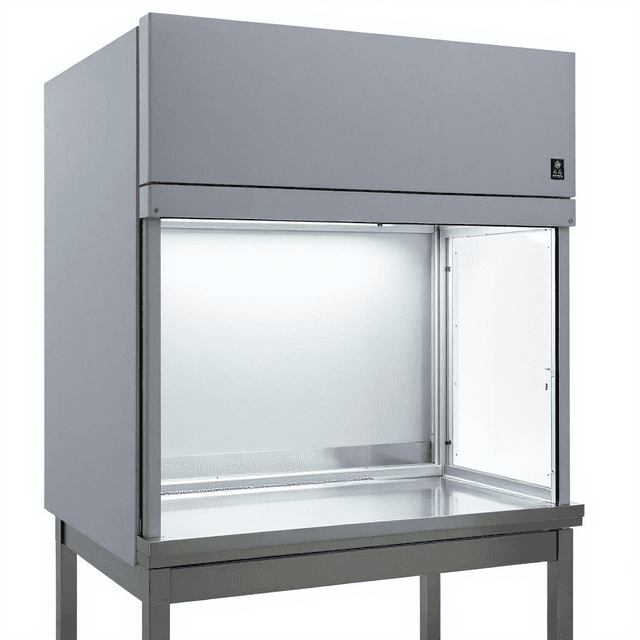
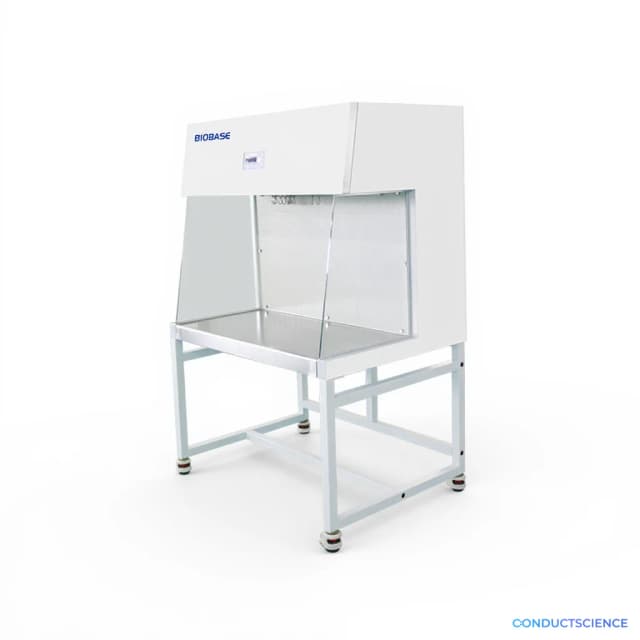
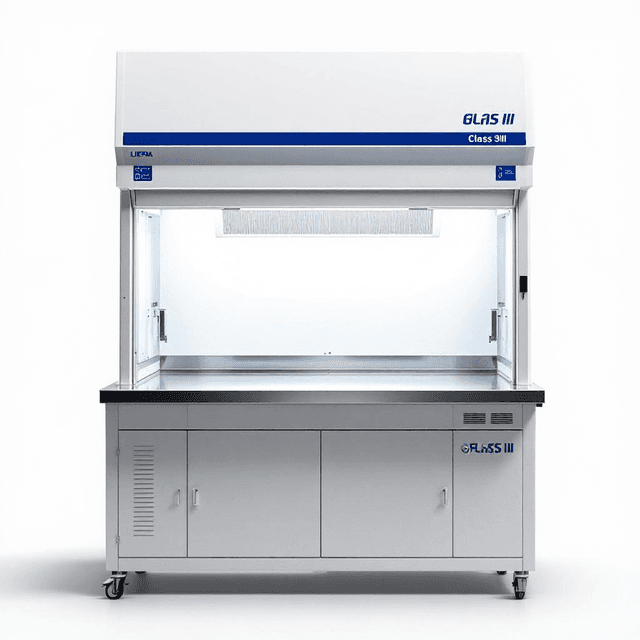
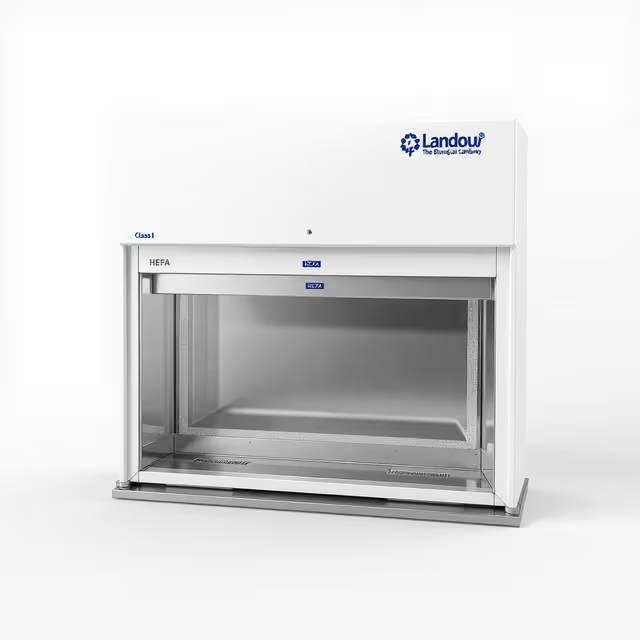
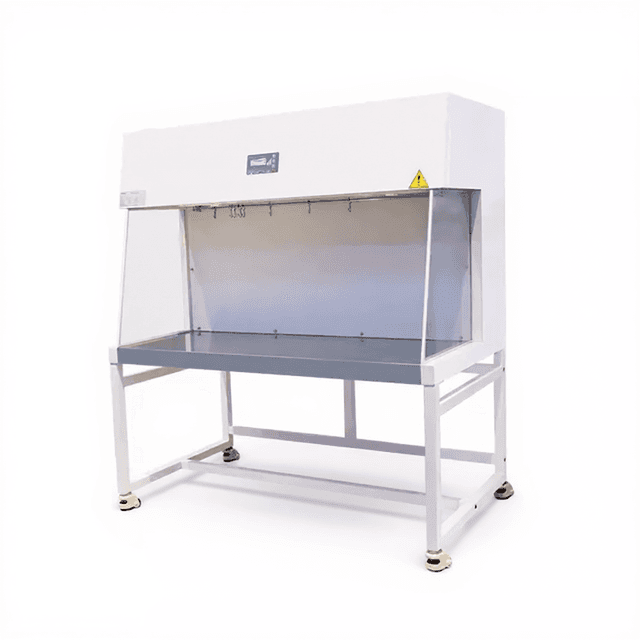
Single-user vertical laminar flow cabinet with HEPA H14 filtration providing ISO level 5 cleanliness for sterile work applications.
A laminar flow clean bench protects only the sample. It blows filtered air toward the user, so it is not for infectious or toxic work.

Louise Corscadden, PhD
Director of Science · ConductScience
Ask Louise about Vertical Laminar Flow Cabinet fit, setup, configuration, or quote prep.
Already working with us? Sign in to connect this with My Scientist.
Key Specifications
Full details →- Model fit
- Configured during quote
- SKU family
- _old_BIO-0050
- Shipping box
- 176.0 x 90.0 x 63.0 cm
- Ordering
- Online checkout and quote request available
- Category
- Clean Benches & Fume Hoods
- Build notes
- Confirm accessories, station layout, and support needs before purchase
The Vertical Laminar Flow Cabinet provides a controlled, sterile work environment for applications requiring contamination-free conditions. This single-user unit features vertical downward airflow with HEPA H14 filtration, achieving ISO level 5 (100 levels) cleanliness standards. The cabinet maintains airflow velocity between 0.2-0.45 m/s with filtration efficiency of ≥99.995% for 0.3 μm particles.
Operating at ≤65 dB(A) with minimal vibration (≤5 μm rms), the cabinet provides a stable working surface at 750 mm height. The front window safety height of 200 mm with maximum opening of 350 mm allows comfortable manipulation while maintaining containment. Internal lighting provides ≥300 lx illumination for detailed work.
How It Works
The cabinet operates on the principle of unidirectional vertical airflow combined with high-efficiency particulate air (HEPA) filtration. Room air is drawn into the cabinet through intake vents and passes through a HEPA H14 filter that removes ≥99.995% of particles 0.3 μm and larger. The filtered air then flows vertically downward across the work surface at a controlled velocity of 0.2-0.45 m/s.
This downward laminar flow creates a sterile work zone by continuously sweeping particles and contaminants away from the work surface and out through the front opening. The vertical flow pattern prevents contaminated air from entering the sterile work zone while allowing easy access for manipulation. The front window acts as a physical barrier while maintaining the airflow pattern.
The cabinet maintains sterility through continuous air exchange and filtration rather than air recirculation. This ensures that any particles generated within the work zone are immediately removed by the downward airflow, maintaining the ISO level 5 cleanliness classification throughout operation.
Features & Benefits
Automation Level
- manual
Flow Mode
- Vertical flow
Number of Users
- Single
Rated Power
- 150VA
Airflow Velocity
- 0.2m/s~0.45m/s
Noise
- ≤65dB(A)
Lighting
- ≥300lx
Vibration
- ≤5μm(rms)
Safety
- Colonies Number≤0.5CFU/30min
Clean Grade
- ISO level 5(100 levels)
Filtration Efficiency
- HEPA(H14) high efficiency filter, filtration efficiency for 0.3μm particle≥99.995%
Front Window Safety Height
- 200mm
Max Opening
- 350mm
Work Surface Height
- 750mm(Customized)
Brand
- ConductScience
Research Domain
- Analytical Chemistry
- Cell Biology
- Environmental Monitoring
- Food Science
- Microbiology
- Pharmaceutical QC
Power/Voltage
- 220V±10%, 50Hz(Standard); 110V±10%, 60Hz(Optional)
Shipping weight
- 175.0 lb
Shipping box
- L: 176.0 cm
- W: 90.0 cm
- H: 63.0 cm
| Feature | This Product | Typical Alternative | Advantage |
|---|---|---|---|
| Filtration Efficiency | HEPA H14 with ≥99.995% efficiency for 0.3 μm particles | Entry-level models often use H13 filters with 99.95% efficiency | Higher filtration efficiency provides greater assurance of sterile conditions for critical applications. |
| Airflow Velocity Range | Variable 0.2-0.45 m/s | Basic models often have fixed airflow without adjustment capability | Variable airflow allows optimization for different procedures while maintaining containment. |
| Cleanliness Classification | ISO level 5 (100 levels) with ≤0.5 CFU/30min | Lower-grade models may only achieve ISO level 6 or 7 | Higher cleanliness level suitable for pharmaceutical and biotechnology applications requiring strict standards. |
| Noise Level | ≤65 dB(A) operation | Standard units often operate at 70-75 dB(A) | Lower noise level enables comfortable extended use without excessive laboratory noise. |
| Vibration Control | ≤5 μm (rms) vibration | Basic models may have higher vibration levels | Minimal vibration provides stable platform for precision work and delicate manipulations. |
| Work Surface Height | 750 mm height (customizable) | Fixed height configurations in most standard models | Customizable height accommodates different user requirements and laboratory configurations. |
This cabinet offers HEPA H14 filtration with variable airflow control and low-noise operation. The ISO level 5 cleanliness rating and minimal vibration design provide a stable, sterile work environment suitable for critical applications requiring precise contamination control.
Practical Tips
Verify airflow velocity quarterly using a calibrated anemometer at a grid of points across the work surface.
Why: Consistent airflow is critical for maintaining sterile conditions and preventing contamination.
Monitor HEPA filter pressure differential and replace filter when resistance exceeds manufacturer specifications.
Why: Clogged filters reduce airflow velocity and compromise sterility performance.
Allow cabinet to run for minimum 30 minutes before use and avoid placing items that obstruct airflow patterns.
Why: Proper airflow establishment and unobstructed flow paths are essential for maintaining sterile conditions.
Keep the front window opening at the specified 200 mm safety height during operation.
Why: Proper window positioning maintains the designed airflow pattern and containment effectiveness.
Perform monthly settling plate tests in multiple locations within the work zone to verify sterility.
Why: Regular microbial monitoring confirms the cabinet is maintaining specified cleanliness levels.
If airflow velocity decreases, check for obstructions and verify HEPA filter condition before assuming equipment failure.
Why: Many airflow issues are caused by blockages or filter loading rather than blower problems.
Clean work surfaces with appropriate disinfectant before and after each use session.
Why: Regular cleaning prevents accumulation of contaminants that could compromise sterile conditions.
Schedule annual professional certification including airflow uniformity, filter integrity, and vibration measurements.
Why: Comprehensive testing ensures all performance parameters remain within specification for reliable operation.
Setup Guide
What’s in the Box
- Vertical laminar flow cabinet main unit
- HEPA H14 filter (pre-installed)
- Power cord and electrical connections
- Operating manual and documentation
- Leveling feet and hardware (typical)
- Performance verification certificate (typical)
Warranty
ConductScience provides a standard 1-year manufacturer warranty covering defects in materials and workmanship, with technical support for installation and operational questions.
Compliance
What is the filtration efficiency and how does it compare to other HEPA grades?
The cabinet uses HEPA H14 filters with ≥99.995% efficiency for 0.3 μm particles. This exceeds H13 filters (99.95% efficiency) and provides superior contamination control for critical applications.
How do I verify the cabinet is maintaining proper airflow velocity?
Use a calibrated anemometer to measure airflow at multiple points across the work surface. Velocity should consistently measure between 0.2-0.45 m/s during operation.
What maintenance is required for optimal performance?
Regular cleaning of work surfaces, periodic HEPA filter replacement based on pressure differential monitoring, and annual airflow velocity verification are essential maintenance procedures.
Can the work surface height be adjusted for different users?
Yes, the standard 750 mm work surface height can be customized during installation to accommodate specific ergonomic requirements or laboratory configurations.
How do I validate sterility performance?
Perform settling plate tests to verify colony counts remain ≤0.5 CFU/30min. This should be done initially and periodically as part of quality assurance protocols.
What power supply options are available?
Standard configuration is 220V±10%, 50Hz with 150VA rated power. Optional 110V±10%, 60Hz power supply is available for North American installations.
How does this compare to horizontal laminar flow cabinets?
Vertical flow cabinets provide better containment as particles are swept downward away from the work zone, while horizontal flow may blow contaminants toward the operator or adjacent work areas.
Have a question about this product?
Have a question? Just ask.
Send it over and we'll email you a personalized answer — no call, no scheduling.
Prefer to talk it through?
Upgrade Options