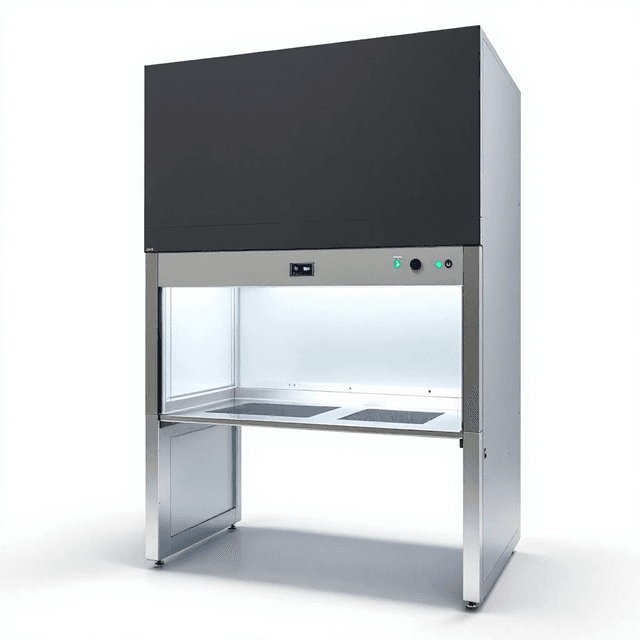
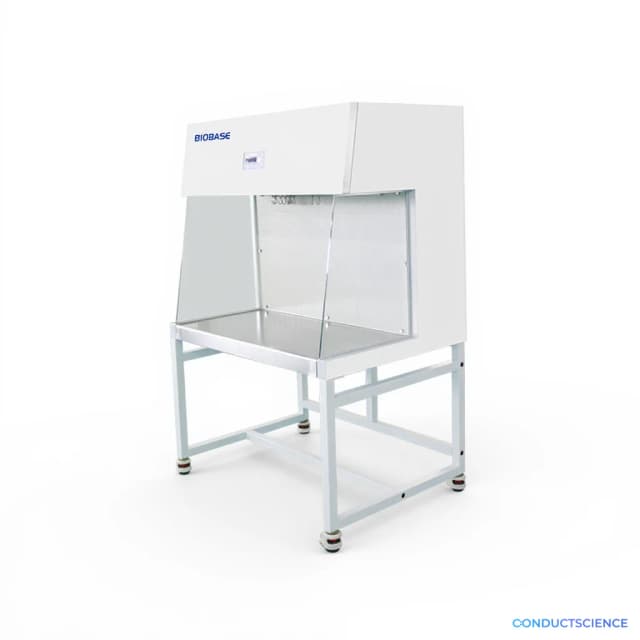
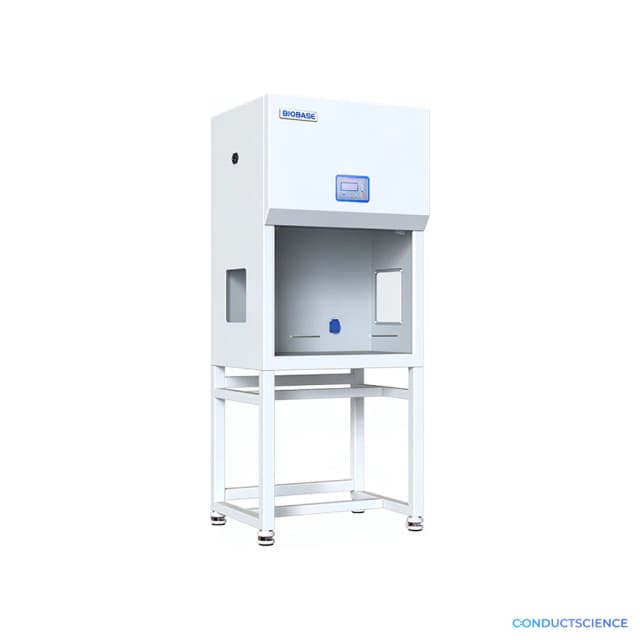
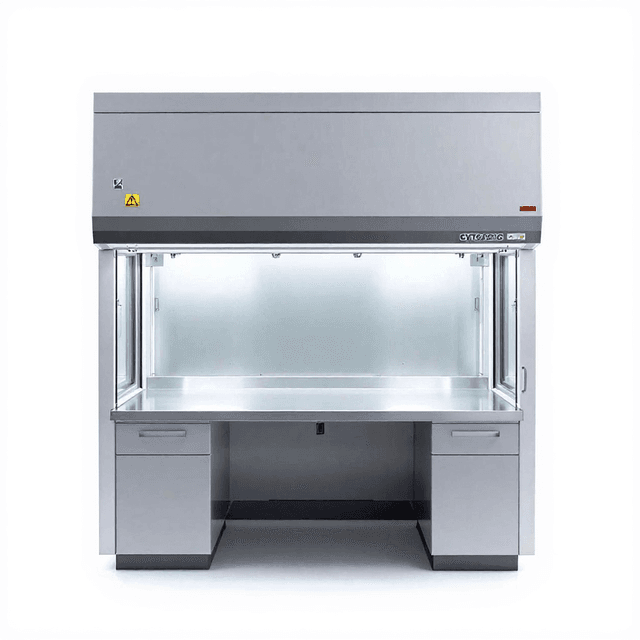
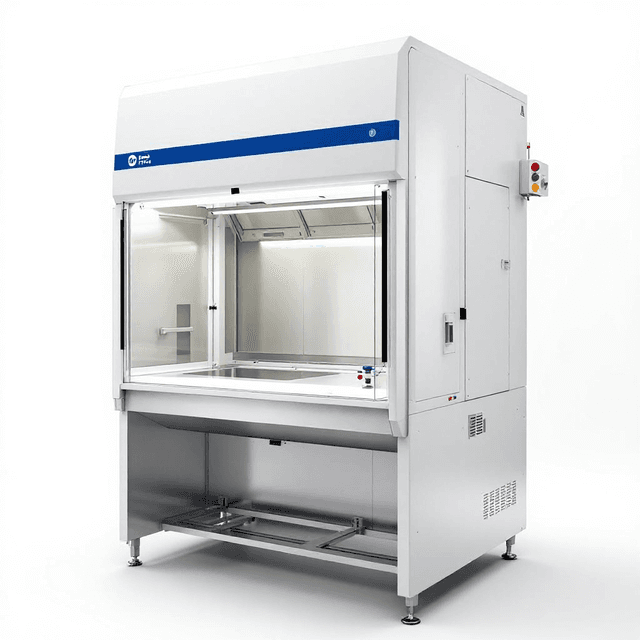
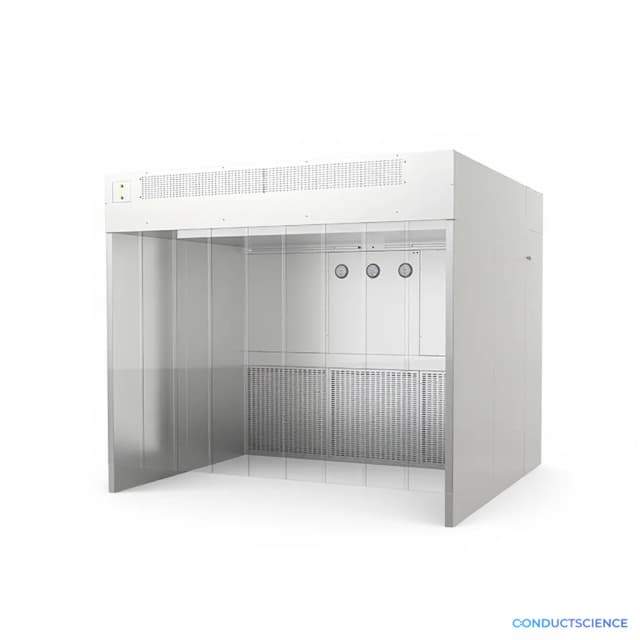
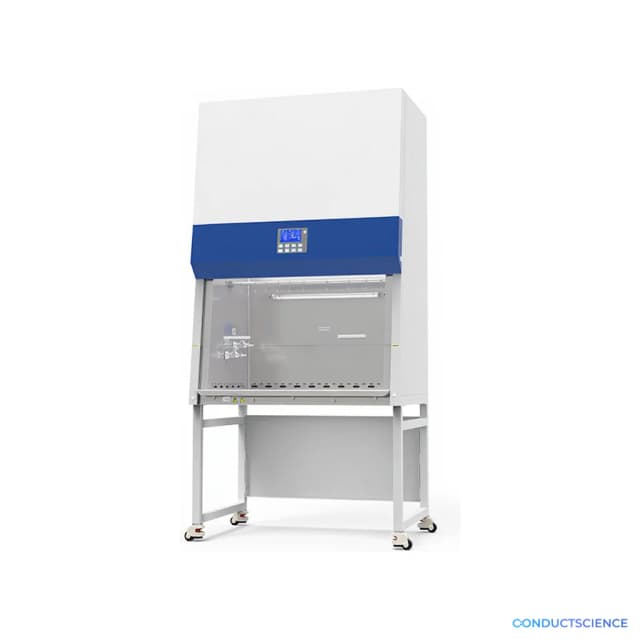
Vertical Laminar Flow Cabinet
Single-user vertical laminar flow cabinet providing ISO Class 5 sterile work environment with HEPA H14 filtration and adjustable airflow from 0.2-0.45 m/s.

Louise Corscadden, PhD
Director of Science · ConductScience
Ask Louise about Vertical Laminar Flow Cabinet fit, setup, configuration, or quote prep.
Already working with us? Sign in to connect this with My Scientist.
Key Specifications
Full details →- Model fit
- Configured during quote
- SKU family
- _old_BIO-0049
- Shipping box
- 186.0 x 110.0 x 63.0 cm
- Ordering
- Online checkout and quote request available
- Category
- Clean Benches & Fume Hoods
- Build notes
- Confirm accessories, station layout, and support needs before purchase
The Vertical Laminar Flow Cabinet provides Class II biological safety protection through vertical downward airflow for sterile work environments. This single-user clean bench maintains ISO Class 5 (100 level) cleanliness using HEPA H14 filtration with 99.995% efficiency for 0.3 μm particles. The cabinet operates with adjustable airflow velocity from 0.2 to 0.45 m/s and maintains low vibration levels (≤5 μm rms) essential for precision work.
Designed for laboratory applications requiring contamination control, the unit features a 200 mm safety window height with maximum opening to 350 mm for equipment access. The cabinet includes integrated lighting (≥300 lx) and operates at noise levels ≤65 dB(A) for comfortable extended use. Power requirements accommodate both 220V (50Hz) and optional 110V (60Hz) configurations.
How It Works
The vertical laminar flow cabinet creates a sterile work environment through unidirectional downward airflow. Room air enters through the top of the unit and passes through a pre-filter before being drawn into a centrifugal blower system. The pressurized air then flows through a HEPA H14 filter, which removes 99.995% of particles 0.3 μm and larger through mechanical filtration mechanisms including impaction, interception, and diffusion.
The filtered air flows vertically downward across the work surface at controlled velocities between 0.2-0.45 m/s, creating a continuous stream of clean air that sweeps contaminants away from the work zone. This laminar airflow pattern prevents turbulence that could reintroduce particles, while the vertical flow design protects both the work materials and the operator. The work surface is positioned within this clean air stream, with the front window providing containment while allowing access for manipulations.
Vibration isolation (≤5 μm rms) prevents disturbance of sensitive procedures, while the integrated lighting system provides uniform illumination (≥300 lx) across the work area. The cabinet maintains ISO Class 5 cleanliness levels, with colony counts ≤0.5 CFU per 30-minute sampling period, suitable for applications requiring sterile technique.
Features & Benefits
Automation Level
- manual
BKCB-V1300
- BKCB-V1500
Flow Mode
- Vertical flow
Number of Users
- Single
Rated Power
- 700VA(including operating area socket load 500VA)
Airflow Velocity
- 0.2m/s~0.45m/s
Noise
- ≤65dB(A)
Lighting
- ≥300lx
Vibration
- ≤5μm(rms)
Safety
- Colonies Number≤0.5CFU/30min
Clean Grade
- ISO level 5(100 levels)
Filtration Efficiency
- HEPA(H14) high efficiency filter, filtration efficiency for 0.3μm particle≥99.995%
Front Window Safety Height
- 200mm
Max Opening
- 350mm
Brand
- ConductScience
Research Domain
- Cell Biology
- Clinical Diagnostics
- Food Science
- Immunology
- Microbiology
- Pharmaceutical QC
Power/Voltage
- 220V±10%, 50Hz(Standard); 110V±10%, 60Hz(Optional)
Shipping weight
- 190.0 lb
Shipping box
- L: 186.0 cm
- W: 110.0 cm
- H: 63.0 cm
| Feature | This Product | Typical Alternative | Advantage |
|---|---|---|---|
| HEPA Filter Grade | H14 grade with 99.995% efficiency for 0.3 μm particles | Entry-level models often use H13 filters with lower efficiency ratings | Higher filtration efficiency provides superior contamination control for critical applications |
| Airflow Velocity Range | Variable 0.2-0.45 m/s with user adjustment | Fixed airflow systems typically offer single-speed operation | Allows optimization for different applications and equipment requirements |
| Vibration Control | ≤5 μm rms vibration specification | Basic models may lack specified vibration control | Enables precision work requiring stable conditions like microscopy and pipetting |
| Cleanliness Classification | ISO Class 5 (100 level) with ≤0.5 CFU/30min validation | Lower-grade units may achieve Class 6 or 7 cleanliness | Meets stringent sterility requirements for cell culture and pharmaceutical applications |
| Power Configuration | Dual voltage options (220V/110V) with 700VA total capacity | Single voltage models require specific electrical compatibility | Provides installation flexibility for different laboratory power systems |
| Noise Level | ≤65 dB(A) operational noise | Higher noise levels are common in budget models | Maintains comfortable working environment during extended use periods |
This cabinet combines H14-grade HEPA filtration with ISO Class 5 cleanliness validation, variable airflow control, and precision vibration isolation. The dual voltage capability and comprehensive specifications make it suitable for demanding sterile work applications across multiple laboratory environments.
Practical Tips
Verify airflow velocity at multiple points across the work surface monthly using a calibrated anemometer to ensure uniform flow pattern.
Why: Uneven airflow can create turbulence zones that compromise sterile conditions
Clean the work surface with 70% isopropanol before and after each use, allowing complete evaporation before placing materials.
Why: Residual disinfectants can affect sensitive biological materials and create aerosols in the airstream
Allow the cabinet to operate for 15-30 minutes before use to establish steady airflow and allow any disturbed particles to clear.
Why: Initial startup turbulence can temporarily compromise the sterile environment
If airflow velocity drops below 0.2 m/s, check for filter loading or obstruction before assuming filter replacement is needed.
Why: Premature filter replacement increases costs and may be unnecessary if blockages are removable
Document airflow measurements, particle counts, and colony count data to establish baseline performance trends.
Why: Trend analysis helps predict maintenance needs and demonstrates consistent sterile conditions for quality systems
Never block the front grille or place large objects that disrupt airflow patterns during operation.
Why: Airflow disruption eliminates the protective barrier and can draw contaminants into the work zone
Work at least 6 inches inside the cabinet perimeter to stay within the protected airflow zone.
Why: Edge effects and airflow turbulence at the cabinet perimeter can compromise sterility
Check vibration isolation feet quarterly for wear or settling that could affect the ≤5 μm rms specification.
Why: Increased vibration can disturb precision work and indicate mechanical issues requiring attention
Setup Guide
What’s in the Box
- Vertical laminar flow cabinet main unit
- HEPA H14 filter (pre-installed)
- Power cord
- User manual and operation instructions
- Vibration isolation feet (typical)
- Performance certification documentation (typical)
Warranty
ConductScience provides a standard one-year manufacturer warranty covering defects in materials and workmanship. Technical support includes installation guidance, operational training, and maintenance protocols to ensure optimal performance throughout the product lifecycle.
Compliance
What type of work can be performed safely in this vertical flow cabinet?
This cabinet is designed for sterile technique applications including cell culture, microbiological sampling, media preparation, and pharmaceutical compounding. The vertical downward airflow provides product protection but limited operator protection, making it suitable for work with non-hazardous biological materials.
How often should the HEPA filter be replaced?
HEPA H14 filter replacement typically occurs annually or when airflow velocity drops below specification, though actual replacement intervals depend on usage frequency and environmental conditions. Monitor airflow velocity and conduct periodic particle counts to assess filter performance.
Can this cabinet accommodate larger equipment or multiple users?
This is a single-user cabinet with specific dimensional constraints (186 cm × 110 cm work area). The 200-350 mm front opening limits the size of equipment that can be introduced, making it suitable for standard laboratory instruments like pipettes, microscopes, and small centrifuges.
What maintenance is required for optimal performance?
Regular maintenance includes weekly surface disinfection, monthly airflow velocity checks, quarterly lighting assessment, and annual HEPA filter evaluation. The low vibration design (≤5 μm rms) requires periodic checking of isolation feet and blower balance.
How do I verify the cabinet maintains ISO Class 5 conditions?
Verification involves active air sampling or settle plate testing to confirm ≤0.5 CFU per 30-minute period, airflow velocity measurement at multiple points across the work surface, and particle counting to verify <100 particles ≥0.5 μm per cubic foot.
What power requirements and electrical considerations apply?
The cabinet requires 700VA total capacity with standard 220V±10% 50Hz operation (110V±10% 60Hz optional). Include the 500VA operating area socket load when planning electrical circuits, and ensure proper grounding for both safety and EMI considerations.
Is this cabinet suitable for work with cell lines or primary cultures?
Yes, the ISO Class 5 environment with 99.995% filtration efficiency effectively removes contaminants that could compromise cell culture work. The adjustable airflow (0.2-0.45 m/s) allows optimization for different culture vessel types and manipulation requirements.
How does this compare to horizontal laminar flow cabinets?
Vertical flow provides better operator protection since contaminated air flows away from the user, while horizontal flow offers superior product protection. This vertical design is preferred for biological safety applications where both sterile conditions and operator protection are important.
Have a question about this product?
Have a question? Just ask.
Send it over and we'll email you a personalized answer — no call, no scheduling.
Prefer to talk it through?
Upgrade Options