Air Purifier
Class 100 cleanroom air purifier with HEPA filtration (99.99% at 0.3μm) and germicidal UV lamp for research environments up to 20m².

Louise Corscadden, PhD
Director of Science · ConductScience
Ask Louise about Air Purifier fit, setup, configuration, or quote prep.
Already working with us? Sign in to connect this with My Scientist.
Key Specifications
Full details →- Model fit
- Configured during quote
- SKU family
- BIO-0073
- Shipping box
- 155.0 x 90.0 x 15.0 cm
- Ordering
- Online checkout and quote request available
- Category
- Air Quality
- Build notes
- Confirm accessories, station layout, and support needs before purchase
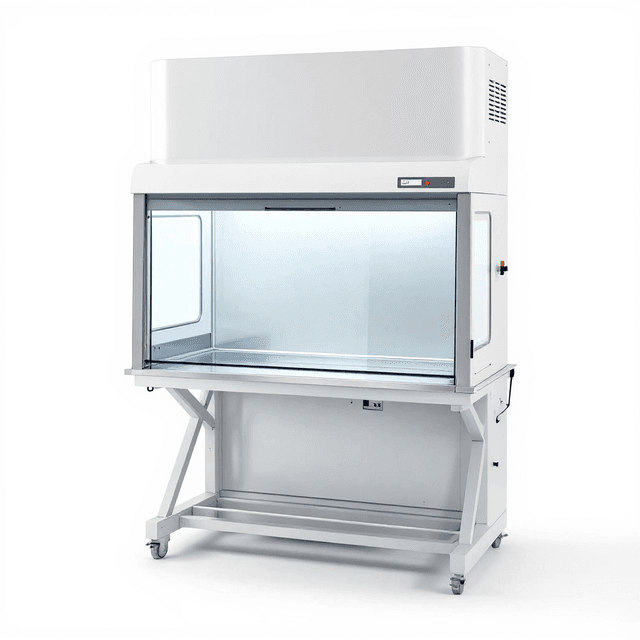
The ConductScience Air Purifier (BIO-0073) provides Class 100 cleanroom-grade air filtration for research environments requiring controlled particulate contamination. This unit combines dual-stage filtration with germicidal UV sterilization to maintain air quality standards in laboratory spaces up to 20 square meters.
The system employs a primary pre-filter followed by a HEPA filter achieving 99.99% efficiency at 0.3 micrometers, coupled with a 253.7 nanometer UV germicidal lamp for microbial decontamination. Three adjustable air speed settings allow researchers to balance filtration performance with noise levels, maintaining operation at ≤58dB for noise-sensitive applications.
How It Works
The air purification system operates through a three-stage process combining mechanical filtration with photochemical sterilization. Ambient air first passes through a primary filter that removes larger particulates and debris, protecting the downstream HEPA filter from premature loading.
The HEPA filter stage employs dense fibrous media to capture particles through inertial impaction, interception, and Brownian diffusion mechanisms. The 99.99% efficiency specification at 0.3 micrometers represents the most penetrating particle size, ensuring higher efficiency for both larger and smaller particles.
Following filtration, air passes by a germicidal UV lamp emitting at 253.7 nanometers, the peak absorption wavelength for DNA/RNA damage in microorganisms. This UV-C radiation disrupts nucleic acid structures, providing microbial inactivation as a secondary decontamination mechanism before air discharge to the workspace.
Features & Benefits
Automation Level
- semi-automated
External Size(W*D*H)
- 900*150*1550mm
Filter
- Primary filter, HEPA filter
HEPA Filter
- 99.99% efficiency at 0.3μm
UV Lamp
- Germicidal UV lamp, Emission of 253.7 nanometers for most efficient decontamination
Optimal Space
- ≤20m²
Noise
- ≤58dB
Consumption
- 240W
Adjustable Air Speed
- 3 levels
Cleanness at Outlet
- Class 100
Package Size(W*D*H)
- 1800*440*1050mm
Brand
- ConductScience
Research Domain
- Analytical Chemistry
- Cell Biology
- Environmental Monitoring
- Materials Science
- Microbiology
- Pharmaceutical QC
Power/Voltage
- AC220V±10%, 50/60Hz; 110V±10%, 60Hz
Weight
- 78kg
Shipping weight
- 78.0 lb
Shipping box
- L: 155.0 cm
- W: 90.0 cm
- H: 15.0 cm
| Feature | This Product | Typical Alternative | Advantage |
|---|---|---|---|
| HEPA Efficiency Rating | 99.99% at 0.3μm | Entry-level units often provide 99.95% or lower efficiency ratings | Higher efficiency removes more submicron particles that could interfere with sensitive analytical work |
| Air Quality Output | Class 100 cleanness standard | Basic models lack specified cleanroom classification | Provides quantified particle count levels suitable for controlled research environments |
| UV Sterilization | 253.7nm germicidal UV lamp integrated | Many units rely solely on mechanical filtration | Dual-mechanism approach addresses both particulate and microbial contamination |
| Coverage Area | Up to 20m² optimal coverage | Smaller units typically cover 10-15m² | Suitable for larger laboratory workspaces and small cleanroom applications |
| Noise Level | ≤58dB operation | Budget models often exceed 60-65dB | Quieter operation suitable for noise-sensitive research and behavioral studies |
| Power Requirements | Dual voltage (110V/220V) compatibility | Single voltage operation limits installation flexibility | International compatibility simplifies laboratory installations and relocations |
This air purifier delivers cleanroom-grade performance through HEPA filtration combined with UV sterilization. The Class 100 output specification and dual voltage compatibility distinguish it from basic air cleaning units.
Practical Tips
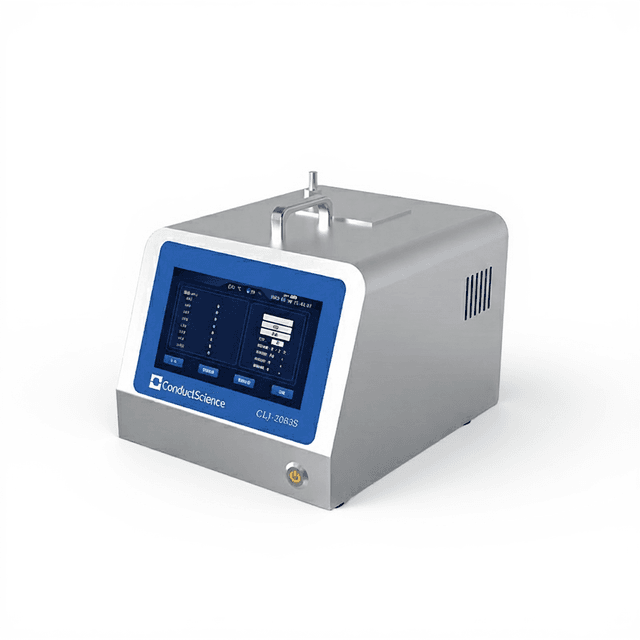
Verify Class 100 output performance monthly using a calibrated particle counter at the air discharge port.
Why: Regular verification ensures consistent air quality output and identifies filter degradation before it affects research.
Replace primary filter more frequently than HEPA filter to prevent premature loading of the expensive HEPA element.
Why: Pre-filtration extends HEPA filter life and maintains system efficiency while reducing operating costs.
Position unit to create positive pressure flow away from critical work areas rather than recirculating air directly over samples.
Why: Directional airflow prevents contaminated air from reaching sensitive procedures while maintaining room cleanliness.
Never bypass UV lamp safety interlocks or operate with housing panels removed during UV operation.
Why: Direct UV-C exposure can cause skin and eye damage; contained operation within the airflow path is essential.
If airflow seems reduced, check for filter clogging before assuming equipment malfunction.
Why: Filter loading is the most common cause of reduced performance and can be resolved without service calls.
Allow 15-30 minutes of operation before beginning critical procedures to achieve steady-state air quality conditions.
Why: Initial startup period is required for UV lamp stabilization and air circulation to reach equilibrium.
Keep spare primary filters in stock as they require more frequent replacement than HEPA elements.
Why: Primary filter availability prevents downtime and ensures continuous protection of the more expensive HEPA filter.
Setup Guide
What’s in the Box
- Air purifier main unit
- Primary filter
- HEPA filter
- UV germicidal lamp
- Power cord
- Installation hardware (typical)
- Operating manual
- Performance specification sheet (typical)
Warranty
ConductScience provides a standard one-year manufacturer warranty covering defects in materials and workmanship. Technical support includes filter replacement guidance and performance troubleshooting assistance.
Compliance
References
Background reading relevant to this product:
What particle size range does the HEPA filter effectively remove?
The HEPA filter achieves 99.99% efficiency at 0.3 micrometers, with higher efficiency for both larger and smaller particles due to different capture mechanisms.
How often should filters be replaced during normal laboratory use?
Filter replacement frequency depends on particulate loading and usage intensity. Monitor pressure differential across filters and replace when airflow drops below specifications or according to manufacturer's maintenance schedule.
Can the UV lamp operate continuously during normal work hours?
The 253.7nm UV lamp is designed for continuous operation within the enclosed airflow path. Direct exposure should be avoided, but contained operation poses no safety concerns.
What is the actual airflow rate at each speed setting?
Specific airflow rates for the three speed levels are not provided in the specifications. Consult the product datasheet for volumetric flow data at each setting.
How does this unit compare to laminar flow hoods for sample protection?
This air purifier provides room air cleaning rather than direct sample protection. For critical sample work, use in conjunction with laminar flow hoods or biological safety cabinets.
What maintenance is required beyond filter replacement?
Routine maintenance includes UV lamp replacement per manufacturer schedule, cleaning of external surfaces, and periodic verification of air quality output using particle counters.
Is the unit suitable for volatile organic compound removal?
The HEPA and primary filters target particulate matter. For chemical vapor control, additional activated carbon filtration would be required.
Have a question about this product?
Have a question? Just ask.
Send it over and we'll email you a personalized answer — no call, no scheduling.
Prefer to talk it through?
Accessories
Enhance your setup with compatible accessories
Frequently Bought Together