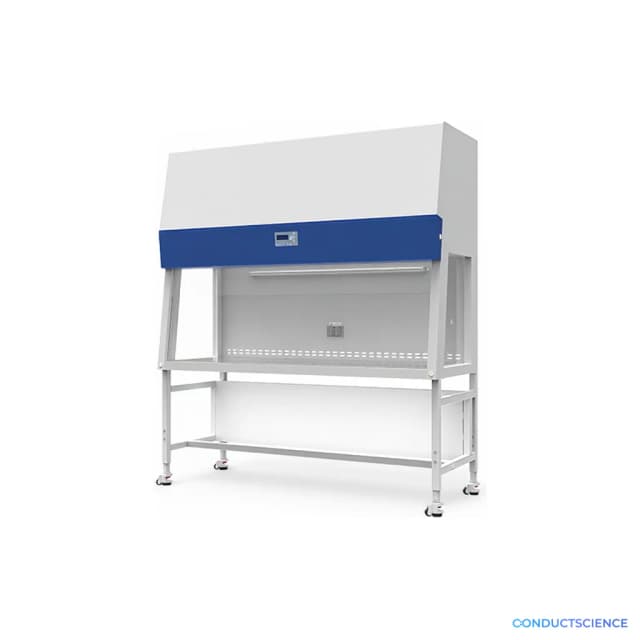
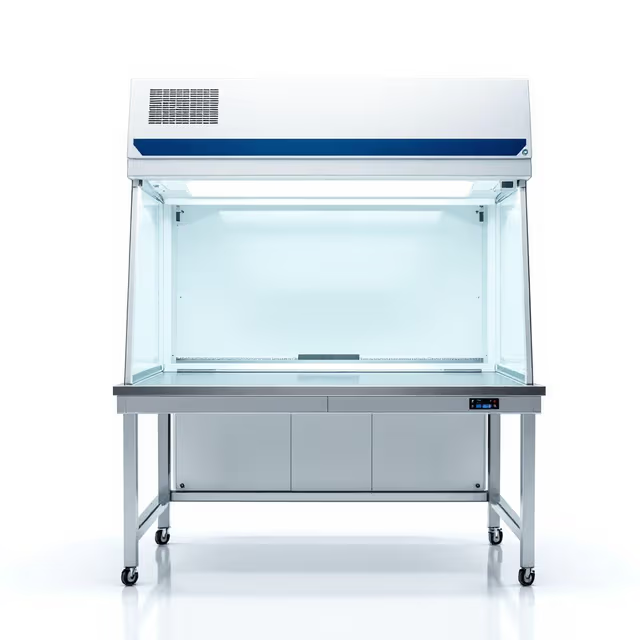
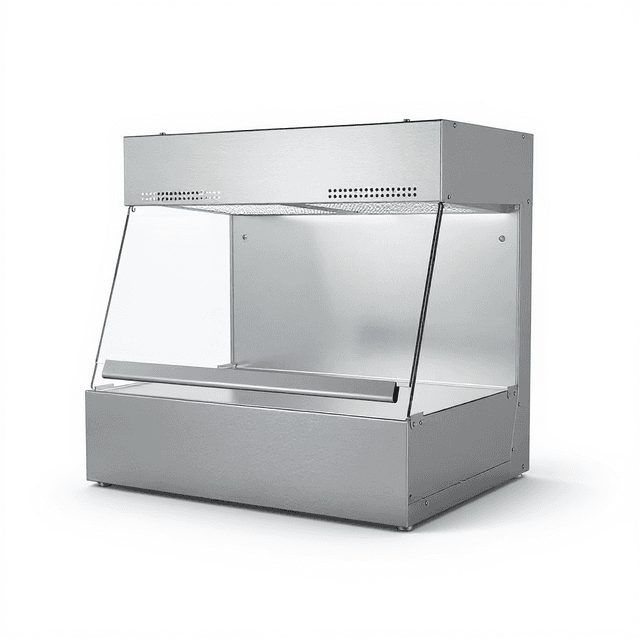
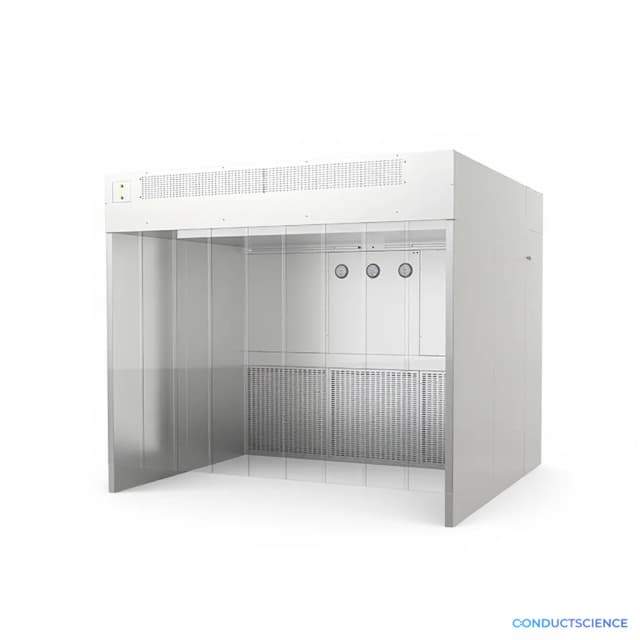
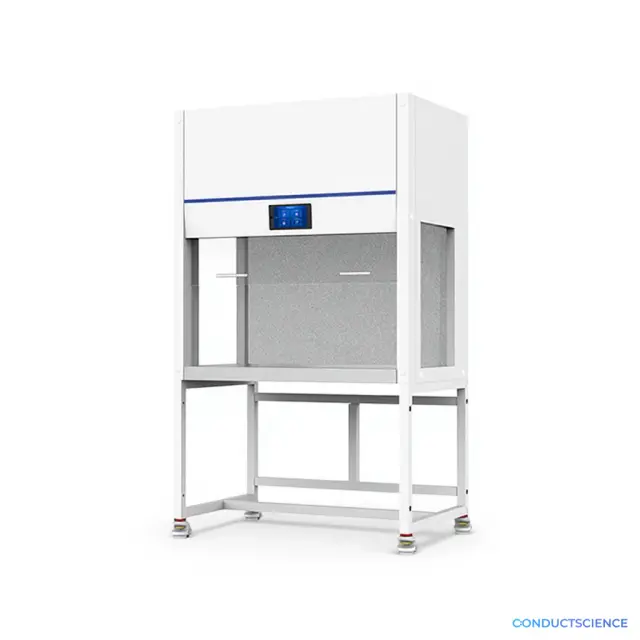
Horizontal Laminar Flow Cabinet
Horizontal laminar flow clean bench providing HEPA-filtered work environment with 204 cm x 130 cm work surface for aseptic laboratory procedures and contamination-sensitive applications.
A laminar flow clean bench protects only the sample. It blows filtered air toward the user, so it is not for infectious or toxic work.

Louise Corscadden, PhD
Director of Science · ConductScience
Ask Louise about Horizontal Laminar Flow Cabinet fit, setup, configuration, or quote prep.
Already working with us? Sign in to connect this with My Scientist.
Key Specifications
Full details →- Model fit
- 2 selectable configurations
- SKU family
- BIO-0041
- Shipping box
- 204.0 x 130.0 x 82.0 cm
- Ordering
- Online checkout and quote request available
- Category
- Clean Benches & Fume Hoods
- Build notes
- Confirm accessories, station layout, and support needs before purchase
The Horizontal Laminar Flow Cabinet provides a contamination-free work environment through continuous horizontal HEPA-filtered air flow across the work surface. This clean bench design directs sterile air horizontally from the rear of the cabinet toward the operator, creating a positive pressure barrier that prevents airborne contaminants from entering the work zone. The cabinet features a spacious 204 cm x 130 cm work surface suitable for a wide range of laboratory applications requiring aseptic conditions.
The unit incorporates a single-stage HEPA filtration system that removes particles ≥0.3 micrometers at 99.97% efficiency, establishing ISO Class 5 (Class 100) cleanliness levels within the work zone. The horizontal airflow pattern makes this cabinet particularly suitable for applications where sample protection is the primary concern, though operators must follow proper aseptic technique as the open front design provides limited personnel protection compared to biological safety cabinets.
How It Works
The horizontal laminar flow cabinet operates on the principle of unidirectional air displacement to maintain a sterile work environment. Room air is drawn through a pre-filter to remove large particles, then passes through a high-efficiency particulate air (HEPA) filter rated at 99.97% efficiency for particles ≥0.3 micrometers. The filtered air is then distributed uniformly across the full width of the work surface through a diffuser plenum.
The horizontal airflow pattern creates a continuous stream of sterile air moving from the rear of the cabinet toward the open front at a velocity typically maintained between 0.3-0.5 m/s. This positive pressure differential prevents room air from entering the work zone while continuously sweeping away particles generated by materials or procedures within the cabinet. The laminar (non-turbulent) flow characteristics ensure that contamination generated at one location within the work zone does not cross-contaminate other areas.
The open-front design allows easy access to the work surface while maintaining product protection, though it provides minimal protection for the operator from hazardous materials. The cabinet relies on proper aseptic technique and workflow planning to prevent disruption of the protective air barrier through arm movements or improper placement of materials.
Features & Benefits
Shipping weight
- 254.0 lb
Shipping box
- L: 204.0 cm
- W: 130.0 cm
- H: 82.0 cm
| Feature | This Product | Typical Alternative | Advantage |
|---|---|---|---|
| Work Surface Dimensions | 204 cm x 130 cm work area | Smaller benchtop models often provide 100-150 cm width | Accommodates larger equipment setups and multiple simultaneous procedures without workspace constraints. |
| Cabinet Height Profile | 82 cm total height | Taller models may exceed 100 cm height | Fits under standard laboratory ceiling installations while maintaining ergonomic access. |
| Construction Weight | 254 kg unit weight | Lighter units typically 150-200 kg | Substantial construction provides vibration-free operation and stable airflow conditions during extended use. |
| Airflow Design | Horizontal laminar flow pattern | Vertical flow models direct air downward | Easier access to tall equipment and better visibility of work procedures without head interference. |
| Access Configuration | Full open-front design | Some models include partial front barriers | Unrestricted access to entire work surface allows flexible arrangement of equipment and materials. |
This cabinet offers a generous 204 cm x 130 cm work surface in a compact 82 cm height profile, suitable for laboratories requiring substantial sterile workspace. The substantial 254 kg construction weight indicates robust blower and filtration systems designed for continuous operation. The horizontal airflow configuration provides excellent access to tall equipment while maintaining product protection.
| Model | SKU | Listed price | Status | Shipping box |
|---|---|---|---|---|
| BBS-H1800-I | BIO-0041 | $5,490.00 | Available | 204.0 x 130.0 x 82.0 cm |
| BBS-H1300-I | BIO-0041 | $4,990.00 | Available | 204.0 x 130.0 x 82.0 cm |
Practical Tips
Verify airflow velocity quarterly using a calibrated anemometer at multiple points across the work surface.
Why: Ensures consistent protective air barrier and early detection of HEPA filter loading.
Replace pre-filters every 3-6 months or when pressure differential increases significantly.
Why: Extends HEPA filter life and maintains optimal airflow performance.
Allow cabinet to run for 15-30 minutes before beginning sterile procedures.
Why: Establishes stable airflow conditions and purges residual particulates from the work zone.
Work from clean to dirty areas, moving materials from rear to front of the cabinet.
Why: Takes advantage of horizontal airflow direction to prevent cross-contamination between samples.
Never use for procedures involving volatile chemicals or biological hazards requiring containment.
Why: Open-front design provides no operator protection from hazardous materials or vapors.
Perform smoke visualization tests monthly to verify proper airflow patterns.
Why: Visual confirmation of laminar flow helps identify disruptions that could compromise sterile conditions.
If airflow becomes uneven, check for obstructions in the plenum or damaged diffuser screens.
Why: Uniform air distribution is critical for maintaining consistent protection across the entire work surface.
Setup Guide
What’s in the Box
- Horizontal laminar flow cabinet main unit
- HEPA filter (pre-installed)
- Power cord and electrical connections
- Operating manual and installation guide
- Airflow velocity certification (typical)
- Pre-filter replacement set (typical)
Warranty
ConductScience provides a standard 1-year manufacturer warranty covering blower motor, electrical components, and structural elements, with technical support available for installation and operational questions.
Compliance
What airflow velocity should I expect across the work surface?
Typical horizontal laminar flow cabinets maintain 0.3-0.5 m/s velocity across the work surface. Consult product datasheet for specific velocity specifications and verification procedures.
How often should the HEPA filter be replaced?
HEPA filter replacement depends on usage frequency and ambient air quality, typically every 1-3 years. Monitor pressure differential across the filter and replace when airflow velocity drops below specifications.
Can this cabinet be used for handling hazardous materials?
No, the open-front design provides product protection but minimal operator protection. Use biological safety cabinets for hazardous materials requiring containment.
What maintenance is required for reliable operation?
Regular cleaning of work surfaces, periodic airflow velocity verification, and pre-filter replacement every 3-6 months depending on ambient air quality.
How do I verify the cabinet is maintaining sterile conditions?
Perform periodic environmental monitoring using settle plates or active air sampling, and conduct smoke visualization tests to verify proper airflow patterns.
What clearance space is needed around the cabinet?
Maintain at least 30 cm clearance on sides and rear for service access, and avoid placement near air conditioning vents or high-traffic areas that create air turbulence.
Can I place equipment inside the cabinet during operation?
Yes, but avoid blocking air intake or disrupting airflow patterns. Place equipment toward the rear of the work surface and leave clear pathways for air movement.
Have a question about this product?
Have a question? Just ask.
Send it over and we'll email you a personalized answer — no call, no scheduling.
Prefer to talk it through?
Upgrade Options