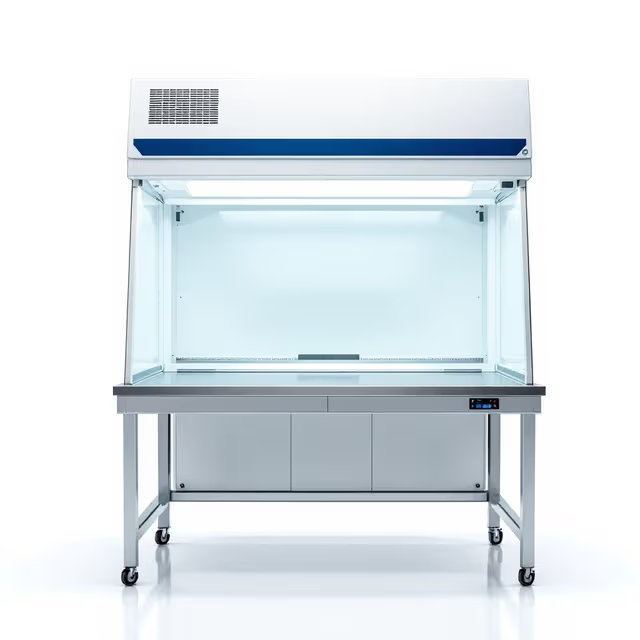
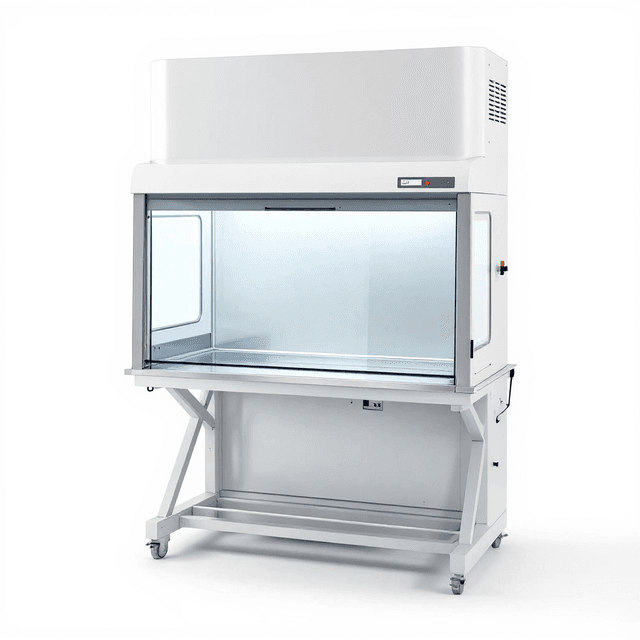
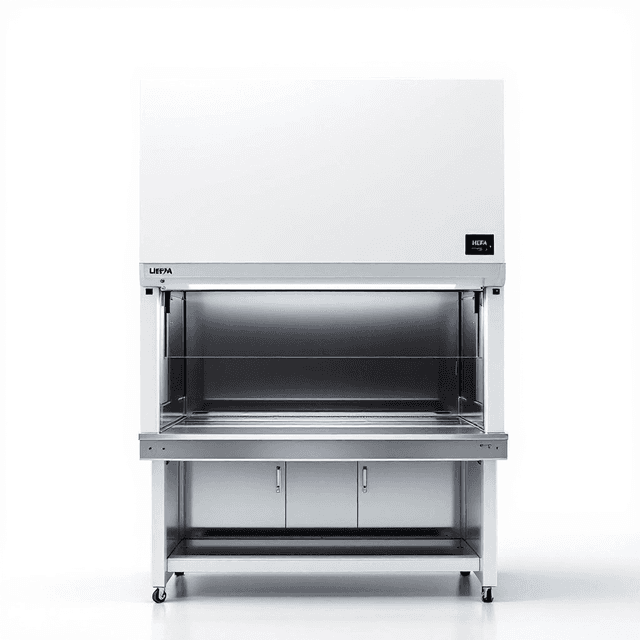
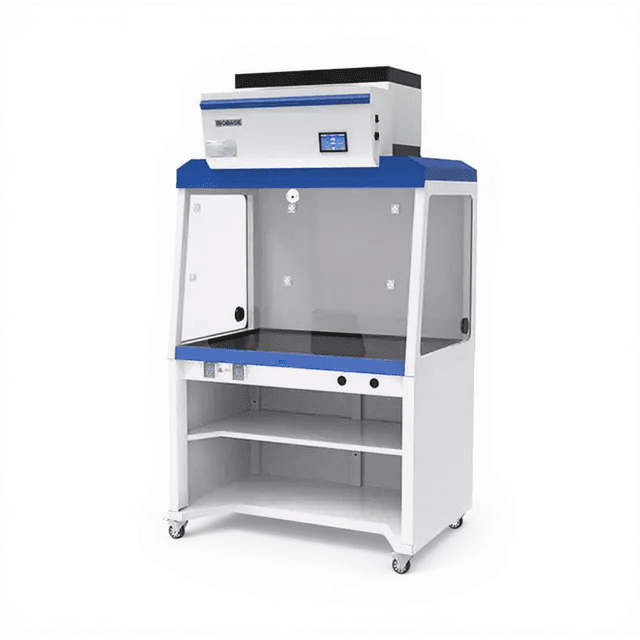
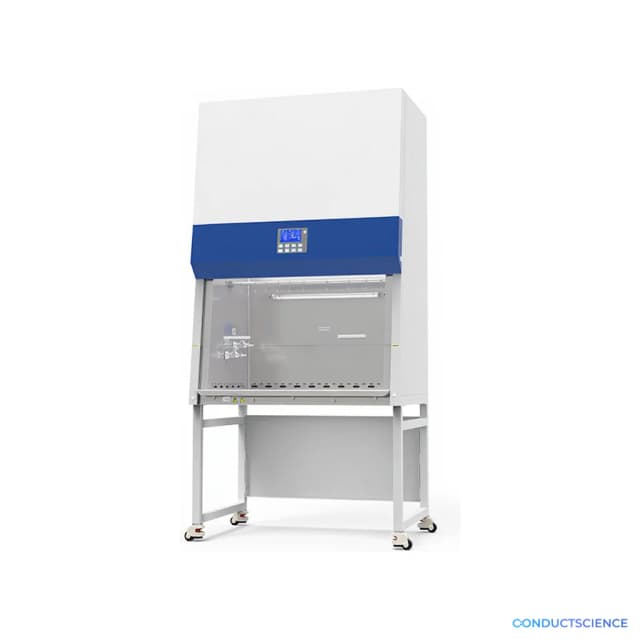
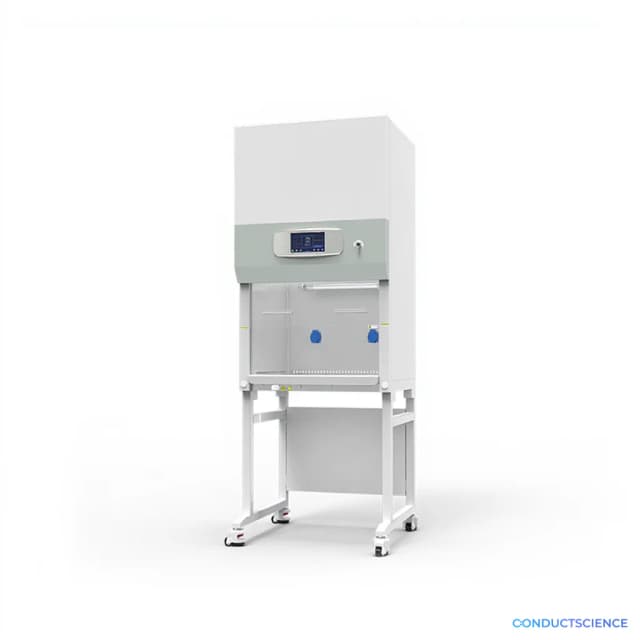
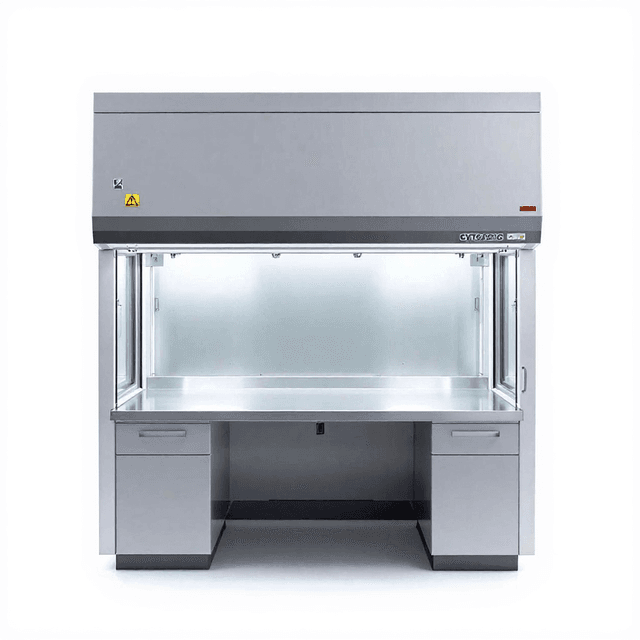
ETL Certified Horizontal Laminar Flow Cabinet
ETL certified horizontal laminar flow cabinet with HEPA filtration (99.995% at 0.3μm) providing Class 100 clean air environment for sterile work applications.
A laminar flow clean bench protects only the sample. It blows filtered air toward the user, so it is not for infectious or toxic work.

Louise Corscadden, PhD
Director of Science · ConductScience
Ask Louise about ETL Certified Horizontal Laminar Flow Cabinet fit, setup, configuration, or quote prep.
Already working with us? Sign in to connect this with My Scientist.
Key Specifications
Full details →- Model fit
- Configured during quote
- SKU family
- BIO-0042
- Shipping box
- 60.0 x 70.0 x 50.0 cm
- Ordering
- Online checkout and quote request available
- Category
- Clean Benches & Fume Hoods
- Build notes
- Confirm accessories, station layout, and support needs before purchase
The ETL Certified Horizontal Laminar Flow Cabinet provides Class 100 (ISO 5) clean air protection for sterile work applications requiring horizontal unidirectional airflow. This cabinet features a single-stage HEPA filtration system with 99.995% efficiency at 0.3 micrometers, delivering consistent airflow velocities between 80-99 feet per minute across the work surface. The horizontal airflow pattern directs filtered air from the rear plenum across the work area toward the operator, making it suitable for applications where product protection is the primary concern.
Available in multiple work surface widths from 700mm to 1700mm internal dimensions, the cabinet accommodates varying workflow requirements while maintaining uniform air distribution. The adjustable work surface height (750-1010mm) and 440mm maximum opening provide ergonomic access for extended operations. An LCD display provides real-time monitoring of airflow parameters and system status, supporting documentation requirements for controlled environment applications.
How It Works
The horizontal laminar flow cabinet operates on the principle of unidirectional airflow to create a sterile work environment. Air enters the system through a polyester fiber pre-filter, which removes larger particulates and extends HEPA filter life. The pre-filtered air then passes through a HEPA filter with 99.995% efficiency at 0.3 micrometers, effectively removing bacteria, fungi, and submicron particles.
The filtered air is distributed through a perforated rear plenum to create uniform horizontal airflow across the entire work surface. This unidirectional flow pattern sweeps airborne contaminants away from the work area toward the front opening, maintaining ISO Class 5 (Class 100) cleanliness levels. The constant airflow velocity of 80-99 feet per minute ensures consistent particle removal without creating turbulence that could redistribute contaminants.
The LCD display continuously monitors airflow velocity and system parameters, alerting operators to any deviations from specified operating conditions. The adjustable work surface height and controlled opening dimensions maintain proper airflow characteristics while providing ergonomic access for laboratory procedures.
Features & Benefits
Automation Level
- manual
BBS-H1100
- BBS-H1300
BBS-H1500
- BBS-H1800
External Size(W*D*H)
- 800*810*(1720~1980)mm
1100*810*(1720~1980)mm
- 1300*810*(1720~1980)mm
1500*810*(1720~1980)mm
- 1800*810*(1720~1980)mm
Internal Size(W*D*H)
- 700*500*600mm
1000*500*600mm
- 1200*500*600mm
1400*500*600mm
- 1700*500*600mm
Work Surface Height
- 750~1010mm
Max Opening
- 440mm
Airflow Velocity
- 80~99fpm
Pre-Filter
- Polyester fiber
HEPA Filter
- One, 99.995% efficiency at 0.3μm
Brand
- ConductScience
Research Domain
- Analytical Chemistry
- Cell Biology
- Environmental Monitoring
- Industrial Hygiene
- Microbiology
- Pharmaceutical QC
Display Type
- LCD display
Shipping weight
- 150.0 lb
Shipping box
- L: 60.0 cm
- W: 70.0 cm
- H: 50.0 cm
| Feature | This Product | Typical Alternative | Advantage |
|---|---|---|---|
| HEPA Filter Efficiency | 99.995% at 0.3μm | Entry-level models often provide 99.97% efficiency | Higher efficiency provides greater assurance of submicron particle removal for critical applications |
| Airflow Velocity Range | 80-99 fpm adjustable | Fixed velocity systems offer less flexibility | Adjustable velocity allows optimization for specific procedures and materials |
| Work Surface Adjustment | 750-1010mm height range | Many models offer limited or no height adjustment | Ergonomic flexibility reduces operator fatigue during extended procedures |
| Size Options | Five widths from 700-1700mm internal | Fewer size options limit workflow optimization | Multiple configurations accommodate different laboratory space and throughput requirements |
| Display Interface | LCD parameter display | Basic models may lack digital displays | Real-time monitoring supports documentation requirements and troubleshooting |
| Safety Certification | ETL certified | Not all models carry third-party electrical certification | Independent safety validation provides assurance for institutional compliance requirements |
This cabinet combines adjustable airflow control, multiple size configurations, and comprehensive monitoring in an ETL-certified package. The 99.995% HEPA efficiency and flexible work surface height provide reliable performance across diverse sterile work applications.
Practical Tips
Verify airflow velocity at nine points across the work surface using a calibrated anemometer to ensure uniform distribution.
Why: Non-uniform airflow can create dead zones where contamination may accumulate.
Replace pre-filters monthly or when visibly loaded to maintain optimal HEPA filter performance and lifespan.
Why: Clogged pre-filters increase system pressure and reduce overall filtration efficiency.
Work at least 6 inches inside the cabinet opening to ensure procedures remain within the protected airflow zone.
Why: Working too close to the opening exposes materials to unfiltered room air and potential contamination.
If airflow velocity drops below specification, check pre-filter loading before assuming HEPA filter replacement is needed.
Why: Pre-filter restriction is the most common cause of reduced airflow and is less expensive to remedy.
Document airflow velocity readings and filter change dates to establish performance trends over time.
Why: Historical data helps predict maintenance needs and supports validation documentation requirements.
Never block the air intake or exhaust areas with equipment or materials during operation.
Why: Airflow restriction can cause system imbalance and compromise sterile conditions within the cabinet.
Minimize rapid movements within the cabinet to prevent disruption of laminar airflow patterns.
Why: Turbulent air can carry contaminants into the sterile work zone and compromise procedure integrity.
Clean the work surface with appropriate disinfectants after each use and allow complete drying before storage.
Why: Residual moisture can support microbial growth and compromise subsequent sterile procedures.
Setup Guide
What’s in the Box
- Laminar flow cabinet main unit
- HEPA filter (installed)
- Polyester pre-filter
- Power cable
- Installation manual
- Performance certification (typical)
- Operation and maintenance guide (typical)
Warranty
ConductScience provides a standard one-year manufacturer warranty covering defects in materials and workmanship, with technical support available for installation guidance and troubleshooting assistance.
Compliance
What airflow velocity should I expect across different areas of the work surface?
The cabinet maintains 80-99 fpm velocity across the work surface with uniform distribution. Verify performance with a calibrated anemometer at multiple points, especially near edges and corners where velocity may vary slightly.
How often should the HEPA filter be replaced?
HEPA filter replacement frequency depends on usage and pre-filter maintenance. Monitor pressure drop across the filter and replace when airflow velocity cannot be maintained within specification or when DOP testing indicates reduced efficiency.
Can this cabinet be used for handling cytotoxic materials?
This horizontal flow cabinet provides product protection but not operator protection. For cytotoxic materials, consider a biological safety cabinet with appropriate containment classification.
What type of work surface cleaning is recommended?
Use 70% isopropanol or appropriate disinfectant compatible with the work surface material. Allow complete evaporation before beginning sterile work to prevent chemical interference with procedures.
How long should the cabinet run before beginning sterile work?
Allow minimum 15-30 minutes warm-up time for airflow stabilization. Some applications may require longer equilibration periods based on specific sterility requirements.
What are the electrical requirements for installation?
Consult product datasheet for specific voltage and amperage requirements. Ensure dedicated circuit with appropriate overcurrent protection and grounding per local electrical codes.
Can multiple operators work at the cabinet simultaneously?
Work surface width varies by model (700-1700mm internal). Larger models can accommodate multiple operators if workflow permits, but consider potential airflow disruption from excessive movement.
Have a question about this product?
Have a question? Just ask.
Send it over and we'll email you a personalized answer — no call, no scheduling.
Prefer to talk it through?
Upgrade Options