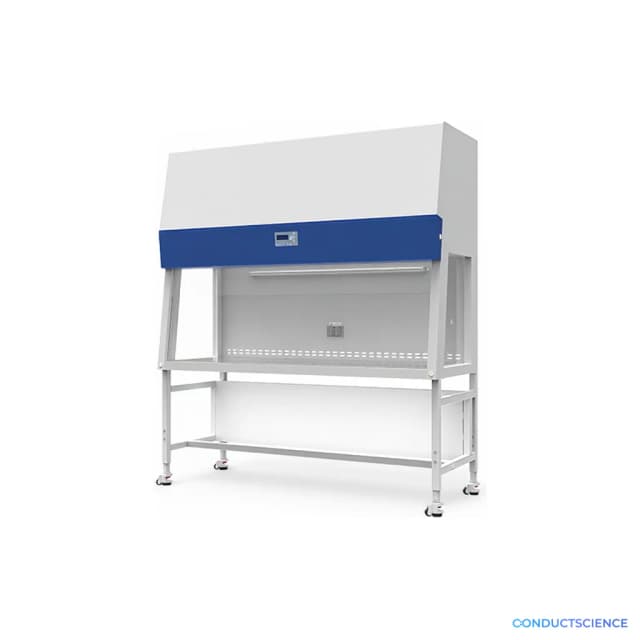
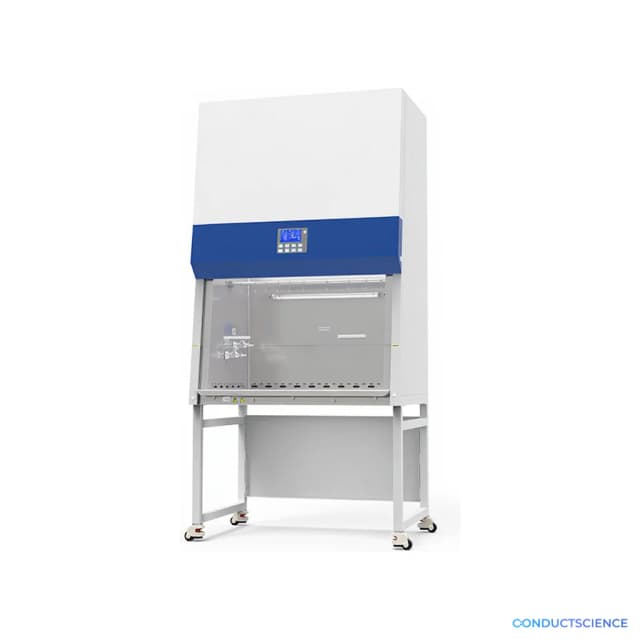
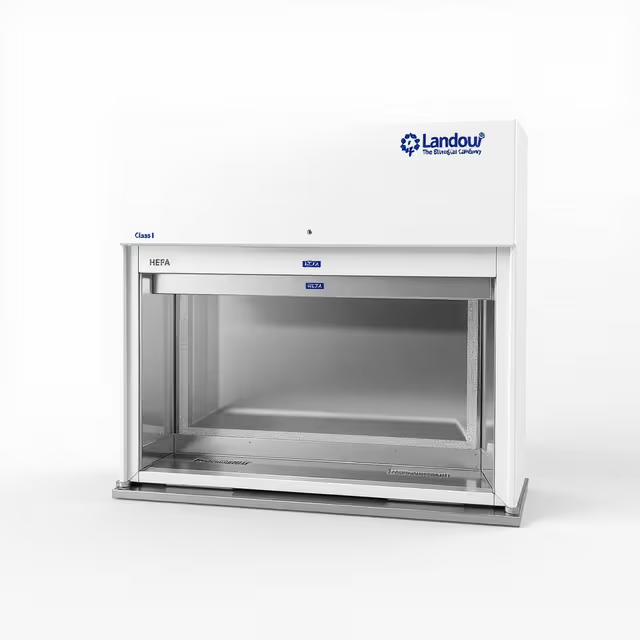
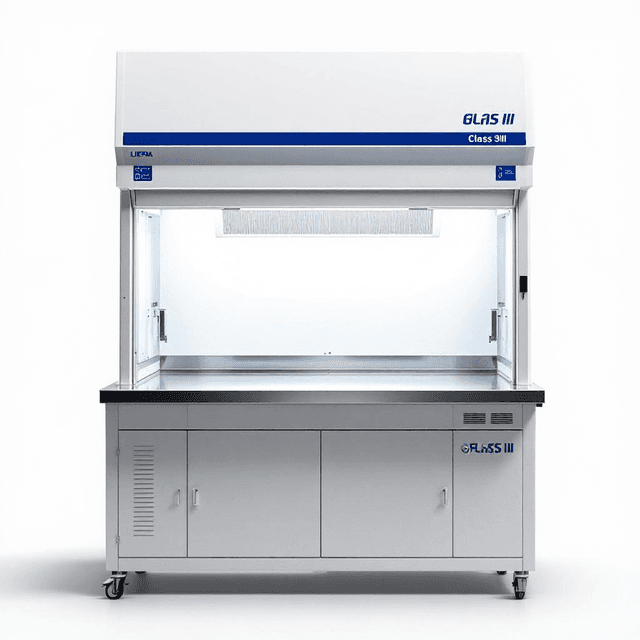
Horizontal Laminar Flow Cabinet
Horizontal laminar flow cabinet with HEPA filtration providing Class 100 work environment for sterile procedures and contamination-sensitive sample handling.
A laminar flow clean bench protects only the sample. It blows filtered air toward the user, so it is not for infectious or toxic work.

Louise Corscadden, PhD
Director of Science · ConductScience
Ask Louise about Horizontal Laminar Flow Cabinet fit, setup, configuration, or quote prep.
Already working with us? Sign in to connect this with My Scientist.
Key Specifications
Full details →- Model fit
- Configured during quote
- SKU family
- BIO-0039
- Shipping box
- 178.0 x 110.0 x 82.0 cm
- Ordering
- Online checkout and quote request available
- Category
- Clean Benches & Fume Hoods
- Build notes
- Confirm accessories, station layout, and support needs before purchase
This horizontal laminar flow cabinet provides a contamination-controlled work environment for sterile procedures and sensitive sample handling. The unit generates unidirectional horizontal airflow through a HEPA filter system, creating a Class 100 work zone suitable for cell culture, media preparation, and other applications requiring particulate contamination control.
The cabinet features a 1000×500×570mm internal work chamber with 0.2-0.45 m/s adjustable airflow velocity and 99.995% filtration efficiency at 0.3 micrometers. Manual front window operation allows ergonomic access while maintaining containment, with LCD display monitoring of system parameters and environmental conditions.
How It Works
The horizontal laminar flow cabinet operates on the principle of unidirectional airflow filtration. Room air is drawn into the cabinet through a polyester fiber pre-filter, which removes larger particulates and protects the downstream HEPA filter from premature loading.
The pre-filtered air then passes through a high-efficiency particulate air (HEPA) filter with 99.995% efficiency at 0.3 micrometers, removing bacteria, fungal spores, and other airborne contaminants. The filtered air flows horizontally across the work surface at 0.2-0.45 m/s, creating a laminar (non-turbulent) airflow pattern that sweeps contaminants away from the work area toward the front opening.
This continuous positive pressure environment prevents ambient room air from entering the work zone, while the horizontal airflow direction protects samples and materials from operator-generated contamination. The manual front window provides access control while maintaining airflow integrity during operations.
Features & Benefits
Automation Level
- manual
External Size(W*D*H)
- 1100*820*1780mm
Internal Size(W*D*H)
- 1000*500*570mm
Work Surface Height
- 750mm(Customized)
Safety Height
- 200mm
Max Opening
- 320mm
Airflow Velocity
- 0.2~0.45m/s
Pre-filter
- Polyester fiber
HEPA Filter
- One, 99.995% efficiency at 0.3μm
Front Window
- Manual
Noise
- ≤65dB(A)
Illumination
- ≥300lx
Vibration
- ≤5μm(rms)
Safety
- Colonies number≤0.5CFU/30min
Brand
- ConductScience
Research Domain
- Analytical Chemistry
- Cell Biology
- Clinical Diagnostics
- Materials Science
- Microbiology
- Pharmaceutical QC
Display Type
- LCD display
Shipping weight
- 235.0 lb
Shipping box
- L: 178.0 cm
- W: 110.0 cm
- H: 82.0 cm
| Feature | This Product | Typical Alternative | Advantage |
|---|---|---|---|
| HEPA Filter Efficiency | 99.995% at 0.3μm | Entry-level models often offer 99.97% efficiency | Higher filtration efficiency provides superior particulate removal for critical sterile applications. |
| Work Chamber Size | 1000×500×570mm internal | Compact units typically offer smaller work areas | Larger work chamber accommodates multiple culture dishes and equipment for increased productivity. |
| Airflow Control | Adjustable 0.2-0.45 m/s | Fixed airflow models provide limited adjustment | Variable airflow allows optimization for different procedures and materials while maintaining laminar characteristics. |
| System Monitoring | LCD display with parameter monitoring | Basic models may lack digital displays | Real-time system monitoring enables immediate detection of performance deviations. |
| Noise Level | ≤65 dB(A) | Standard units may operate at higher noise levels | Quiet operation reduces operator fatigue during extended use periods. |
| Work Surface Height | 750mm (customizable) | Fixed height designs offer limited ergonomic adjustment | Customizable height improves operator comfort and reduces ergonomic strain. |
This cabinet combines high-efficiency HEPA filtration with adjustable airflow control and comprehensive monitoring in a spacious work chamber design. The customizable work surface height and quiet operation enhance usability for extended laboratory procedures.
Practical Tips
Perform airflow velocity measurements quarterly using a calibrated anemometer at multiple points across the work surface.
Why: Regular velocity verification ensures maintained laminar flow characteristics essential for contamination control.
Replace the polyester pre-filter every 3-6 months or when pressure differential indicators show increased resistance.
Why: Pre-filter maintenance protects the expensive HEPA filter from premature loading and extends its service life.
Allow the cabinet to operate for 15 minutes before use and avoid sudden movements within the work chamber.
Why: Airflow stabilization time and gentle movements maintain laminar flow integrity and prevent turbulence.
Never use the cabinet for procedures involving volatile chemicals or hazardous biological materials.
Why: Horizontal flow cabinets provide no operator protection and are designed only for sterile work with non-hazardous materials.
Document filter replacement dates and airflow verification results in a maintenance log.
Why: Systematic record-keeping supports validation requirements and enables trending of system performance over time.
If airflow appears turbulent, check for obstructions in the work chamber and verify the front window position.
Why: Proper airflow patterns are essential for contamination control and can be disrupted by equipment placement or window height.
Position frequently used materials on the upstream side of the work chamber and work from clean to potentially contaminated areas.
Why: Strategic material placement utilizes the horizontal airflow to prevent cross-contamination between samples.
Setup Guide
What’s in the Box
- Horizontal laminar flow cabinet main unit
- HEPA filter (pre-installed)
- Polyester fiber pre-filter (pre-installed)
- Power cord
- User manual and operating instructions (typical)
- Airflow certification documentation (typical)
Warranty
ConductScience provides standard one-year manufacturer warranty covering defects in materials and workmanship, with technical support for installation and operation guidance.
Compliance
What class of cleanroom environment does this cabinet provide?
The cabinet creates a Class 100 (ISO 5) work environment with HEPA filtration achieving 99.995% efficiency at 0.3 micrometers and horizontal laminar airflow.
How do I verify proper airflow performance?
Use smoke tubes or airflow visualization methods to confirm laminar flow pattern across the work surface, and verify airflow velocity is within the 0.2-0.45 m/s specification using an anemometer.
What maintenance is required for the filtration system?
Monitor pressure differential across filters using system indicators, replace pre-filter as needed based on loading, and schedule annual HEPA filter integrity testing with replacement when efficiency degrades.
Can this cabinet accommodate standard laboratory equipment?
The 1000×500mm work surface can accommodate standard cell culture dishes, small centrifuges, and reagent bottles, with 570mm internal height for most laboratory equipment.
What safety precautions should be followed during operation?
Maintain the 200mm safety clearance above work surface, avoid blocking airflow patterns with large equipment, and ensure proper decontamination procedures between different sample types.
How does this compare to vertical laminar flow cabinets?
Horizontal flow provides direct protection of samples from operator contamination but does not protect the operator from sample exposure, making it suitable for sterile work with non-hazardous materials.
What environmental conditions are required for proper operation?
Install in low-traffic area away from air currents, with stable electrical supply and ambient conditions that allow the cabinet to maintain specified airflow and noise parameters.
Have a question about this product?
Have a question? Just ask.
Send it over and we'll email you a personalized answer — no call, no scheduling.
Prefer to talk it through?