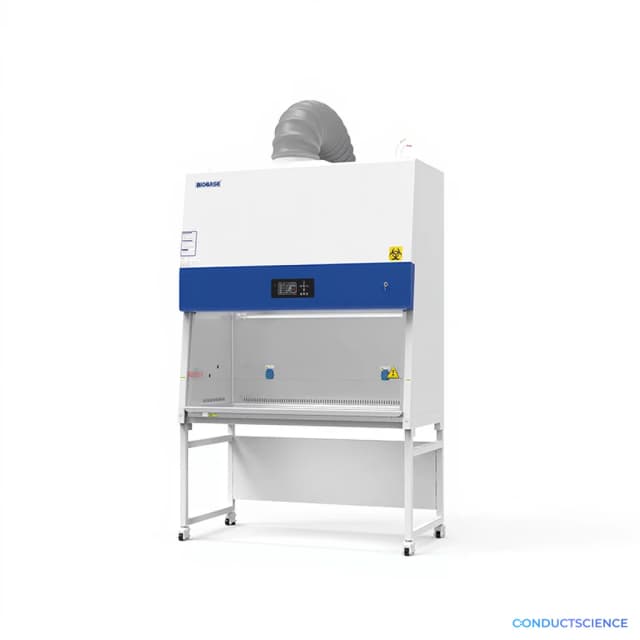
Double-side Class II A2 Biological Safety Cabinet
Class II A2 biological safety cabinet with dual ULPA filtration and two-sided access for sterile cell culture and microbiology applications.

Louise Corscadden, PhD
Director of Science · ConductScience
Ask Louise about Double-side Class II A2 Biological Safety Cabinet fit, setup, configuration, or quote prep.
Already working with us? Sign in to connect this with My Scientist.
Key Specifications
Full details →- Model fit
- Configured during quote
- SKU family
- BIO-0013
- Shipping box
- 222.0 x 150.0 x 78.5 cm
- Ordering
- Online checkout and quote request available
- Category
- Clean Benches & Fume Hoods
- Build notes
- Confirm accessories, station layout, and support needs before purchase
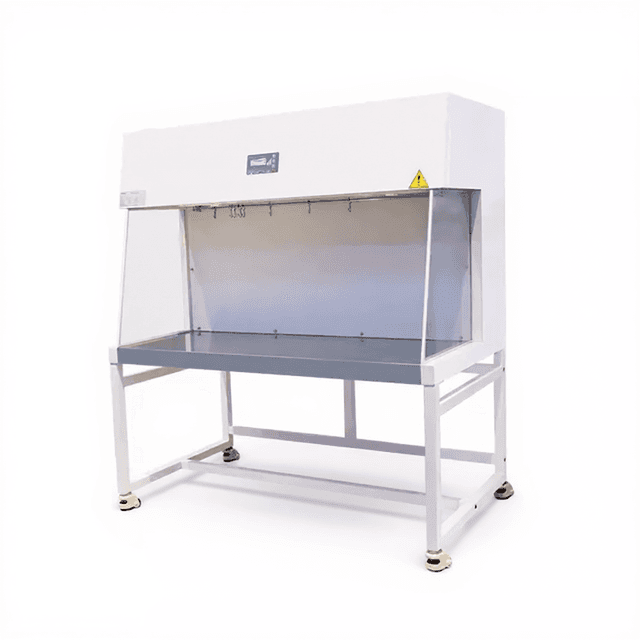
The Double-side Class II A2 Biological Safety Cabinet provides sterile working conditions for cell culture, microbiology, and other biological research applications requiring containment. This cabinet employs dual ULPA filtration with 99.9995% efficiency at 0.12 micrometers to protect both the work surface and operator from biological aerosols.
The unit features two-sided access with an internal workspace of 1160×700×660mm, accommodating multiple researchers or large equipment setups. Controlled airflow maintains precise inflow velocity of 0.48±0.025 m/s and downflow velocity of 0.33±0.025 m/s, creating effective containment barriers while preserving sterile conditions within the work zone.
How It Works
The Class II A2 biological safety cabinet operates on the principle of directional airflow containment combined with ULPA filtration. Room air enters through the front opening and is immediately directed downward, creating an air curtain that prevents contaminants from escaping the work zone. This inflow air combines with ULPA-filtered downflow air to maintain sterile conditions within the workspace.
Two ULPA filters remove 99.9995% of particles at 0.12 micrometers, including bacteria, fungi, and viral particles. The filtered air creates a laminar downflow across the work surface at 0.33±0.025 m/s, while the inflow velocity of 0.48±0.025 m/s ensures adequate containment of aerosols generated during biological manipulations.
The dual-sided design allows access from both front and rear positions, enabling collaborative work or accommodation of large equipment while maintaining proper airflow patterns and contamination control throughout the workspace.
Features & Benefits
Automation Level
- manual
External Size(W*D*H)
- 1500*785*2220mm
Internal Size(W*D*H)
- 1160*700*660mm
Tested Opening
- Safety height 200mm
Max Opening
- 450mm
Inflow Velocity
- 0.48±0.025m/s
Downflow Velocity
- 0.33±0.025m/s
ULPA Filter
- Two, 99.9995% efficiency at 0.12μm, filter life indicator
Front Window
- Two-layer laminated toughened glass≥5mm. Anti UV.
Noise
- ≤67dB
LED Lamp
- 16W*2
Illumination
- ≥1000Lux
Consumption
- 1300W
Socket
- Two, total consumption: 500W
Brand
- ConductScience
Research Domain
- Cell Biology
- Clinical Diagnostics
- Developmental Biology
- Immunology
- Microbiology
- Pharmaceutical QC
Display Type
- LCD display
Shipping weight
- 325.0 lb
Shipping box
- L: 222.0 cm
- W: 150.0 cm
- H: 78.5 cm
| Feature | This Product | Typical Alternative | Advantage |
|---|---|---|---|
| Workspace Dimensions | 1160×700×660mm internal workspace | Entry-level models often provide smaller work areas around 900×600mm | Larger workspace accommodates multiple users and equipment configurations for complex experimental setups |
| Filter Efficiency | 99.9995% efficiency at 0.12 micrometers | Standard HEPA filters typically offer 99.97% at 0.3 micrometers | Superior submicron filtration captures smaller particles including viruses and fine aerosols |
| Access Configuration | Dual-sided access with controlled airflow | Most cabinets provide single-sided front access only | Two-sided design enables collaborative work and flexible equipment positioning while maintaining containment |
| Lighting System | Dual 16W LED providing ≥1000 Lux | Fluorescent lighting systems with lower efficiency | LED technology provides consistent illumination with lower heat generation and longer operational life |
| Opening Height | 200mm safety height, expandable to 450mm maximum | Fixed opening heights around 200-250mm | Variable opening height accommodates different equipment sizes while maintaining optimal containment |
| Electrical Capacity | Two sockets with 500W total capacity | Single socket or limited power availability | Dual socket configuration supports multiple equipment pieces simultaneously |
This Class II A2 cabinet offers enhanced workspace capacity and dual-access functionality compared to standard single-sided models. The ULPA filtration system provides superior submicron particle removal, while the variable opening height and dual electrical sockets accommodate diverse experimental requirements.
Practical Tips
Verify airflow velocities monthly using a calibrated anemometer at the center of each access opening.
Why: Consistent airflow verification ensures containment effectiveness and early detection of filter loading.
Clean the interior surfaces with appropriate disinfectant after each use and perform deep cleaning weekly.
Why: Regular cleaning prevents biofilm formation and maintains sterile conditions for subsequent experiments.
Allow the cabinet to operate for 15 minutes before use and avoid rapid movements within the workspace.
Why: Stabilized airflow patterns and gentle movements prevent disruption of the protective air curtains.
If the filter life indicator shows yellow or red status, contact qualified service personnel immediately.
Why: Compromised filtration can result in contamination or exposure risks requiring immediate attention.
Document LCD display readings during each use session for maintenance tracking and compliance records.
Why: Systematic monitoring creates an audit trail demonstrating consistent performance and regulatory compliance.
Position materials at least 6 inches from the front opening and avoid blocking air intake grilles.
Why: Proper positioning maintains effective containment airflow and prevents contamination escape.
Organize workflow from clean to contaminated areas within the workspace to minimize cross-contamination risk.
Why: Directional workflow reduces the potential for contaminating sterile materials during multi-step procedures.
Monitor noise levels during operation as increases may indicate fan or motor issues requiring service.
Why: Early detection of mechanical problems prevents unexpected downtime and maintains optimal containment performance.
Setup Guide
What’s in the Box
- Double-side Class II A2 Biological Safety Cabinet
- LCD display control panel
- Two ULPA filters (pre-installed)
- Dual LED lighting system
- Power cable
- User manual and operation guide
- Filter life indicator system
- Installation hardware (typical)
- Calibration certificate (typical)
Warranty
ConductScience provides a standard one-year manufacturer warranty covering defects in materials and workmanship. Technical support includes installation guidance, operational training, and maintenance scheduling assistance.
Compliance
What is the maximum size of equipment that can be operated inside this cabinet?
The internal workspace dimensions of 1160×700×660mm accommodate most standard laboratory equipment. Ensure equipment does not obstruct airflow patterns or exceed the 500W electrical capacity of the two built-in sockets.
How often do the ULPA filters need replacement?
Filter replacement frequency depends on usage intensity and particle load. The integrated filter life indicator monitors pressure differential and provides replacement alerts. Consult product datasheet for specific replacement intervals based on your application.
Can this cabinet handle BSL-2 organisms safely?
Class II A2 cabinets are commonly used with BSL-2 organisms when proper containment practices are followed. The 99.9995% filtration efficiency at 0.12 micrometers captures bacteria and most viruses, but specific organism compatibility should be verified with institutional biosafety guidelines.
What maintenance is required for optimal performance?
Regular maintenance includes weekly surface decontamination, monthly airflow verification, quarterly filter status checks, and annual certification by qualified technicians. The LCD display monitors key parameters between formal inspections.
How does the two-sided access affect containment?
The dual-access design maintains containment through controlled airflow patterns from both openings. Each access point follows the same 0.48±0.025 m/s inflow velocity specification to ensure proper air curtain formation.
What types of disinfectants are safe to use inside the cabinet?
Most laboratory-grade disinfectants including 70% ethanol, quaternary ammonium compounds, and phenolic disinfectants are compatible. Avoid bleach or other chlorine-based cleaners that may corrode metal surfaces or damage filters.
Can this cabinet accommodate cell culture flasks larger than T-175?
Yes, the 1160×700mm work surface can accommodate multiple large flasks or roller bottles. Ensure adequate spacing for proper airflow circulation around all culture vessels during manipulation.
How does this compare to laminar flow hoods for cell culture?
Unlike laminar flow hoods that provide product protection only, this Class II cabinet offers both product and personnel protection through containment airflow. This makes it suitable for work with potentially infectious materials or when operator protection is required.
Have a question about this product?
Have a question? Just ask.
Send it over and we'll email you a personalized answer — no call, no scheduling.
Prefer to talk it through?
Replacement Parts & Consumables