Portable Microbial Air Sampler, 100 L/min
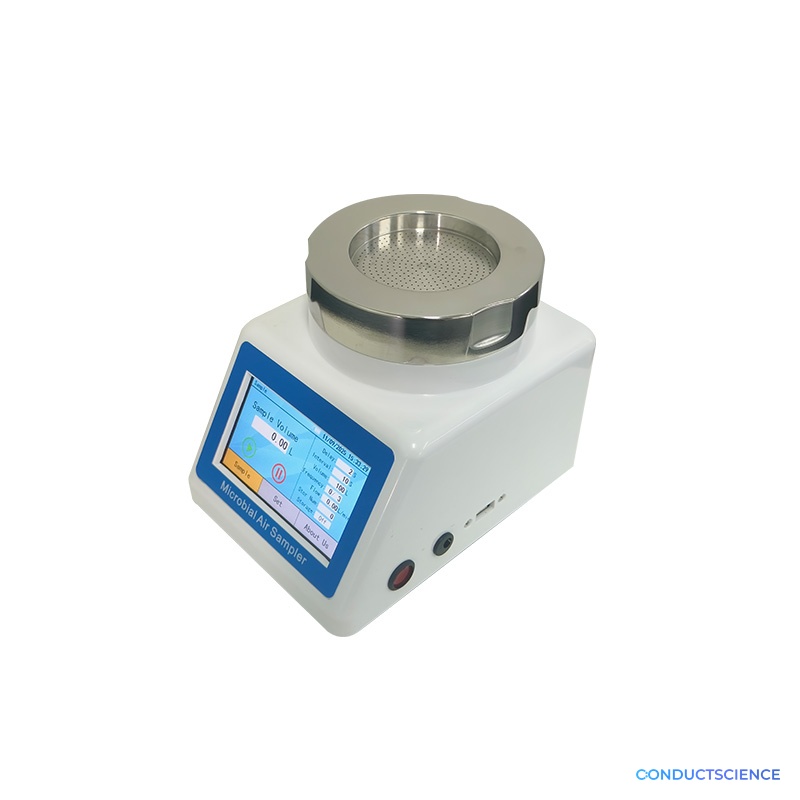
Portable microprocessor-controlled air sampler for biological particle collection at 100 L/min flow rate with battery or AC operation.

Louise Corscadden, PhD
Director of Science · ConductScience
Ask Louise about Portable Microbial Air Sampler, 100 L/min fit, setup, configuration, or quote prep.
Already working with us? Sign in to connect this with My Scientist.
Key Specifications
Full details →- Model fit
- 2 selectable configurations
- SKU family
- Assigned during quote
- Shipping box
- 34.0 x 12.0 x 20.0 cm
- Ordering
- Online checkout and quote request available
- Category
- Air Quality
- Build notes
- Confirm accessories, station layout, and support needs before purchase
The Biological Air Sampler is a portable microprocessor-controlled instrument designed for collection and assessment of airborne biological particles in research and monitoring environments. The system employs a low-noise pump to draw air samples at 100 L/min ±5% through collection media, enabling quantitative analysis of microbial contamination levels in various settings.
Built with anodized aluminum construction for durability, the unit features dual power operation through rechargeable 12V/3000mAh battery or AC mains supply. The compact design (120×200×340mm) and 6-8 hour battery operation facilitate field sampling campaigns and continuous monitoring applications where AC power may be unavailable.
How It Works
The Biological Air Sampler operates on the principle of active air sampling, where a microprocessor-controlled pump draws ambient air through the sampling system at a calibrated flow rate of 100 L/min ±5%. The controlled airflow ensures consistent sample collection volumes essential for quantitative analysis.
Air is drawn through collection media (typically agar plates, impaction surfaces, or filtration substrates) where biological particles are captured based on their size and inertial properties. The low-noise pump design minimizes vibration and operational interference while maintaining precise flow control through integrated microprocessor regulation.
Collected samples can then be processed using standard microbiological techniques including culture-based enumeration, molecular analysis, or microscopic examination depending on the specific research objectives and target organisms.
Features & Benefits
Shipping weight
- 2.0 lb
Shipping box
- L: 34.0 cm
- W: 12.0 cm
- H: 20.0 cm
| Feature | This Product | Typical Alternative | Advantage |
|---|---|---|---|
| Sampling Flow Rate | 100 L/min ±5% | Entry-level models often provide lower flow rates of 50-75 L/min | Higher flow rates enable faster sample collection and improved detection of low-concentration contaminants. |
| Flow Control Accuracy | ±5% precision with microprocessor control | Manual flow control systems may have ±10-15% variation | Precise flow control ensures reproducible sample volumes essential for quantitative microbial analysis. |
| Power Options | Dual AC/DC operation with 6-8 hour battery life | Basic models often require continuous AC power connection | Battery operation enables field sampling and remote location deployment without infrastructure requirements. |
| Construction Material | Anodized aluminum housing | Plastic housings are common in lower-cost alternatives | Metal construction provides superior durability and easier decontamination between sampling campaigns. |
| Weight and Portability | 2kg net weight with compact 120×200×340mm dimensions | Comparable units may weigh 3-5kg with larger form factors | Lightweight design facilitates transport between multiple sampling locations during field studies. |
This biological air sampler combines high flow rate sampling (100 L/min) with microprocessor-controlled precision and dual power operation. The anodized aluminum construction and compact design provide durability and portability for diverse research and monitoring applications.
| Model | SKU | Listed price | Status | Shipping box |
|---|---|---|---|---|
| Battery & AC | BIO-0658 | $2,464.99 | Available | 34.0 x 12.0 x 20.0 cm |
| Battery Only | BIO-0659 | $1,061.99 | Available | 30.0 x 12.0 x 19.5 cm |
Practical Tips
Verify flow rate accuracy using a certified external flow meter before critical sampling campaigns, particularly after transport or extended storage.
Why: Flow rate precision directly affects sample volume calculations and quantitative analysis accuracy.
Clean and inspect pump intake regularly for debris or biological buildup that could affect flow characteristics.
Why: Obstructions can reduce sampling efficiency and compromise flow rate stability during collection periods.
Position the sampler at breathing zone height (1.5m) and away from direct air currents or HVAC outlets when assessing human exposure risks.
Why: Proper positioning ensures representative samples of the air actually inhaled by occupants in the environment.
Monitor battery voltage during extended sampling runs and maintain spare charged batteries for critical field deployments.
Why: Battery depletion during sampling can result in incomplete collection and compromised data quality.
Record ambient temperature, humidity, and wind conditions during sampling as these factors affect particle dispersion and collection efficiency.
Why: Environmental conditions influence microbial viability and distribution, affecting interpretation of sampling results.
Use appropriate PPE and follow biosafety protocols when sampling in potentially contaminated environments or handling collected samples.
Why: Biological air sampling may concentrate pathogenic organisms requiring containment and handling precautions.
Check for pump seal integrity if flow rate deviates from specification, as worn seals can cause pressure losses.
Why: Seal degradation is a common cause of flow rate drift and reduced sampling performance over time.
Setup Guide
What’s in the Box
- Biological Air Sampler main unit
- AC power adapter (110V-220V)
- Rechargeable battery (pre-installed)
- User manual and operation guide
- Calibration certificate (typical)
- Transport case (typical)
Warranty
ConductScience provides a standard one-year manufacturer warranty covering defects in materials and workmanship, along with comprehensive technical support for operational questions and troubleshooting assistance.
Compliance
References
Background reading relevant to this product:
What collection media types are compatible with this air sampler?
The system accommodates standard microbiological collection media including agar plates, gelatin filters, and impaction surfaces. Specific media selection depends on target organisms and downstream analysis requirements.
How accurate is the flow rate control and does it require regular calibration?
Flow rate is maintained at 100 L/min ±5% through microprocessor control. Regular verification with external flow meters is recommended, with formal calibration frequency depending on usage intensity and accuracy requirements.
Can the unit operate in high humidity or temperature environments?
The anodized aluminum construction provides environmental resistance, though specific operating ranges should be confirmed via product datasheet. Condensation prevention may require consideration in high humidity applications.
What is the particle size collection efficiency for different microorganisms?
Collection efficiency varies with particle size, media type, and flow dynamics. Consult product datasheet for specific efficiency curves and validate performance for your target organism size range.
How does battery performance change with temperature and age?
The DC12V/3000mAh battery provides 6-8 hours operation under standard conditions. Performance may decrease in extreme temperatures or with battery aging, requiring monitoring for critical applications.
Is the pump vibration level suitable for sensitive sampling environments?
Low-noise pump design minimizes vibration and operational interference. For extremely vibration-sensitive applications, isolation mounting may be beneficial.
What data logging or connectivity features are available?
Microprocessor control provides operational monitoring, though specific data output capabilities should be verified via product specifications for integration with data management systems.
Have a question about this product?
Have a question? Just ask.
Send it over and we'll email you a personalized answer — no call, no scheduling.
Prefer to talk it through?