Fluoride Test Kit
Analytical test kit for quantitative fluoride determination in water samples using standardized detection methodology.
| Product name | Model No. |
| fluoride test kit | LH2031 |
| Automation Level | manual |
| Brand | ConductScience |

The ConductScience Fluoride Test Kit (Model LH2031) provides analytical capabilities for fluoride ion determination in water samples. This test kit enables quantitative measurement of fluoride concentrations through established analytical chemistry methods, supporting water quality assessments in laboratory and field applications.
The kit includes reagents and instrumentation necessary for fluoride analysis, utilizing ion-selective electrode methodology or colorimetric detection principles commonly employed in water chemistry laboratories. The LH2031 configuration provides researchers with a standardized approach to fluoride quantification across diverse water matrices, from drinking water samples to industrial process streams.
How It Works
Fluoride test kits typically operate through ion-selective electrode (ISE) methodology or colorimetric detection systems. In ISE-based systems, a fluoride-selective electrode generates a potential proportional to fluoride ion activity in solution, following the Nernst equation. The electrode response is calibrated against standard fluoride solutions to establish the concentration-potential relationship.
Colorimetric methods rely on fluoride's ability to form complexes with specific indicator compounds, producing measurable color changes proportional to fluoride concentration. Common approaches include the alizarin fluorine blue method or SPADNS (4,5-dihydroxy-3-[(4-sulfophenyl)azo]-2,7-naphthalenedisulfonic acid) complexation, where fluoride disrupts metal-dye complexes to produce quantifiable spectral changes.
Sample preparation involves pH adjustment and ionic strength optimization to ensure accurate measurements. Total ionic strength adjustment buffer (TISAB) is often employed to complex interfering ions and maintain consistent measurement conditions across sample types.
Features & Benefits
Product name
- Model No.
fluoride test kit
- LH2031
Automation Level
- manual
Brand
- ConductScience
Research Domain
- Analytical Chemistry
- Clinical Diagnostics
- Environmental Monitoring
- Food Science
- Industrial Hygiene
- Pharmaceutical QC
Weight
- 0.26 kg
Dimensions
- L: 30.0 mm
- W: 20.0 mm
- H: 10.0 mm
Comparison Guide
| Feature | This Product | Typical Alternative | Advantage |
|---|---|---|---|
| Analytical Methodology | Model LH2031 configuration with standardized detection protocol | Entry-level kits often use simple colorimetric strips with limited quantitative capability | Provides quantitative measurements with documented precision for regulatory compliance and research applications. |
| Kit Completeness | Complete analytical system including all necessary reagents and standards | Basic kits may require separate purchase of calibration standards and buffer solutions | Eliminates procurement delays and ensures reagent compatibility for immediate analytical setup. |
| Sample Matrix Compatibility | Multi-matrix analytical capability for diverse water types | Limited-purpose kits often restricted to specific sample types like drinking water only | Supports broader research applications from environmental monitoring to industrial process control. |
| Quality Assurance Components | ConductScience analytical grade reagents and documentation | Consumer-grade kits may lack proper QC materials and validation protocols | Ensures measurement traceability and method validation capabilities required for scientific publications. |
The Model LH2031 offers comprehensive analytical capabilities for fluoride determination with complete reagent systems and standardized protocols. The kit design emphasizes quantitative accuracy and multi-matrix compatibility for research applications.
Practical Tips
Prepare fresh calibration standards daily and verify electrode response with a mid-range check standard.
Why: Electrode drift and reagent degradation can affect measurement accuracy over time.
Store fluoride electrode in appropriate conditioning solution and avoid exposure to high fluoride concentrations for extended periods.
Why: Proper storage maintains electrode sensitivity and extends operational lifetime.
Allow samples and standards to equilibrate to room temperature before measurement to ensure consistent electrode response.
Why: Temperature variations affect electrode potential and can introduce systematic measurement errors.
Add TISAB to all samples and standards in consistent ratios to maintain uniform ionic strength conditions.
Why: Ionic strength variations alter electrode response and compromise calibration accuracy.
Perform duplicate analyses on 10% of samples and include matrix spike recoveries for quality control documentation.
Why: Statistical quality control identifies analytical problems and demonstrates measurement reliability.
If electrode response becomes sluggish, clean with dilute acid solution and recondition in fluoride-free electrolyte.
Why: Protein or mineral deposits on the electrode surface can impair response time and sensitivity.
Handle fluoride standards and reagents with appropriate personal protective equipment including gloves and eye protection.
Why: Fluoride compounds can cause skin and eye irritation, requiring standard laboratory safety precautions.
Setup Guide
What’s in the Box
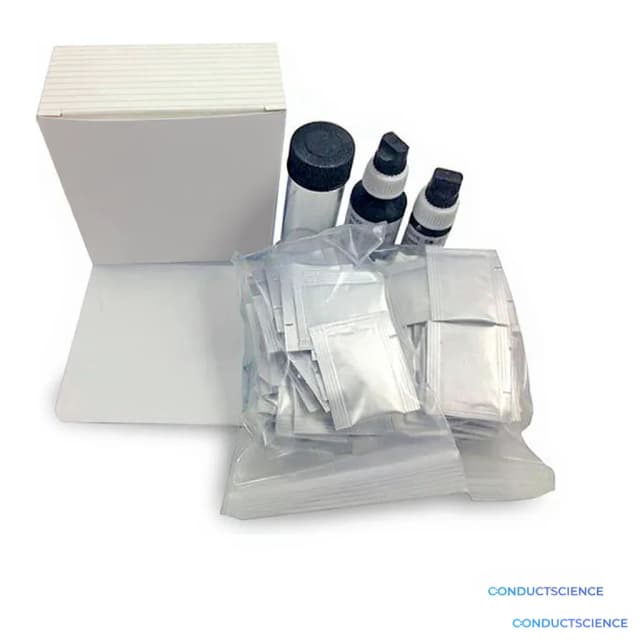
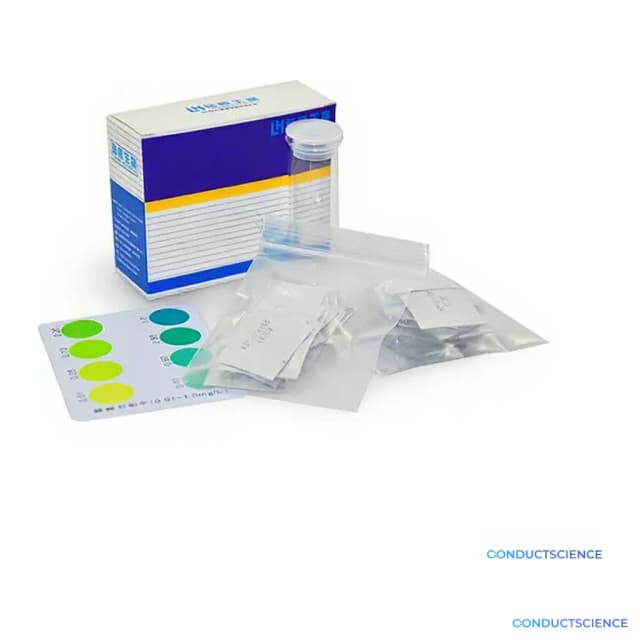
- Fluoride detection instrumentation (typical)
- Calibration standard solutions (typical)
- Buffer and reagent chemicals (typical)
- Sample preparation materials (typical)
- User manual and protocol documentation (typical)
- Quality control reference materials (typical)
Warranty
ConductScience provides standard manufacturer warranty coverage for analytical instrumentation with technical support for method optimization and troubleshooting.
Compliance
References
Background reading relevant to this product:
What is the detection limit and linear range for fluoride measurement with this kit?
Detection limits and calibration ranges depend on the specific analytical methodology employed (ISE vs colorimetric) and sample matrix. Typical ISE systems achieve detection limits in the 0.1-1 ppm range with linear response over 2-3 orders of magnitude.
How does sample pH affect fluoride measurements and what adjustments are required?
Fluoride electrode response is pH-dependent, with optimal performance typically between pH 5-6. TISAB buffer maintains appropriate pH while complexing interfering ions like aluminum and iron that can bind fluoride.
What interfering ions affect fluoride analysis and how are they addressed?
Common interferences include aluminum, iron, and hydroxide ions. TISAB buffer contains complexing agents like CDTA to sequester metal interferences and maintain consistent ionic strength.
Can this kit analyze fluoride in biological samples or only water matrices?
While designed primarily for water analysis, the kit may be adapted for biological samples through appropriate sample preparation including protein precipitation and matrix dilution protocols.
What is the shelf life of kit reagents and how should they be stored?
Reagent stability varies by component - fluoride standards remain stable for months when properly stored, while buffer solutions may require periodic verification. Store according to manufacturer specifications for optimal performance.
How frequently does the electrode require calibration and maintenance?
ISE electrodes require daily calibration verification with fresh standards. Electrode maintenance involves regular cleaning, proper storage in conditioning solutions, and periodic replacement of reference electrodes.
What quality control procedures should be implemented with this analytical method?
Standard QC includes duplicate analyses, matrix spike recoveries, blank measurements, and analysis of certified reference materials to verify method accuracy and precision.
How does this kit compare to ion chromatography methods for fluoride analysis?
ISE methods offer simpler sample preparation and faster analysis times compared to ion chromatography, while IC provides better selectivity for complex matrices with multiple anions present.
Have a question about this product?
Accessories
Enhance your setup with compatible accessories
Frequently Bought Together