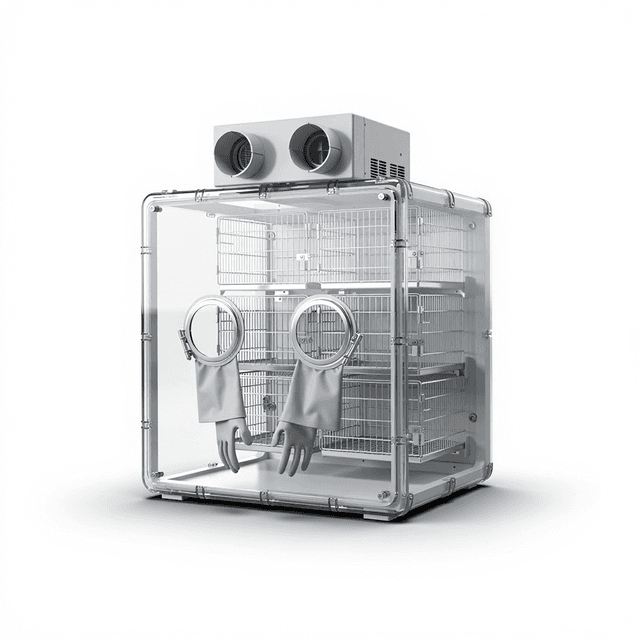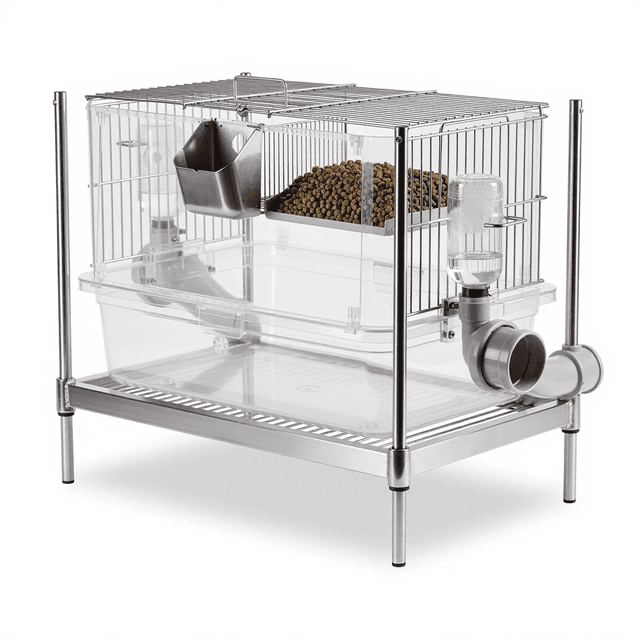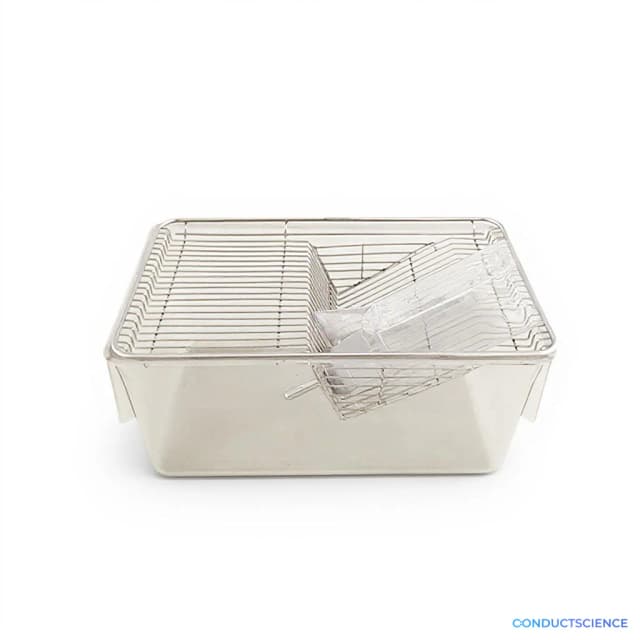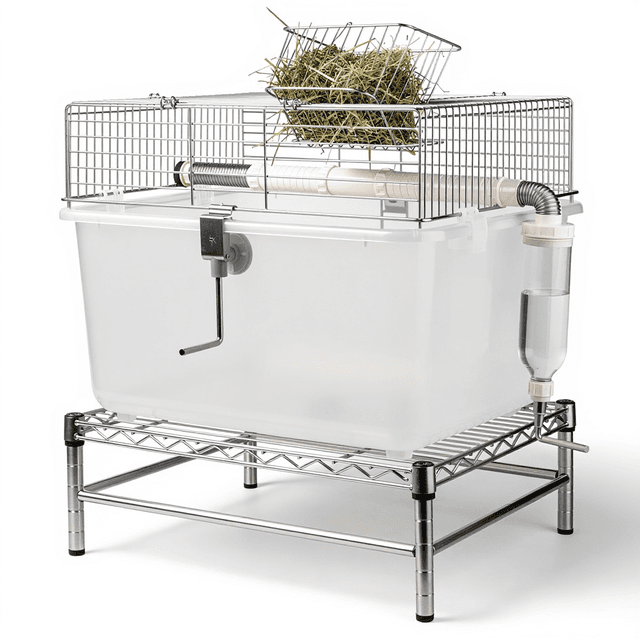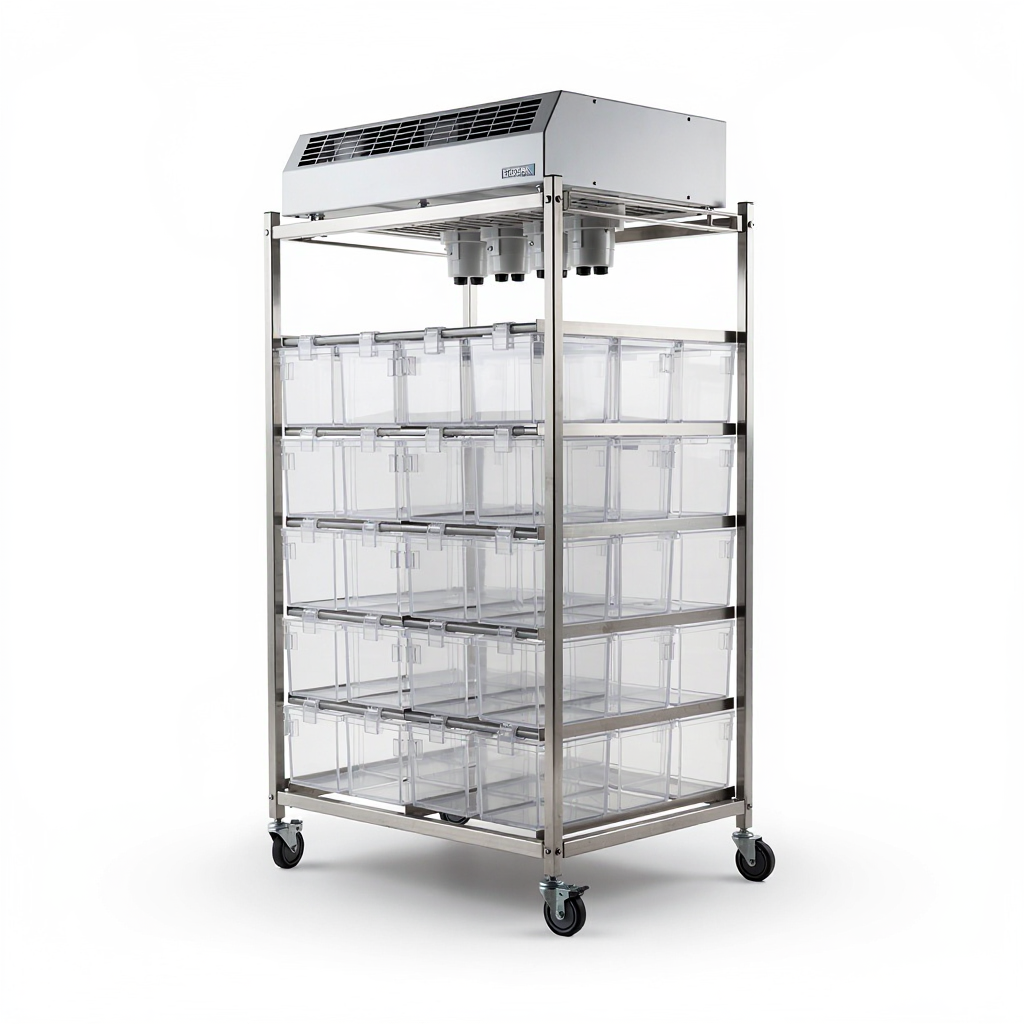
High-Density IVC System for Mice (Touchscreen, Up to 126 Cages)
High-capacity individually ventilated cage system housing up to 126 mouse cages with touchscreen control, HEPA filtration, and real-time environmental monitoring for large-scale research operations.
| Cage Material | PC, PSU, or PEI (configurable) |
| Rack Material | Stainless Steel SS304 |
| AHU Control | Intelligent touchscreen with real-time monitoring |
| Fan Type | Dual-speed, frequency-controlled |
| Ventilation Type | Individual supply and exhaust per cage |
| Filtration | Primary + high-efficiency HEPA |

The High-Density IVC System for Mice provides individually ventilated cage housing for up to 126 mouse cages per rack, designed for large-scale research operations requiring precise microenvironmental control. Each cage receives independent supply and exhaust ventilation through dual-speed, frequency-controlled fans with primary and high-efficiency HEPA filtration to minimize cross-contamination and maintain stable environmental conditions.
The system features an intelligent touchscreen AHU control interface for real-time monitoring and management of environmental parameters across all cages. The stainless steel SS304 rack construction accommodates configurable cage materials including polycarbonate (PC), polysulfone (PSU), or polyetherimide (PEI) options to suit specific experimental requirements. Universal voltage compatibility (110V-250V) enables installation in diverse laboratory environments.
How It Works
The IVC system operates through independent air handling for each cage position, creating isolated microenvironments that prevent cross-contamination between cages while maintaining optimal conditions for mouse health and experimental consistency. Dual-speed, frequency-controlled fans provide precise airflow control, with each cage receiving dedicated supply air that passes through primary filtration followed by high-efficiency HEPA filtration to remove particles and potential contaminants down to 0.3 micrometers.
The intelligent touchscreen AHU control system continuously monitors and adjusts environmental parameters including airflow rates, temperature, and humidity across all 126 cage positions. Real-time data acquisition enables immediate detection of system anomalies or environmental deviations that could impact research outcomes. The exhaust ventilation system removes cage-level ammonia, moisture, and other contaminants while maintaining slight negative pressure to contain odors and prevent escape of potential allergens.
The modular design accommodates different cage materials (PC, PSU, or PEI) selected based on chemical compatibility, autoclave requirements, and experimental protocols. The stainless steel SS304 rack construction provides chemical resistance and facilitates sanitization procedures required in research environments.
Features & Benefits
Cage Material
- PC, PSU, or PEI (configurable)
Rack Material
- Stainless Steel SS304
AHU Control
- Intelligent touchscreen with real-time monitoring
Fan Type
- Dual-speed, frequency-controlled
Ventilation Type
- Individual supply and exhaust per cage
Filtration
- Primary + high-efficiency HEPA
Species
- Mouse
Max Cage Capacity
- Up to 126 cages per rack
Warranty
- 1 Year
Automation Level
- semi-automated
Brand
- ConductScience
Power/Voltage
- 110V-250V
Certifications
- CE, ISO, RoHS
Research Domain
- Behavioral Pharmacology
- Cancer Research
- Developmental Biology
- Immunology
- Neuroscience
- Pharmaceutical QC
- Toxicology
Weight
- 150.0 kg
Dimensions
- L: 65.0 mm
- W: 32.0 mm
- H: 82.0 mm
Comparison Guide
| Feature | This Product | Typical Alternative | Advantage |
|---|---|---|---|
| Maximum Cage Capacity | Up to 126 cages per rack | Entry-level systems often accommodate 20-60 cages per rack | Higher housing density reduces facility footprint requirements while maintaining individual environmental control for each cage position. |
| Ventilation Control | Individual supply and exhaust per cage with dual-speed, frequency-controlled fans | Basic systems may provide shared ventilation or single-speed fans | Independent cage ventilation prevents cross-contamination and enables precise airflow adjustment for different experimental conditions. |
| Control Interface | Intelligent touchscreen AHU control with real-time monitoring | Manual controls or basic digital displays with limited monitoring | Real-time parameter monitoring enables immediate detection of environmental deviations that could impact research outcomes. |
| Filtration System | Primary plus high-efficiency HEPA filtration | Single-stage filtration or lower efficiency filters | Dual-stage filtration removes particles to 0.3 micrometers, providing cleaner air supply for sensitive research applications. |
| Cage Material Options | Configurable PC, PSU, or PEI cage materials | Fixed cage material, typically polycarbonate only | Material selection flexibility accommodates diverse chemical compatibility requirements and sterilization protocols. |
| Voltage Compatibility | Universal voltage operation (110V-250V) | Fixed voltage requirements for specific regions | International installation flexibility without voltage conversion requirements simplifies global research facility deployment. |
This high-density IVC system offers 126-cage capacity with individual ventilation control, intelligent touchscreen monitoring, and configurable cage materials. The dual-stage HEPA filtration and universal voltage compatibility support diverse research applications while maximizing housing efficiency in large-scale operations.
Practical Tips
Verify airflow rates at each cage position during initial setup and after any maintenance using a calibrated anemometer to ensure consistent ventilation performance.
Why: Uniform airflow distribution is critical for maintaining standardized environmental conditions across all experimental groups.
Monitor differential pressure across HEPA filters weekly and establish replacement schedules based on facility air quality conditions rather than fixed time intervals.
Why: Filter performance directly impacts air quality and system efficiency, with replacement timing dependent on actual contamination levels.
Configure cage materials based on experimental chemical exposure requirements, using PEI for aggressive solvents and PC for standard protocols.
Why: Material compatibility prevents chemical degradation that could introduce confounding variables or compromise cage integrity.
If touchscreen displays environmental alarms, verify cage placement and sealing before adjusting fan speeds or other system parameters.
Why: Improper cage sealing is the most common cause of ventilation irregularities and should be checked before mechanical adjustments.
Download environmental monitoring data regularly from the touchscreen system and correlate with experimental timelines to identify potential confounding factors.
Why: Environmental data provides valuable context for experimental results and helps identify periods of system instability that could affect outcomes.
Establish clear protocols for system shutdown procedures during maintenance, including notification of research staff and temporary animal relocation if needed.
Why: Planned maintenance downtime prevents emergency situations and ensures animal welfare is maintained during system servicing.
Implement a cage rotation schedule to distribute any minor environmental variations across experimental groups over time.
Why: Systematic cage position rotation helps minimize the impact of any rack-level environmental gradients on experimental results.
Clean and inspect the touchscreen interface monthly with appropriate cleaning agents to maintain display clarity and touch sensitivity.
Why: Clear interface operation is essential for accurate parameter monitoring and system control during critical experimental periods.
Setup Guide
What’s in the Box
- High-density IVC rack system with stainless steel SS304 construction
- Dual-speed, frequency-controlled fan units
- Primary and HEPA filtration components
- Intelligent touchscreen AHU control interface
- Cage mounting hardware and positioning guides
- Electrical connection components and power cables
- Installation and operation manual
- System validation documentation
- 1-year warranty certificate (typical)
Compliance
References
Background reading relevant to this product:
Warranty & ConductCare
ConductScience provides a 1-year manufacturer warranty covering system components and technical support for installation, operation, and maintenance guidance. Extended service agreements and on-site training programs are available for comprehensive facility support.
What air change rates does the system provide for each cage?
Consult product datasheet for specific air change rates per hour. The dual-speed, frequency-controlled fans enable adjustment of airflow rates based on cage occupancy and experimental requirements.
How does the touchscreen interface integrate with facility management systems?
The intelligent touchscreen AHU control provides real-time monitoring capabilities. Consult technical specifications for data output formats and integration options with existing facility management platforms.
What maintenance schedule is required for the HEPA filtration system?
HEPA filter replacement frequency depends on facility air quality and usage intensity. Regular monitoring of differential pressure across filters indicates replacement timing, typically every 6-12 months in standard research environments.
Can the system accommodate different cage sizes beyond standard mouse cages?
The rack design is optimized for mouse cage dimensions with configurable materials (PC, PSU, PEI). Consult manufacturer specifications for exact cage size compatibility and mounting requirements.
How does the system handle alarm conditions or ventilation failures?
The touchscreen control system provides real-time monitoring with alarm capabilities for environmental deviations. Consult operation manual for specific alarm parameters, notification methods, and emergency response protocols.
What power requirements and electrical specifications are needed for installation?
The system operates on universal voltage (110V-250V) with frequency-controlled fans. Consult installation guide for specific amperage requirements, circuit specifications, and electrical connection details.
How does this high-density configuration compare to modular IVC systems?
The 126-cage capacity provides centralized control and higher density than smaller modular units, while maintaining individual cage ventilation. Trade-offs include reduced flexibility for partial system operation versus easier expansion with modular designs.
Have a question about this product?
Accessories
Enhance your setup with compatible accessories
Frequently Bought Together
Upgrade Options