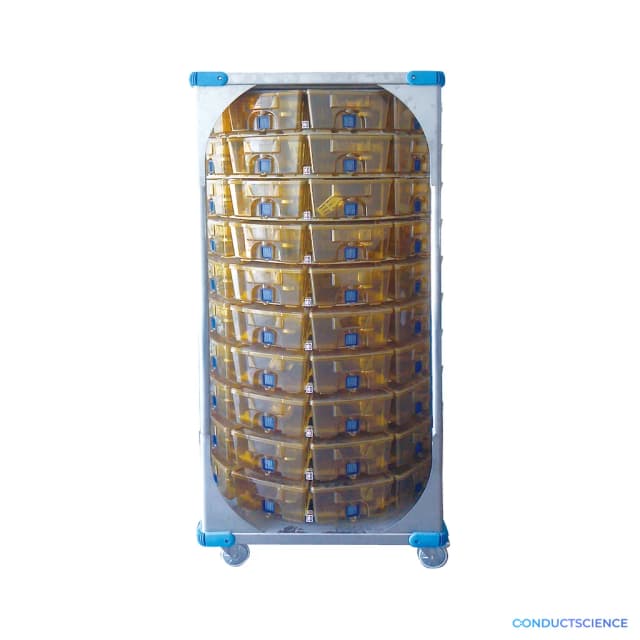
Exhaust Ventilated Cage System for Mice (Fan Type, PC)
Fan-driven exhaust ventilated cage system with polycarbonate cages, stainless steel racks, and HEPA filtration for controlled laboratory mouse housing with contamination control.

Louise Corscadden, PhD
Director of Science · ConductScience
Ask Louise about Exhaust Ventilated Cage System for Mice (Fan Type, PC) fit, setup, configuration, or quote prep.
Already working with us? Sign in to connect this with My Scientist.
Key Specifications
Full details →- Model fit
- Mouse
- SKU family
- PTY-0008
- Shipping box
- 65.0 x 32.0 x 82.0 cm
- Ordering
- Online checkout and quote request available
- Category
- EVC Systems
- Build notes
- Polycarbonate (PC)
The Exhaust Ventilated Cage System for Mice provides controlled air management for laboratory animal housing through fan-driven exhaust ventilation. The system features polycarbonate cages mounted on stainless steel SS304 racks with integrated HEPA filtration to remove airborne contaminants from the animal environment. This exhaust-only configuration maintains consistent air quality while preventing the accumulation of ammonia, allergens, and pathogenic microorganisms that can compromise animal health and experimental outcomes.
The system's exhaust ventilation design creates negative pressure within each cage, drawing contaminated air through HEPA filters before discharge. This approach minimizes cross-contamination between cages while providing each animal with access to filtered room air. The polycarbonate cage construction offers chemical resistance and optical clarity for behavioral observation, while the stainless steel rack provides structural stability and resistance to corrosion from sanitizing agents.
How It Works
The exhaust ventilated cage system operates on negative pressure principles to maintain controlled air quality within individual mouse cages. Fan-driven exhaust creates continuous air flow that draws room air into each cage while removing contaminated air through HEPA filtration. This unidirectional airflow prevents the accumulation of ammonia from urine decomposition, volatile organic compounds from bedding materials, and airborne allergens that can compromise both animal welfare and research outcomes.
The negative pressure differential ensures that contaminated air from each cage is captured before it can escape into the room environment or cross-contaminate adjacent cages. HEPA filters remove particles and microorganisms from the exhaust air stream before discharge, preventing the recirculation of pathogens within the animal facility. The polycarbonate cage material provides chemical inertness and optical transparency for animal observation, while the stainless steel SS304 rack construction resists corrosion from cleaning agents and provides structural stability for multi-tier housing configurations.
Features & Benefits
Cage Material
- Polycarbonate (PC)
Rack Material
- Stainless Steel SS304
Ventilation Type
- Exhaust-only, fan-driven
Filtration
- Exhaust HEPA filter
Warranty
- 1 Year
Automation Level
- semi-automated
Brand
- ConductScience
Certifications
- CE, ISO
Research Domain
- Aging Research
- Behavioral Pharmacology
- Cancer Research
- Immunology
- Neuroscience
- Toxicology
Species
- Mouse
Shipping weight
- 100.0 lb
Shipping box
- L: 65.0 cm
- W: 32.0 cm
- H: 82.0 cm
| Feature | This Product | Typical Alternative | Advantage |
|---|---|---|---|
| Ventilation Configuration | Exhaust-only with fan-driven negative pressure | Many systems use supply-and-exhaust configurations with both filtered intake and exhaust air | Simplified design reduces infrastructure requirements while maintaining contamination control between cages |
| Cage Material | Polycarbonate (PC) construction | Basic systems often use polysulfone or other plastic materials | Provides superior chemical resistance and optical clarity for behavioral observation during extended studies |
| Rack Construction | Stainless steel SS304 | Entry-level systems may use powder-coated steel or aluminum frames | Offers enhanced corrosion resistance to sanitizing agents and maintains structural integrity in high-humidity environments |
| Filtration System | HEPA exhaust filtration | Some systems use standard particulate filters or no exhaust filtration | Removes microorganisms and fine particles from exhaust air to prevent facility contamination |
| Certification Status | CE and ISO certified | Varies by manufacturer and model | Provides documentation of compliance with international safety and quality management standards |
This system provides exhaust-only ventilation with HEPA filtration in a robust stainless steel and polycarbonate construction with international certifications. The design focuses on contamination control and cross-contamination prevention using negative pressure principles rather than filtered air supply.
Practical Tips
Verify negative pressure differential across all cage positions during initial setup using manometer measurements to ensure uniform airflow performance.
Why: Consistent pressure differentials prevent preferential airflow that could create contamination gradients between cages.
Monitor HEPA filter pressure drop weekly and establish replacement schedules based on facility particulate load rather than time intervals alone.
Why: Filter efficiency decreases as particle accumulation increases resistance, reducing system performance.
Position the rack system away from high-traffic areas and HVAC discharge points to minimize air turbulence that could disrupt negative pressure maintenance.
Why: External air currents can interfere with the exhaust system's ability to maintain directional airflow into cages.
If cage odors become noticeable, check fan operation and filter integrity before adjusting ventilation rates or cage change frequency.
Why: Odor breakthrough typically indicates ventilation system malfunction rather than inadequate air exchange rates.
Document cage position effects on animal behavior during initial studies, as slight airflow variations between rack levels may influence some behavioral parameters.
Why: Systematic position effects can confound experimental results if not accounted for in study design and randomization.
Use appropriate respiratory protection when changing filters or performing maintenance on the exhaust system to prevent exposure to concentrated animal allergens.
Why: Exhaust filters accumulate high concentrations of airborne allergens that can trigger sensitization in laboratory personnel.
Coordinate cage changes across all positions simultaneously to maintain consistent environmental conditions and prevent air turbulence from disrupting neighboring cages.
Why: Sequential cage changes can create pressure imbalances that temporarily compromise containment in adjacent positions.
Setup Guide
What’s in the Box
- Stainless steel SS304 rack assembly
- Polycarbonate cage units
- Fan-driven exhaust ventilation system
- HEPA filter assemblies
- Ventilation manifold and connections
- Installation hardware and brackets
- User manual and setup guide (typical)
- Warranty documentation (typical)
Warranty
ConductScience provides a 1-year manufacturer warranty covering defects in materials and workmanship, with technical support available for installation guidance and operational troubleshooting.
Compliance
What air exchange rates does this system achieve for ammonia control?
Consult product datasheet for specific air change rates. The fan-driven exhaust system is designed to maintain negative pressure and continuous air exchange, but exact ventilation rates depend on facility infrastructure and operational settings.
How does the HEPA filtration efficiency compare to supply-side ventilated systems?
This exhaust-only system filters air leaving the cages rather than supplying filtered air. While this prevents cross-contamination between cages, animals breathe room air rather than HEPA-filtered supply air as in positive pressure systems.
What cage capacity does the rack system support?
Consult product datasheet for specific cage quantities and rack configurations. The stainless steel SS304 construction supports multi-tier arrangements, but exact capacity varies by facility requirements.
How frequent is HEPA filter replacement required?
Filter replacement intervals depend on cage occupancy, bedding type, and facility particulate load. Monitor pressure differential across filters and replace when airflow restriction becomes excessive or per facility protocols.
Can the system accommodate different cage sizes for various study protocols?
The system is designed for mouse cages with specific dimensions compatible with the ventilation manifold. Consult technical specifications for cage size requirements and compatibility with different housing protocols.
What maintenance access is required for cleaning and filter changes?
The rack design provides access to individual cage positions and filter compartments. Plan for adequate clearance around the system for routine cage changes, cleaning procedures, and filter maintenance.
Have a question about this product?
Have a question? Just ask.
Send it over and we'll email you a personalized answer — no call, no scheduling.
Prefer to talk it through?
Accessories
Enhance your setup with compatible accessories
Frequently Bought Together
Upgrade Options
Related Products