Industrial Continuous Flow Glass Microreactor
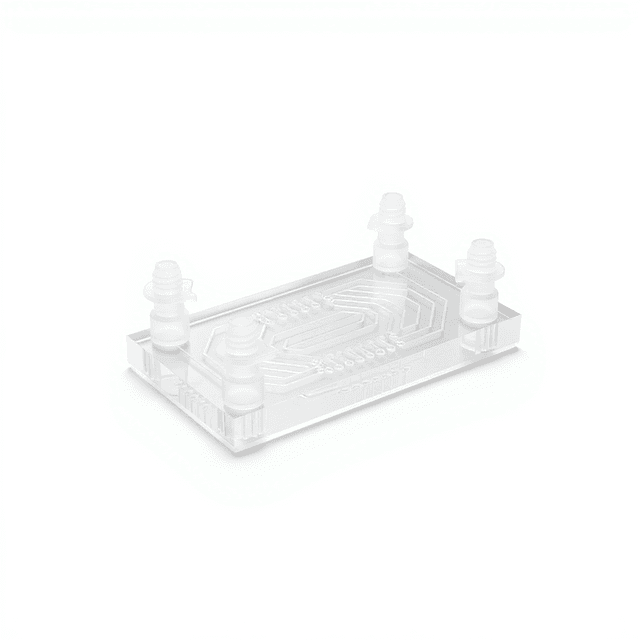
Industrial-scale continuous flow glass microreactor for production synthesis and chemical process scale-up applications.

Louise Corscadden, PhD
Director of Science · ConductScience
Ask Louise about Industrial Continuous Flow Glass Microreactor fit, setup, configuration, or quote prep.
Already working with us? Sign in to connect this with My Scientist.
Key Specifications
Full details →- Model fit
- Configured during quote
- SKU family
- WHM-0062
- Shipping box
- 500.0 x 400.0 x 300.0 cm
- Ordering
- Online checkout and quote request available
- Category
- Lab Equipment
- Build notes
- glass
The Industrial Continuous Flow Glass Microreactor is a pilot-scale synthesis platform designed for production chemistry applications and process scale-up operations. Constructed from glass materials, this microreactor system enables continuous flow processing for chemical synthesis reactions in industrial and pilot production environments. The system provides researchers and process chemists with a controlled environment for scaling synthetic procedures from laboratory to production scale.
This microreactor system facilitates continuous flow chemistry techniques that offer advantages over traditional batch processing, including improved heat and mass transfer, enhanced mixing efficiency, and more precise reaction control. The glass construction provides chemical compatibility with a wide range of solvents and reagents while allowing visual monitoring of reaction progress. The industrial scale design supports production synthesis workflows and process development activities.
How It Works
Continuous flow microreactor technology operates on the principle of flowing reactants through precisely controlled reaction channels where mixing, reaction, and separation occur in a continuous process. Unlike traditional batch reactors, the continuous flow design provides superior heat and mass transfer characteristics due to the high surface-area-to-volume ratio of the microchannels. Reactants are introduced at controlled flow rates and mixed at the microscale level, ensuring uniform reaction conditions throughout the process.
The glass construction provides excellent chemical resistance and thermal properties while allowing visual monitoring of the reaction stream. Temperature control is achieved through external heating or cooling of the reactor body, with the small thermal mass enabling rapid temperature changes and precise control. Residence time is determined by the flow rate and internal volume, allowing fine-tuning of reaction kinetics. The continuous nature eliminates the need for repeated batch operations and provides consistent product quality.
Scale-up advantages include predictable linear scaling of throughput with flow rate, consistent reaction conditions independent of batch size, and reduced processing time for large quantities. The system design facilitates process development and optimization through systematic variation of flow rates, temperatures, and residence times.
Features & Benefits
Scale
- Industrial / pilot
Automation Level
- semi-automated
Brand
- ConductScience
Material
- glass
Research Domain
- Analytical Chemistry
- Environmental Monitoring
- Food Science
- Industrial Hygiene
- Materials Science
- Pharmaceutical QC
Shipping weight
- 25.0 lb
Shipping box
- L: 500.0 cm
- W: 400.0 cm
- H: 300.0 cm
| Feature | This Product | Typical Alternative | Advantage |
|---|---|---|---|
| Scale designation | Industrial/pilot scale | Laboratory-scale models often limited to analytical or small batch applications | Supports meaningful throughput for process development and pilot production requirements |
| Construction material | Glass | Stainless steel or polymer systems common in flow reactors | Enables visual monitoring of reaction progress while providing excellent chemical compatibility |
| Application focus | Production synthesis and scale-up | Many systems designed primarily for analytical or research applications | Optimized for manufacturing workflows and process development rather than just experimentation |
| Physical footprint | 500 × 400 × 300 mm dimensions | Bench-scale units typically much smaller | Provides substantial processing capacity while remaining manageable for pilot plant integration |
| System architecture | Continuous flow design | Batch processing remains common in many applications | Delivers consistent product quality with predictable scaling characteristics for commercial development |
This industrial-scale glass microreactor combines the chemical compatibility and visual monitoring advantages of glass construction with the throughput capabilities required for pilot and production applications. The continuous flow design provides process advantages over batch methods including improved heat transfer and consistent product quality.
Practical Tips
Establish flow rate calibration curves using fluids with viscosities similar to your reaction mixtures.
Why: Viscosity differences can significantly affect actual vs. set flow rates in microfluidic systems.
Develop standardized cleaning procedures using compatible solvents between different reaction campaigns.
Why: Thorough cleaning prevents cross-contamination and maintains consistent product quality across different syntheses.
Start new reactions at reduced flow rates to establish steady-state conditions before optimizing for throughput.
Why: Gradual startup allows identification of potential issues before committing to full-scale operation.
Monitor pressure drop across the system to detect fouling or blockage development.
Why: Increasing pressure drop indicates potential flow restrictions that could affect reaction performance.
Record residence time, temperature, and flow rate data for all successful reaction conditions.
Why: Complete documentation enables reproducible scale-up and process transfer to manufacturing.
Implement appropriate secondary containment for the reactor system when handling hazardous materials.
Why: Glass systems require additional precautions against breakage when processing toxic or reactive compounds.
Validate mixing efficiency by conducting tracer studies with colored solutions before running actual syntheses.
Why: Visual confirmation of mixing patterns helps optimize inlet designs and flow conditions for uniform reactions.
Periodically verify temperature control accuracy using independent thermocouples at multiple reactor positions.
Why: Temperature uniformity across the reactor volume affects reaction selectivity and product quality.
Setup Guide
What’s in the Box
- Glass microreactor main unit
- Mounting hardware and support structure (typical)
- Inlet and outlet fittings (typical)
- Connection tubing set (typical)
- Operating manual and technical documentation (typical)
- Safety data sheets for materials of construction (typical)
Warranty
ConductScience provides a standard one-year manufacturer warranty covering defects in materials and workmanship. Technical support includes installation guidance, operating procedures, and troubleshooting assistance for optimal system performance.
Compliance
What chemical compatibility considerations apply to the glass construction?
The glass material provides excellent resistance to most organic solvents and acids. Avoid prolonged exposure to hydrofluoric acid and strong bases that can etch glass surfaces. Consult chemical compatibility charts for specific reagents.
How do I determine optimal flow rates for my synthesis?
Start with literature residence times for similar reactions and calculate corresponding flow rates based on reactor internal volume. Systematically vary flow rate while monitoring product quality and conversion efficiency.
What maintenance procedures are required for continuous operation?
Regular cleaning between different chemistries prevents cross-contamination. Inspect glass surfaces for etching or deposits. Replace tubing and fittings based on chemical exposure and operating hours.
Can the system handle temperature-sensitive reactions?
The glass construction and compact design provide good thermal control. External heating/cooling systems can maintain precise temperatures. The low thermal mass enables rapid temperature changes when needed.
How does throughput compare to batch processing?
Continuous flow typically provides higher space-time yields due to improved heat and mass transfer. Exact throughput depends on reaction kinetics and required residence time for complete conversion.
What pressure limitations should I consider?
Glass reactor pressure ratings depend on wall thickness and design. Consult product datasheet for maximum operating pressure. Consider pressure drop through the system when sizing pumps.
How do I scale up from this system to larger production?
Continuous flow systems scale predictably through numbering-up (parallel reactors) or increasing channel dimensions. Maintain similar residence times and mixing characteristics during scale-up.
What data collection capabilities are available?
Visual monitoring allows real-time observation of reaction progress. Consider integrating temperature, pressure, and flow rate monitoring for process documentation and optimization.
Have a question about this product?
Have a question? Just ask.
Send it over and we'll email you a personalized answer — no call, no scheduling.
Prefer to talk it through?
Upgrade Options