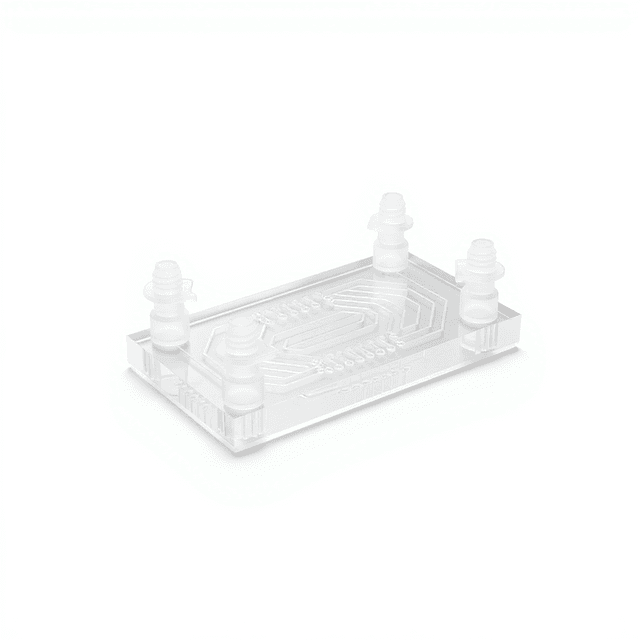
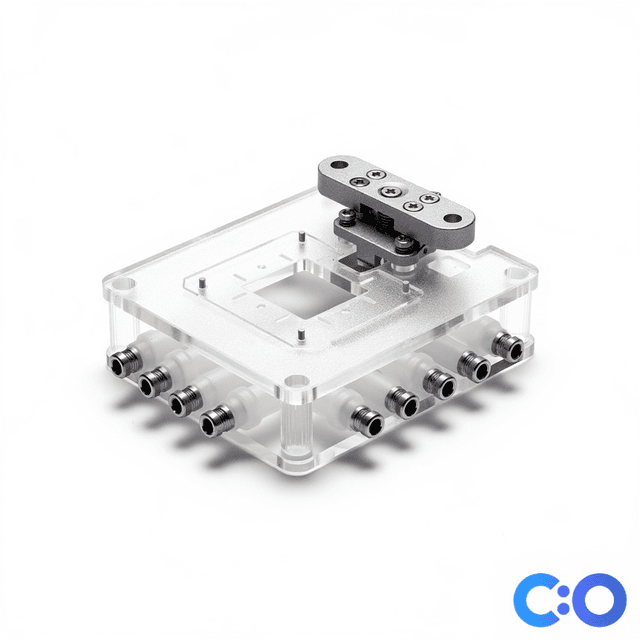
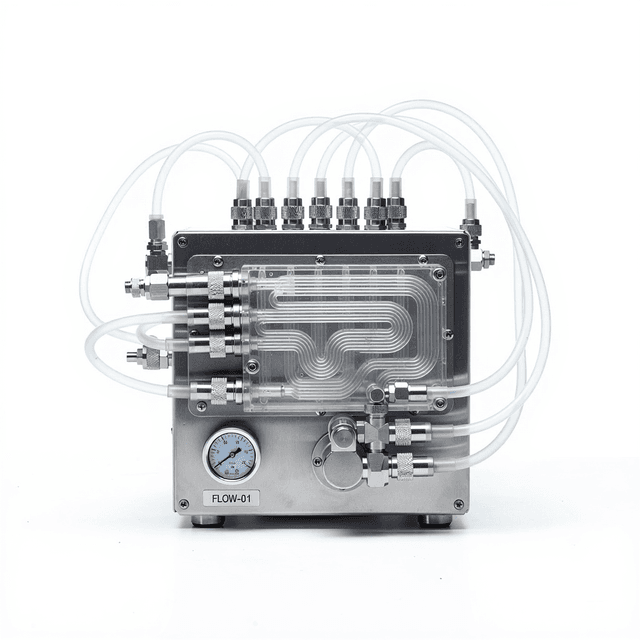
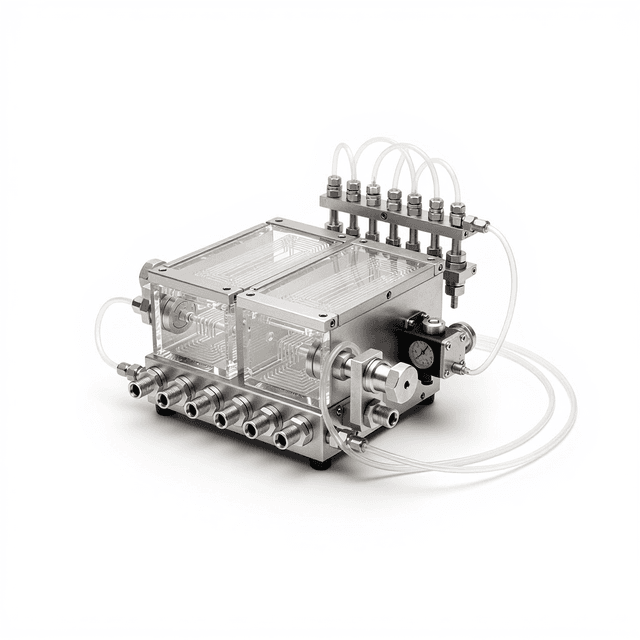
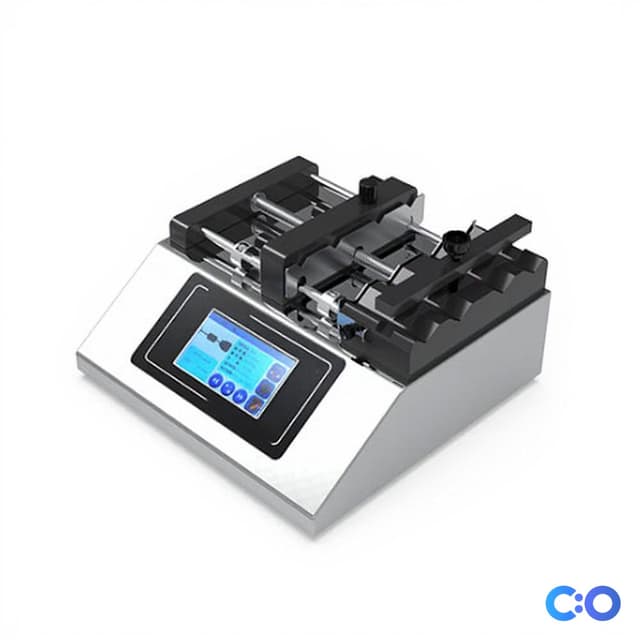
15-Channel Constant Pressure Microfluidic Pump
Multi-channel constant pressure pump system for precise fluid control in microfluidic circuits and organ-on-chip applications.

Louise Corscadden, PhD
Director of Science · ConductScience
Ask Louise about 15-Channel Constant Pressure Microfluidic Pump fit, setup, configuration, or quote prep.
Already working with us? Sign in to connect this with My Scientist.
Key Specifications
Full details →- Model fit
- Configured during quote
- SKU family
- WHM-0034
- Shipping box
- 400.0 x 300.0 x 120.0 cm
- Ordering
- Online checkout and quote request available
- Category
- Lab Equipment
- Build notes
- Confirm accessories, station layout, and support needs before purchase
The 15-Channel Constant Pressure Microfluidic Pump is a laboratory instrument designed for precise fluid control in complex microfluidic circuits and organ-on-chip applications. This multi-channel system enables simultaneous control of multiple fluid streams with consistent pressure delivery across all channels, supporting advanced cell culture models and microfluidic experimental protocols.
The instrument provides researchers with the capability to maintain stable flow conditions in microfluidic devices that require multiple input streams or gradient generation. The 15-channel configuration supports complex experimental designs including perfusion studies, drug gradient testing, and multi-compartment organ-on-chip models where precise fluid control is critical for maintaining physiologically relevant conditions.
How It Works
Constant pressure microfluidic pumps operate by maintaining a stable pressure differential across microfluidic channels, enabling predictable flow rates through devices with known fluidic resistance. The system uses pressure regulation mechanisms to compensate for variations in channel resistance that occur during experiments, such as cell growth or particle accumulation that would otherwise alter flow characteristics.
The multi-channel design allows independent pressure control for each fluid line, enabling researchers to create complex flow patterns, concentration gradients, or sequential delivery protocols. Each channel maintains its set pressure regardless of downstream resistance changes, providing stable experimental conditions over extended time periods typical of cell culture and perfusion studies.
Flow rates in each channel are determined by the applied pressure and the fluidic resistance of the connected microfluidic device. This relationship allows researchers to calculate expected flow rates based on device geometry or to adjust pressure settings to achieve desired flow conditions for their specific experimental requirements.
Features & Benefits
Number of Channels
- 15
Automation Level
- semi-automated
Brand
- ConductScience
Research Domain
- Analytical Chemistry
- Cancer Research
- Cell Biology
- Developmental Biology
- Materials Science
- Pharmaceutical QC
Shipping weight
- 4.0 lb
Shipping box
- L: 400.0 cm
- W: 300.0 cm
- H: 120.0 cm
| Feature | This Product | Typical Alternative | Advantage |
|---|---|---|---|
| Channel Count | 15 independent channels | Entry-level systems often provide fewer channels | Enables complex multi-input experimental designs without requiring multiple pump units |
| Pressure Control Method | Constant pressure regulation | Some systems use constant flow mechanisms | Maintains stable conditions when device resistance changes during cell growth or particle accumulation |
| Application Focus | Complex microfluidic circuits and organ-on-chip systems | Many pumps target general microfluidic applications | Specifically designed for advanced biomedical applications requiring precise multi-channel control |
| Form Factor | Compact 400×300×120 mm design | Larger systems may require more bench space | Integrates efficiently with microscopy systems and incubators in space-limited laboratory environments |
This 15-channel system provides extensive multi-input capability in a compact design specifically optimized for complex microfluidic and organ-on-chip applications. The constant pressure approach offers superior flow stability compared to flow-controlled alternatives when working with varying resistance microfluidic devices.
Practical Tips
Verify pressure outputs using a calibrated pressure gauge before starting critical experiments.
Why: Ensures accurate pressure delivery and validates system performance for your specific experimental requirements
Replace tubing connections regularly and inspect for wear or contamination between experiments.
Why: Maintains pressure integrity and prevents cross-contamination between different experimental conditions
Prime all channels thoroughly with working fluid before connecting to microfluidic devices to eliminate air bubbles.
Why: Air bubbles can cause pressure instabilities and disrupt steady flow conditions in microfluidic channels
Check for blockages or kinks in tubing if flow rates appear inconsistent between channels.
Why: Physical obstructions are the most common cause of unexpected pressure or flow variations
Allow system to equilibrate for several minutes after pressure adjustments before starting data collection.
Why: Ensures stable baseline conditions and improves reproducibility of flow-sensitive measurements
Use appropriate pressure ratings for all tubing and fittings to prevent system failures during operation.
Why: Prevents potentially hazardous pressure releases and protects expensive microfluidic devices from damage
Label each channel clearly and maintain a log of pressure settings for different experimental protocols.
Why: Improves experimental reproducibility and reduces setup time for repeated protocol implementations
Setup Guide
What’s in the Box
- 15-Channel Constant Pressure Microfluidic Pump (main unit)
- Power adapter (typical)
- User manual and setup guide (typical)
- Pressure line fittings set (typical)
- Quick start reference card (typical)
Warranty
ConductScience provides a one-year manufacturer warranty covering defects in materials and workmanship, with technical support for setup and operation assistance.
Compliance
How do I determine appropriate pressure settings for my microfluidic device?
Calculate required pressure based on your device's fluidic resistance and desired flow rate using Hagen-Poiseuille principles, then adjust settings accordingly during initial setup.
Can the system handle viscous media like cell culture solutions?
Yes, the constant pressure design automatically compensates for medium viscosity differences, though higher viscosity solutions may require increased pressure settings.
What tubing compatibility should I consider?
The system accommodates standard microfluidic tubing with appropriate pressure ratings; consult specifications for fitting types and pressure limits.
How stable are the pressure outputs over long experiments?
Constant pressure regulation maintains stable output despite downstream resistance changes, suitable for extended cell culture and perfusion protocols.
Can I use different fluids simultaneously across channels?
Yes, each channel operates independently, allowing simultaneous delivery of different media, reagents, or buffer solutions.
What maintenance is required for consistent performance?
Regular cleaning of fluid pathways and replacement of tubing connections as needed to prevent contamination and maintain pressure integrity.
How does this compare to syringe pump alternatives?
Constant pressure systems provide more stable flow in varying resistance conditions compared to constant flow syringe pumps, particularly important in cell-based assays.
Have a question about this product?
Have a question? Just ask.
Send it over and we'll email you a personalized answer — no call, no scheduling.
Prefer to talk it through?
Upgrade Options