8-Channel Parallel Microfluidic Chip
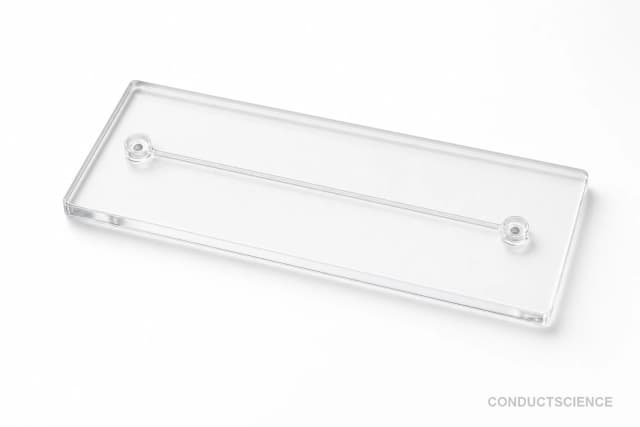
8-channel parallel microfluidic platform with 200 μm channel dimensions for high-throughput screening and dose-response applications.
Reusable chip — designed for multiple experimental runs. Compatible with standard microfluidic tubing: steel pins (0.7 mm ID / 1.0 mm OD) and silicone tubing (0.8 mm ID / 1.9 mm OD). Available in bulk packs (5‑, 10‑, and 25‑unit) for lab-scale and consumable workflows.

Louise Corscadden, PhD
Director of Science · ConductScience
Ask Louise about 8-Channel Parallel Microfluidic Chip fit, setup, configuration, or quote prep.
Already working with us? Sign in to connect this with My Scientist.
Key Specifications
Full details →- Model fit
- 3 selectable configurations
- SKU family
- WHM-0007
- Shipping box
- 25.0 x 15.0 x 4.0 cm
- Ordering
- Online checkout and quote request available
- Category
- Glass Chips
- Build notes
- Confirm accessories, station layout, and support needs before purchase
The 8-Channel Parallel Microfluidic Chip enables simultaneous processing of multiple samples through eight independent microfluidic channels, each with precise 200 μm width and depth dimensions. This platform supports high-throughput screening applications and dose-response studies by allowing researchers to test multiple conditions or concentrations simultaneously under controlled flow conditions.
The chip's parallel architecture provides consistent channel geometry across all eight pathways, enabling comparative analysis between different experimental conditions. The standardized dimensions and multi-channel design facilitate reproducible fluid handling and cell culture applications in microscale environments.
How It Works
The microfluidic chip operates on principles of laminar flow within microscale channels, where fluid behavior is governed by low Reynolds numbers and predictable flow patterns. Each 200 μm channel provides consistent cross-sectional area for uniform flow rates and mixing characteristics when connected to external pumping systems.
Sample introduction occurs through inlet ports connected to each channel, with flow rates controlled by external syringe pumps or pressure-driven systems. The parallel design ensures identical flow conditions across all eight channels, enabling direct comparison of experimental results. Channel geometry maintains laminar flow profiles suitable for cell culture, chemical reactions, and particle manipulation applications.
Optical access through the chip material allows real-time microscopic observation of processes within each channel. The standardized dimensions enable predictable diffusion rates and residence times for applications requiring precise temporal control of sample exposure to reagents or environmental conditions.
Features & Benefits
Shipping weight
- 0.04 lb
Shipping box
- L: 25.0 cm
- W: 15.0 cm
- H: 4.0 cm
| Feature | This Product | Typical Alternative | Advantage |
|---|---|---|---|
| Number of Channels | 8 parallel channels | Entry-level chips often provide 1-4 channels | Higher throughput enables comprehensive dose-response studies or multiple condition testing in single experimental run |
| Channel Dimensions | 200 μm width × 200 μm depth | Channel sizes vary from 50-500 μm depending on application | Standardized geometry provides predictable flow characteristics suitable for cell culture and analytical applications |
| Chip Size | 25×15×4 mm compact format | Larger chips may require specialized stage adapters | Fits standard microscope stages without modification while maximizing channel density |
| Application Range | High-throughput screening and dose-response | Many chips target single specific applications | Versatile design supports multiple experimental approaches from screening to detailed kinetic studies |
This 8-channel parallel microfluidic chip provides higher throughput than typical entry-level devices while maintaining standardized 200 μm channel dimensions. The compact 25×15 mm format maximizes experimental capacity within standard microscope stage constraints.
| Model | SKU | Listed price | Status | Shipping box |
|---|---|---|---|---|
| 25-Pack | WHM-0007-25PK | Quote | Available | 25.0 x 15.0 x 4.0 cm |
| 10-Pack | WHM-0007-10PK | $1,490.00 | Available | 25.0 x 15.0 x 4.0 cm |
| 5-Pack | WHM-0007-5PK | Quote | Available | 25.0 x 15.0 x 4.0 cm |
Practical Tips
Verify flow rates in each channel independently before starting experiments using timed volume measurements.
Why: Channel-to-channel variations can affect experimental reproducibility and data interpretation.
Flush all channels with appropriate cleaning solutions immediately after use to prevent sample carryover.
Why: Residual samples can interfere with subsequent experiments and may cause channel blockage.
Use consistent inlet pressures across all channels and monitor for pressure drops during experiments.
Why: Pressure variations can indicate channel blockage or connection issues affecting experimental conditions.
If channels show uneven flow, check for air bubbles in tubing connections and re-prime the system.
Why: Air bubbles disrupt laminar flow patterns and cause inconsistent sample delivery.
Record flow rates and pressure settings for each channel to enable reproduction of experimental conditions.
Why: Microfluidic experiments require precise flow control documentation for result validation.
Use appropriate containment and ventilation when working with hazardous chemicals in microfluidic systems.
Why: Small volumes can still pose exposure risks, and confined flow paths may concentrate vapors.
Setup Guide
What’s in the Box
- 8-Channel Parallel Microfluidic Chip
- User manual with specifications
- Quality control certificate (typical)
Warranty
ConductScience provides a standard 1-year manufacturer warranty covering defects in materials and workmanship, with technical support available for setup and operational guidance.
Compliance
References
Background reading relevant to this product:
What pumping systems are compatible with this chip?
The chip is designed for use with standard syringe pumps, peristaltic pumps, or pressure-driven flow systems. Connection requires appropriate tubing and fittings matched to your pump's specifications.
What is the recommended flow rate range for the 200 μm channels?
Optimal flow rates depend on your application but typically range from 1-100 μL/min per channel. Consult product datasheet for specific pressure drop calculations and flow rate recommendations.
Can the chip be reused for multiple experiments?
Reusability depends on the application and cleaning protocols. For cell culture applications, single-use is often preferred, while chemical applications may allow reuse with appropriate cleaning and sterilization.
What materials is the chip fabricated from?
Consult product datasheet for specific material composition. Most microfluidic chips use PDMS, glass, or polymer materials selected for optical clarity and chemical compatibility.
How do I prevent cross-contamination between channels?
Ensure proper sealing of all connections and use separate inlet lines for each channel. Monitor for pressure differences that could indicate leakage between channels.
What microscope compatibility should I consider?
The chip dimensions (25×15×4 mm) fit standard microscope stages. Ensure your microscope has appropriate working distance and magnification for 200 μm channel observation.
Can I modify the channel surface properties?
Surface modifications depend on chip material. Common treatments include plasma treatment, coating with extracellular matrix proteins, or chemical functionalization for specific applications.
Have a question about this product?
Have a question? Just ask.
Send it over and we'll email you a personalized answer — no call, no scheduling.
Prefer to talk it through?
Upgrade Options