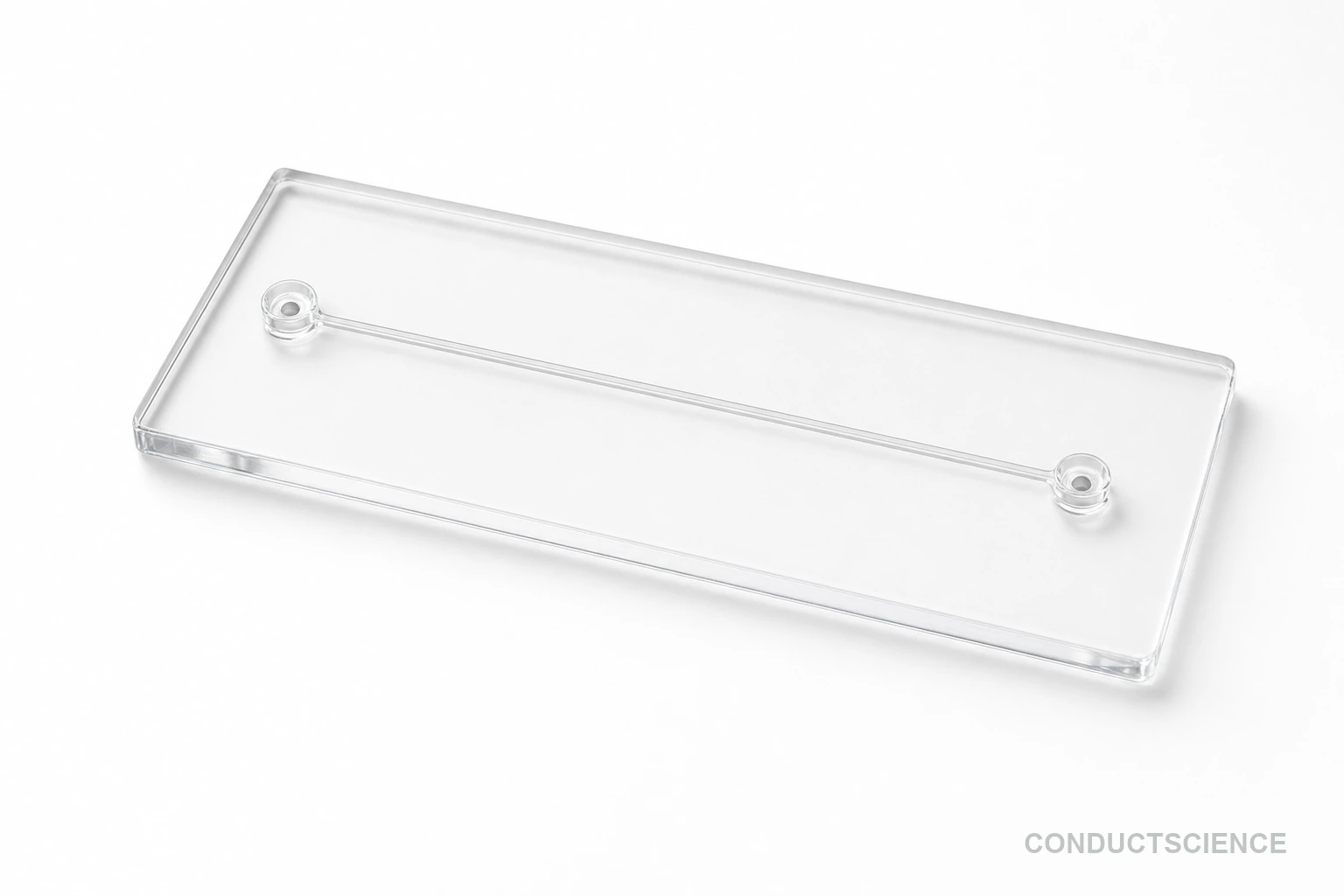
Single-Channel Straight Microfluidic Chip
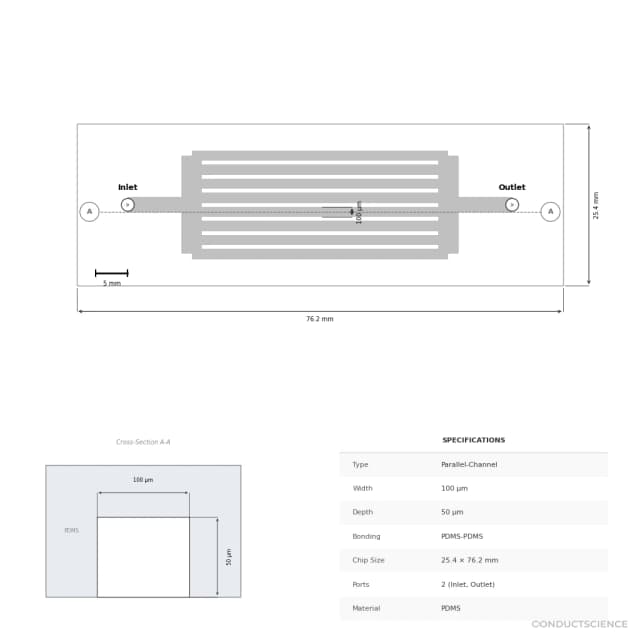
Single-channel microfluidic chip with 100 μm × 100 μm straight channel for flow characterization, prototyping, and microfluidics education.
Reusable chip — designed for multiple experimental runs. Compatible with standard microfluidic tubing: steel pins (0.7 mm ID / 1.0 mm OD) and silicone tubing (0.8 mm ID / 1.9 mm OD). Available in bulk packs (5‑, 10‑, and 25‑unit) for lab-scale and consumable workflows.

Louise Corscadden, PhD
Director of Science · ConductScience
Ask Louise about Single-Channel Straight Microfluidic Chip fit, setup, configuration, or quote prep.
Already working with us? Sign in to connect this with My Scientist.
Key Specifications
Full details →- Model fit
- 2 selectable configurations
- SKU family
- WHM-0008
- Shipping box
- 25.0 x 15.0 x 4.0 cm
- Ordering
- Online checkout and quote request available
- Category
- Glass Chips
- Build notes
- Confirm accessories, station layout, and support needs before purchase
Single-channel microfluidic chip with 50 μm D × 50/100/150/200 μm straight channel for flow characterization, prototyping, and microfluidics education.
The Single-Channel Straight Microfluidic Chip provides a precisely fabricated 100 μm × 100 μm microchannel for fundamental microfluidics research and education. This glass substrate device features a single straight channel designed for flow characterization studies, prototyping microfluidic systems, and teaching microfluidics principles to students and researchers.
The chip's uniform channel geometry enables consistent flow behavior analysis, making it suitable for establishing baseline measurements in microfluidic experiments, validating computational fluid dynamics models, and training personnel in microfluidic handling techniques. The straight channel configuration eliminates complex geometries, allowing researchers to focus on fundamental flow physics without confounding variables from channel bends or junctions.
Key Specs
| Material | PDMS |
|---|---|
| Geometry | 1 channel; single straight channel |
| Ports | 2 ports (Inlet, Outlet) |
| Chip footprint | 25.4 x 76.2 mm standard slide format |
| Channel width | 50 um, 100 um, 150 um, 200 um |
| Channel depth | 50 um |
| Bonding | PDMS-PDMS, PDMS-glass |
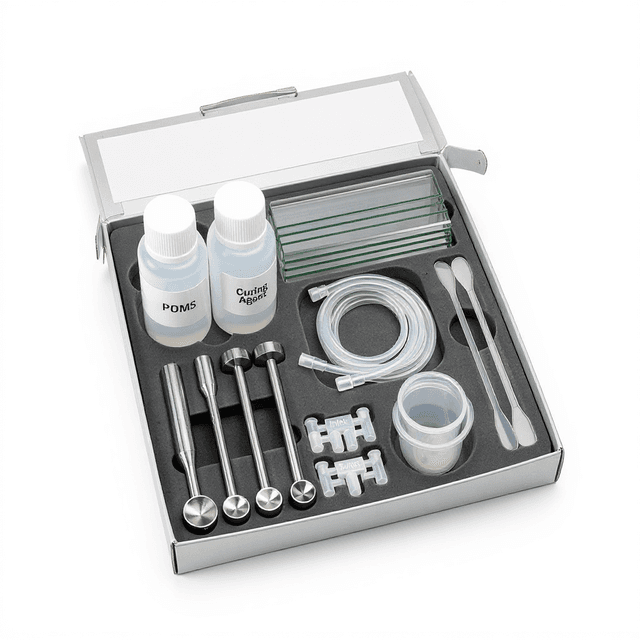
| Packaging | Standard glass slide (25.4x76.2mm), stainless steel tubes (0.7x1.0x15mm), silicone tubing (0.8x1.9mm) |
| Source | suppliers/wenhao/docs/pdms-chips-catalog.json; 3.2.002.00.001, 3.2.002.00.002, 3.2.002.00.003, 3.2.002.00.004, 3.2.002.00.005, 3.2.002.00.006, 3.2.002.00.007, 3.2.002.00.008 |
This source-backed block lists available source configurations; confirm selected width/bonding when quoting.
How It Works
The microfluidic chip operates on principles of laminar flow in microchannels, where fluid motion is governed by the Reynolds number and channel geometry. At the 100 μm scale, viscous forces dominate over inertial forces, creating predictable laminar flow profiles with parabolic velocity distributions across the channel cross-section.
Flow through the straight channel follows the Hagen-Poiseuille equation, where volumetric flow rate depends on applied pressure gradient, fluid viscosity, and channel dimensions. The uniform 100 μm width and depth provide consistent hydraulic diameter, enabling reproducible flow calculations and predictable residence times for analytical applications.
Surface interactions between the fluid and channel walls become significant at this scale, with the surface-to-volume ratio affecting mass transfer, heat transfer, and chemical reactions. The glass substrate provides chemically inert surfaces with well-characterized wetting properties for aqueous and organic solvents commonly used in microfluidic applications.
Features & Benefits
Shipping weight
- 0.04 lb
Shipping box
- L: 25.0 cm
- W: 15.0 cm
- H: 4.0 cm
| Feature | This Product | Typical Alternative | Advantage |
|---|---|---|---|
| Channel Geometry | Single straight channel with uniform 100 μm × 100 μm cross-section | Entry-level chips often feature multiple channels or complex geometries that complicate flow analysis | Eliminates confounding variables from channel complexity, enabling focused study of fundamental flow physics |
| Channel Dimensions | 100 μm width and depth for consistent hydraulic diameter | Educational chips often have larger channels (200-500 μm) with different aspect ratios | Provides true microscale flow regime with high surface-to-volume ratio typical of practical microfluidic applications |
| Substrate Material | Glass construction with optical transparency and chemical resistance | Many prototyping chips use PDMS which can absorb small molecules and swell in organic solvents | Enables accurate flow visualization and compatibility with broader range of experimental fluids |
| Application Focus | Designed specifically for flow characterization, teaching, and prototyping | General-purpose chips may include unnecessary features that increase cost and complexity | Provides cost-effective solution optimized for fundamental microfluidic studies without extraneous features |
This chip offers a focused approach to microfluidic education and flow characterization with its simple straight-channel geometry and glass construction. The 100 μm dimensions provide true microscale flow conditions while maintaining ease of use for prototyping applications.
| Model | SKU | Listed price | Status | Shipping box |
|---|---|---|---|---|
| 25-Pack | WHM-0008-25PK | Quote | Available | 25.0 x 15.0 x 4.0 cm |
| 10-Pack | WHM-0008-10PK | $1,490.00 | Available | 25.0 x 15.0 x 4.0 cm |
Practical Tips
Always handle chips by the edges and store in protective packaging between uses to prevent surface contamination and damage.
Why: Fingerprints and scratches on the optical surfaces interfere with flow visualization and measurement accuracy.
Establish flow rate calibration using known viscosity fluids and compare measured pressure drops to theoretical calculations.
Why: Validates system performance and ensures accurate flow characterization for subsequent experiments.
Flush channels immediately after experiments, especially when using protein solutions or cell suspensions that can cause fouling.
Why: Prevents channel blockage and maintains consistent flow behavior for repeated use.
Allow sufficient time for flow development before taking measurements, typically 3-5 channel residence times.
Why: Ensures fully developed laminar flow profile and steady-state conditions for accurate flow characterization.
If bubbles appear during operation, check for leaks at connections and ensure all tubing is primed before chip connection.
Why: Air bubbles disrupt laminar flow patterns and cause erratic flow behavior that affects measurement reliability.
Use appropriate chemical compatibility charts before introducing new solvents and work in ventilated areas when using volatile compounds.
Why: Prevents chemical damage to the chip and ensures safe handling of potentially hazardous microfluidic reagents.
Setup Guide
What’s in the Box
- Single-channel microfluidic chip
- Product specification sheet
- Handling instructions (typical)
Warranty
ConductScience provides a standard 1-year manufacturer warranty covering defects in materials and workmanship, with technical support for proper handling and usage guidance.
Compliance
What flow rates are appropriate for laminar flow in this channel geometry?
For aqueous solutions, flow rates of 0.1-10 μL/min typically maintain laminar flow (Re < 1) in the 100 μm channel. Higher viscosity fluids can accommodate higher flow rates while remaining laminar.
How do I calculate pressure drop across the channel length?
Use the Hagen-Poiseuille equation: ΔP = 32μLQ/wh³ for rectangular channels, where μ is viscosity, L is channel length, Q is flow rate, w is width, and h is height. Consult product datasheet for exact channel length.
What visualization methods work best with this chip?
Bright-field microscopy with fluorescent tracers or colored dyes provides clear flow visualization. The glass substrate is compatible with UV, visible, and near-IR wavelengths for fluorescence microscopy.
Can this chip handle organic solvents?
Glass construction provides compatibility with most organic solvents including alcohols, hydrocarbons, and many other common laboratory solvents. Avoid hydrofluoric acid and other glass-etching chemicals.
How do I connect this chip to my pump system?
Standard microfluidic fittings compatible with your tubing size connect to the chip ports. Ensure proper sealing without over-tightening to prevent chip damage.
What is the maximum pressure rating?
Consult product datasheet for specific pressure limits. Glass microfluidic chips typically handle pressures up to several atmospheres, but exact limits depend on chip thickness and bonding method.
How should I clean the chip between experiments?
Flush with appropriate solvents (water, ethanol, or other compatible cleaning solutions) followed by air drying. Avoid harsh chemicals that might damage the glass surface or bonding.
Can I modify the surface chemistry for specific applications?
Glass surfaces can be silanized or otherwise functionalized using standard surface chemistry protocols. Ensure compatibility with your experimental requirements and cleaning procedures.
Have a question about this product?
Have a question? Just ask.
Send it over and we'll email you a personalized answer — no call, no scheduling.
Prefer to talk it through?