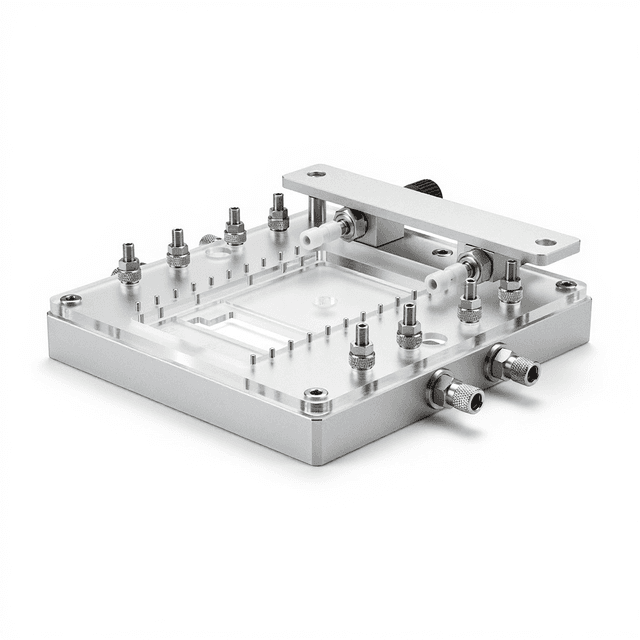
Double-Sided Herringbone Mixing Chip
Microfluidic mixing chip with double-sided herringbone structures for rapid fluid mixing through chaotic advection, featuring 1000 μm channel dimensions.
Reusable chip — designed for multiple experimental runs. Compatible with standard microfluidic tubing: steel pins (0.7 mm ID / 1.0 mm OD) and silicone tubing (0.8 mm ID / 1.9 mm OD). Available in bulk packs (5‑, 10‑, and 25‑unit) for lab-scale and consumable workflows.

Louise Corscadden, PhD
Director of Science · ConductScience
Ask Louise about Double-Sided Herringbone Mixing Chip fit, setup, configuration, or quote prep.
Already working with us? Sign in to connect this with My Scientist.
Key Specifications
Full details →- Model fit
- 3 selectable configurations
- SKU family
- WHM-0006
- Shipping box
- 25.0 x 15.0 x 4.0 cm
- Ordering
- Online checkout and quote request available
- Category
- Glass Chips
- Build notes
- Confirm accessories, station layout, and support needs before purchase
The Double-Sided Herringbone Mixing Chip is a microfluidic device designed for rapid fluid mixing through chaotic advection. The chip features dual herringbone structures on opposite channel walls, creating three-dimensional flow patterns that enhance mixing efficiency compared to simple T-junction or Y-junction mixers. With channels measuring 1000 μm in both width and depth, the device accommodates moderate flow rates while maintaining precise control over mixing dynamics.
This mixing chip is particularly valuable for applications requiring rapid, homogeneous mixing of multiple fluid streams, including nanoparticle synthesis, chemical reactions, and sample preparation. The herringbone geometry generates transverse flows that fold and stretch fluid elements, reducing mixing times from minutes to seconds compared to diffusion-limited mixing in straight channels.
How It Works
The double-sided herringbone mixing chip operates on the principle of chaotic advection, where asymmetric channel features create complex three-dimensional flow patterns. Herringbone ridges on both the top and bottom channel walls are oriented at angles to the main flow direction, generating transverse velocity components that cause fluid streams to fold and stretch repeatedly as they progress through the channel.
When two or more fluid streams enter the channel, the herringbone structures induce rotational and helical flow patterns that exponentially increase the interfacial area between fluids. This process dramatically reduces the characteristic diffusion length scale, allowing molecular diffusion to complete mixing within milliseconds rather than the minutes required in straight channels. The double-sided configuration enhances the chaotic flow compared to single-sided herringbone designs, providing more efficient mixing at moderate Reynolds numbers.
The 1000 μm channel width and depth dimensions are optimized for applications requiring mixing of viscous fluids or higher flow rates while maintaining the chaotic flow regime necessary for effective mixing.
Features & Benefits
Shipping weight
- 0.04 lb
Shipping box
- L: 25.0 cm
- W: 15.0 cm
- H: 4.0 cm
| Feature | This Product | Typical Alternative | Advantage |
|---|---|---|---|
| Mixing Mechanism | Double-sided herringbone chaotic advection | Single-sided herringbone or simple geometric mixing | Enhanced three-dimensional flow patterns provide more efficient mixing with shorter residence times |
| Channel Dimensions | 1000 μm width × 1000 μm depth | Smaller channels typically 100-500 μm | Accommodates higher flow rates and more viscous fluids for scaling up applications |
| Application Focus | Optimized for rapid mixing and nanoparticle synthesis | General-purpose mixing without specific optimization | Specialized design ensures consistent results for critical synthesis and reaction applications |
| Device Footprint | 25 × 15 × 4 mm compact design | Larger devices often require more bench space | Easy integration into existing microfluidic systems and automated platforms |
This mixing chip combines enhanced double-sided herringbone geometry with optimized 1000 μm channel dimensions to deliver superior mixing performance for applications requiring rapid, homogeneous fluid combination. The device is specifically designed for nanoparticle synthesis and other applications where mixing quality directly impacts results.
| Model | SKU | Listed price | Status | Shipping box |
|---|---|---|---|---|
| 25-Pack | WHM-0006-25PK | Quote | Available | 25.0 x 15.0 x 4.0 cm |
| 10-Pack | WHM-0006-10PK | $1,490.00 | Available | 25.0 x 15.0 x 4.0 cm |
| 5-Pack | WHM-0006-5PK | Quote | Available | 25.0 x 15.0 x 4.0 cm |
Practical Tips
Use fluorescent dyes at different concentrations to map mixing efficiency across various flow rates before processing actual samples.
Why: This establishes optimal operating conditions and verifies uniform mixing across the full range of experimental conditions.
Clean channels immediately after use and store dry to prevent crystallization or biofilm formation that could alter flow patterns.
Why: Residue buildup changes channel geometry and disrupts the chaotic flow patterns essential for effective mixing.
Maintain equal flow rates from all inlets and use pulse-free pumps to ensure consistent mixing performance.
Why: Flow rate imbalances or pulsations create asymmetric mixing patterns that reduce overall efficiency and reproducibility.
If mixing appears incomplete, check for air bubbles in channels and verify that Reynolds number is within the optimal range for chaotic advection.
Why: Air bubbles disrupt flow patterns while incorrect Reynolds numbers prevent the formation of chaotic mixing flows.
Allow the system to reach steady-state flow before collecting samples, typically requiring 2-3 residence times.
Why: Transient startup effects can cause variable mixing ratios that compromise experimental reproducibility.
Use appropriate chemical compatibility charts and avoid exceeding pressure limits to prevent channel rupture or leakage.
Why: Chemical attack or overpressure can cause sudden failure, potentially exposing users to hazardous materials or causing sample loss.
Setup Guide
What’s in the Box
- Double-sided herringbone mixing chip
- Connection fittings (typical)
- User manual and specifications sheet (typical)
- Quality control certificate (typical)
Warranty
ConductScience provides a standard one-year manufacturer warranty covering defects in materials and workmanship, with technical support for setup and operation guidance.
Compliance
What flow rate range is optimal for effective mixing?
Flow rates should be adjusted to maintain Reynolds numbers between 10-100 for optimal chaotic advection. Start with 10-50 μL/min per inlet and optimize based on your specific fluids and mixing requirements.
How do I verify mixing efficiency?
Use fluorescent dyes or pH indicators to visualize mixing quality. Complete mixing is indicated by uniform fluorescence or color distribution at the outlet. Quantitative analysis can be performed using fluorescence microscopy or spectrophotometry.
Can this chip handle viscous fluids?
Yes, the 1000 μm channel dimensions accommodate moderately viscous fluids. However, very high viscosity may reduce mixing efficiency and require pressure-driven flow rather than syringe pumps.
What materials are compatible with this chip?
Consult product datasheet for specific material compatibility. Generally, avoid strong organic solvents or highly basic solutions that may affect channel integrity.
How do I clean the chip between uses?
Flush thoroughly with appropriate solvents (typically water, ethanol, or isopropanol) followed by drying with nitrogen or air. Use sonication if necessary to remove stubborn residues.
What is the pressure limit for this device?
Consult product datasheet for maximum pressure specifications. Typical microfluidic chips handle 1-10 bar, but specific limits depend on material and bonding methods used.
How does this compare to T-junction mixers?
Herringbone mixers provide significantly faster and more complete mixing than simple T-junctions, especially for Reynolds numbers above 1. They achieve mixing in shorter channel lengths and with better uniformity.
Have a question about this product?
Have a question? Just ask.
Send it over and we'll email you a personalized answer — no call, no scheduling.
Prefer to talk it through?
Upgrade Options