8-Channel Drug Screening Microfluidic Chip
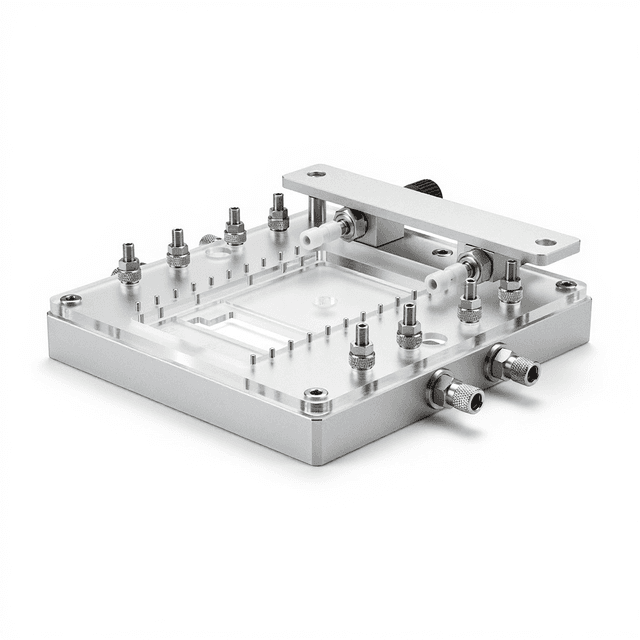
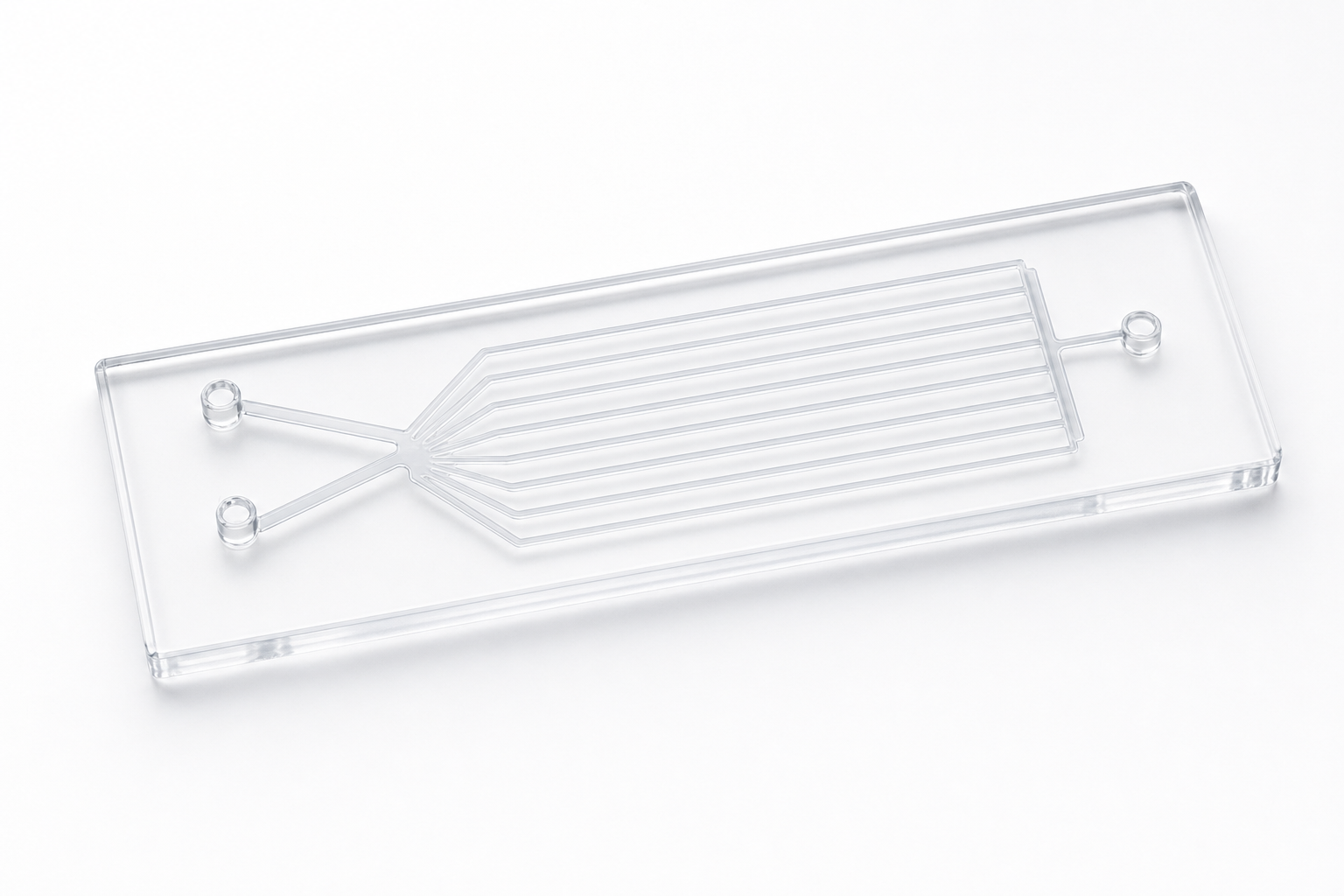
8-channel microfluidic chip with 40 μm depth channels designed for parallel drug screening and dose-response studies in pharmaceutical research.
Reusable chip — designed for multiple experimental runs. Compatible with standard microfluidic tubing: steel pins (0.7 mm ID / 1.0 mm OD) and silicone tubing (0.8 mm ID / 1.9 mm OD). Available in bulk packs (5‑, 10‑, and 25‑unit) for lab-scale and consumable workflows.

Louise Corscadden, PhD
Director of Science · ConductScience
Ask Louise about 8-Channel Drug Screening Microfluidic Chip fit, setup, configuration, or quote prep.
Already working with us? Sign in to connect this with My Scientist.
Key Specifications
Full details →- Model fit
- 3 selectable configurations
- SKU family
- WHM-0017
- Shipping box
- 25.0 x 15.0 x 3.0 cm
- Ordering
- Online checkout and quote request available
- Category
- Lab Equipment
- Build notes
- Confirm accessories, station layout, and support needs before purchase
The 8-Channel Drug Screening Microfluidic Chip provides parallel concentration gradient generation for pharmaceutical dose-response characterization. Eight independent microchannels with 40 μm depth enable simultaneous testing of multiple drug concentrations or compounds under identical environmental conditions. The chip architecture supports laminar flow-based gradient formation, allowing researchers to establish stable concentration profiles across the channel network for quantitative pharmacological assessment.
This microfluidic platform addresses the need for standardized, high-throughput drug screening workflows in pharmaceutical research. The multi-channel design reduces experimental variability by maintaining consistent flow dynamics and environmental parameters across all test conditions, while the 40 μm channel depth accommodates various cell culture applications and microscopy protocols commonly used in drug discovery pipelines.
How It Works
The microfluidic chip operates on laminar flow principles to generate stable concentration gradients across the eight parallel channels. Sample and buffer solutions are introduced at designated inlets, where controlled flow rates establish predictable mixing ratios. The 40 μm channel depth maintains laminar flow conditions while providing sufficient volume for cell culture applications and optical access for microscopy.
Concentration gradients form through diffusion-based mixing at channel junctions, creating distinct drug concentrations in each of the eight channels. The chip geometry ensures consistent flow velocity and shear stress across all channels, minimizing variability in cellular exposure conditions. This parallel architecture allows simultaneous dose-response characterization, reducing experimental time and improving statistical power compared to sequential testing approaches.
Features & Benefits
Shipping weight
- 0.03 lb
Shipping box
- L: 25.0 cm
- W: 15.0 cm
- H: 3.0 cm
| Feature | This Product | Typical Alternative | Advantage |
|---|---|---|---|
| Channel Number | 8 parallel channels | Entry-level devices often provide 2-4 channels | Higher throughput screening with improved statistical power for dose-response studies |
| Channel Depth | 40 μm depth | Depths vary from 20-100 μm depending on application | Optimized for cell culture while maintaining optical compatibility with standard microscopy |
| Application Focus | Drug screening and dose-response studies | General-purpose microfluidic platforms may lack optimization for pharmaceutical workflows | Purpose-built design specifically addresses requirements of drug discovery protocols |
| Form Factor | 25 × 15 × 3 mm dimensions | Chip sizes vary widely based on channel complexity | Compact design fits standard microscope stages while accommodating multiple test conditions |
This 8-channel microfluidic chip provides higher throughput than typical entry-level devices while maintaining the precision required for pharmaceutical dose-response studies. The 40 μm channel depth and compact form factor optimize the balance between cell culture requirements and optical accessibility.
| Model | SKU | Listed price | Status | Shipping box |
|---|---|---|---|---|
| 25-Pack | WHM-0017-25PK | Quote | Available | 25.0 x 15.0 x 3.0 cm |
| 10-Pack | WHM-0017-10PK | $1,490.00 | Available | 25.0 x 15.0 x 3.0 cm |
| 5-Pack | WHM-0017-5PK | Quote | Available | 25.0 x 15.0 x 3.0 cm |
Practical Tips
Prime all channels with buffer solution before introducing cells to ensure uniform flow distribution and eliminate air bubbles.
Why: Air bubbles disrupt laminar flow and create unpredictable mixing patterns that compromise gradient stability.
Use fluorescent tracers to map concentration profiles across channels before drug experiments.
Why: Visual verification of gradient formation ensures experimental validity and helps optimize flow rate ratios.
Clean channels immediately after experiments using appropriate solvents to prevent protein or cell debris accumulation.
Why: Residue buildup alters flow characteristics and can interfere with subsequent gradient formation.
Monitor flow rates continuously during experiments to detect any pump irregularities or channel blockages.
Why: Flow rate variations directly impact concentration gradients and can invalidate dose-response measurements.
If gradients appear unstable, reduce flow rates to ensure laminar conditions are maintained throughout the channel network.
Why: Turbulent flow disrupts diffusion-based mixing and creates unpredictable concentration distributions.
Handle chips with appropriate PPE when working with cytotoxic compounds, as the open channel design allows direct exposure.
Why: Microfluidic systems can generate aerosols during loading or disconnection procedures.
Setup Guide
What’s in the Box
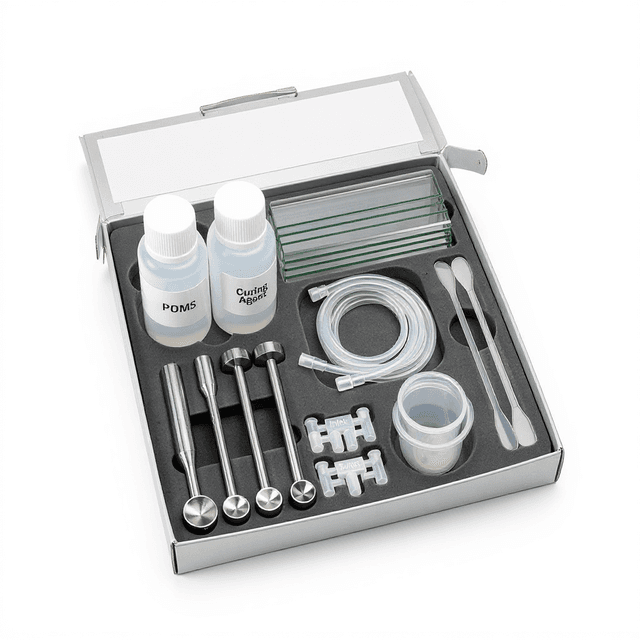
- 8-Channel microfluidic chip
- Inlet/outlet connectors (typical)
- User manual with flow rate recommendations (typical)
- Quality control certificate (typical)
Warranty
ConductScience provides a standard one-year warranty covering manufacturing defects and technical support for setup and operation protocols.
Compliance
References
Background reading relevant to this product:
What flow rates are recommended for stable gradient formation?
Consult product datasheet for specific flow rate recommendations. Generally, laminar flow conditions require low Reynolds numbers, typically achieved with flow rates between 0.1-10 μL/min per channel.
Is the chip compatible with live cell imaging systems?
Yes, the PDMS construction provides optical transparency and the 40 μm depth is compatible with standard microscopy objectives for real-time monitoring.
Can the chip be reused for multiple experiments?
Reusability depends on experimental conditions and cleaning protocols. Consult manufacturer guidelines for specific decontamination procedures and reuse limitations.
What cell densities work best in the 40 μm channels?
Cell density optimization depends on cell type and experimental timeline. The channel depth accommodates most adherent cell lines with appropriate seeding concentrations.
How do I verify concentration gradients across channels?
Use fluorescent tracers or analytical measurement to characterize gradient profiles before drug application. This ensures proper mixing ratios and flow stability.
What pump systems are compatible with this chip?
Standard syringe pumps or pressure-driven systems work effectively. Choose pumps capable of precise flow control in the μL/min range for optimal gradient formation.
Have a question about this product?
Have a question? Just ask.
Send it over and we'll email you a personalized answer — no call, no scheduling.
Prefer to talk it through?