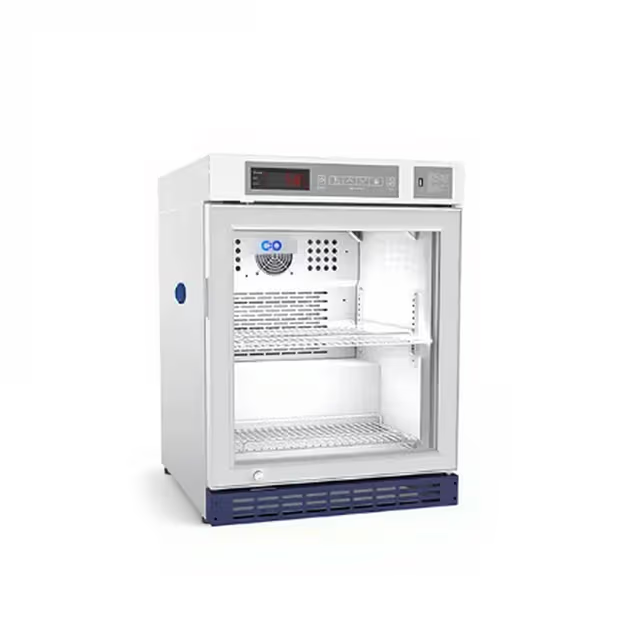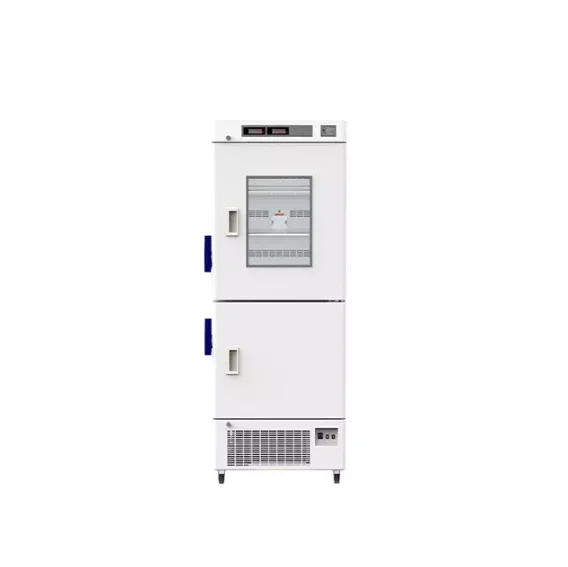
-25°C Freezer (Separate Refrigerator)
Dual-compartment laboratory storage system combining 2-8°C refrigeration and -10 to -25°C freezing capabilities with 0.1°C temperature accuracy and microprocessor-based monitoring for comprehensive sample preservation.

Louise Corscadden, PhD
Neuroscience · ConductScience
Ask Louise about -25°C Freezer (Separate Refrigerator) fit, setup, configuration, or quote prep.
Already working with us? Sign in to connect this with My Scientist.
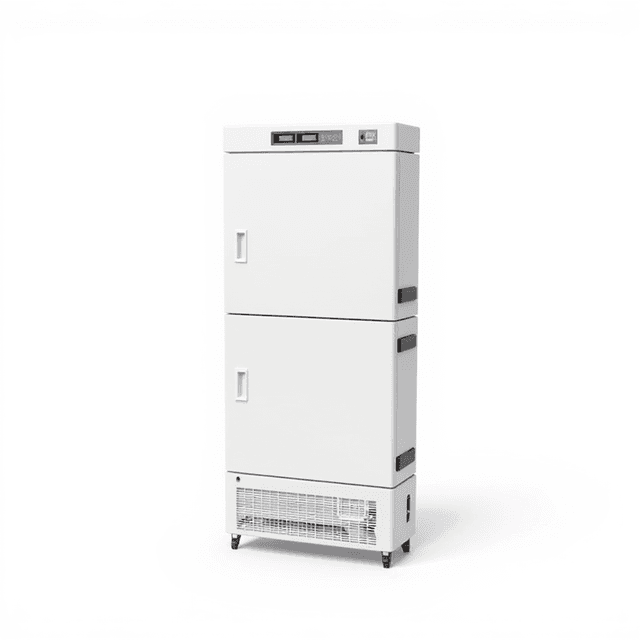
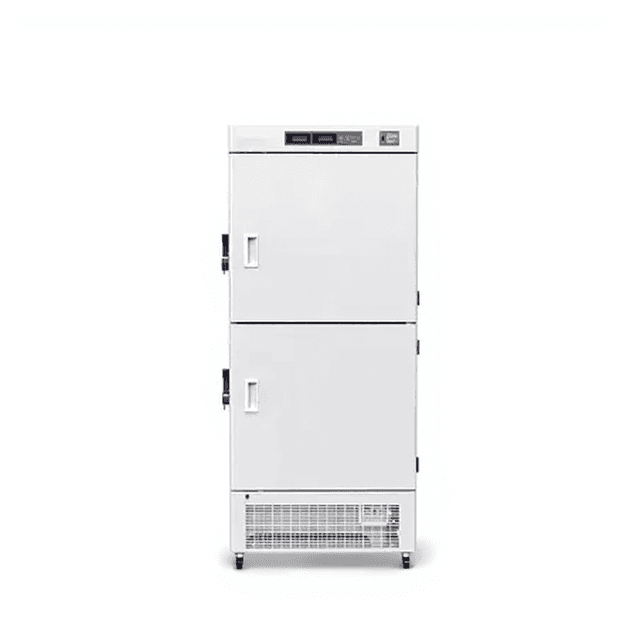
The -25°C Freezer (Separate Refrigerator) is a dual-compartment laboratory storage system designed for temperature-sensitive biological samples, reagents, and specimens. The unit combines a 2-8°C refrigerator compartment with a -10 to -25°C freezer compartment in a single vertical housing, providing comprehensive cold storage capabilities for research environments. Available in four capacity configurations ranging from 300L to 450L total volume, each model maintains precise temperature control with 0.1°C accuracy and microprocessor-based monitoring.
The system features independent temperature zones optimized for different storage requirements: the refrigerator compartment maintains standard laboratory refrigeration temperatures while the freezer section achieves sub-zero temperatures suitable for sample preservation protocols requiring temperatures below standard freezing. Comprehensive alarm systems monitor both compartments for temperature deviations, power failures, and door status, with power failure protection extending up to 72 hours on selected models. Temperature uniformity is maintained within ±2°C throughout each compartment, with stability performance of ±3°C during normal operation.
How It Works
The dual-compartment system operates through independent refrigeration circuits designed to maintain distinct temperature zones within a single housing unit. The refrigerator compartment utilizes standard vapor-compression refrigeration to maintain temperatures between 2-8°C, employing forced-air circulation to ensure uniform temperature distribution throughout the storage volume. Temperature sensors positioned strategically within each compartment continuously monitor thermal conditions and relay data to the microprocessor-based control system.
The freezer compartment employs enhanced cooling capacity to achieve temperatures from -10°C to -25°C, utilizing additional insulation and specialized refrigeration components optimized for sub-zero operation. The microprocessor control system manages both temperature zones independently, allowing simultaneous operation at different setpoints while maintaining the specified accuracy of ±0.1°C. Temperature uniformity within ±2°C is achieved through optimized air circulation patterns and thermal management systems designed to minimize temperature gradients across the storage volume.
Comprehensive monitoring systems track temperature performance, door status, and power conditions for both compartments. Alarm protocols activate when temperature deviations exceed programmed limits, during power interruptions, or when door-open conditions persist beyond safe durations. The system maintains temperature stability within ±3°C during normal operation, with power failure protection systems designed to preserve sample integrity during electrical outages.
Features & Benefits
Model
- BIO-BRF-25V300
- BIO-BRF-25V318
- BIO-BRF-25V368
- BIO-BRF-25V450
Automation Level
- semi-automated
Temperature Accuracy
- 0.1°C
Temperature Uniformity
- ≤2°C
Temperature Stability
- ≤3°C
Internal Dimensions (W×D×H)
- 580×613×1325mm
External Dimensions (W×D×H)
- 680×747×1885mm
Research Domain
- Analytical Chemistry
- Cancer Research
- Cell Biology
- Clinical Diagnostics
- Developmental Biology
- Histopathology
- Immunology
- Microbiology
- Pharmaceutical QC
Capacity
- 450L
Temperature Range
- 2~8°C
Power/Voltage
- 220W
Weight
- 135kg
Weight
- 297.62 kg
Dimensions
- L: 52.17 mm
- W: 24.13 mm
- H: 22.83 mm
| Feature | This Product | Typical Alternative | Advantage |
|---|---|---|---|
| Temperature Accuracy | ±0.1°C accuracy with microprocessor control | Entry-level models often provide ±0.5°C to ±1.0°C accuracy | Enhanced precision supports protocols requiring strict temperature validation and regulatory documentation. |
| Storage Configuration | Dual-compartment design with independent refrigerator and freezer zones | Most units offer single-compartment storage requiring separate units for different temperature ranges | Eliminates need for multiple storage units while maintaining thermal isolation between temperature zones. |
| Temperature Uniformity | ±2°C uniformity throughout each compartment | Basic models may have ±5°C to ±10°C temperature variations | Reduces sample-to-sample temperature variability that could affect experimental reproducibility. |
| Monitoring System | Microprocessor-based control with comprehensive alarm monitoring | Simple thermostat control with basic alarm functions | Provides continuous monitoring and advanced alarm capabilities for enhanced sample security. |
| Power Failure Protection | Up to 72 hours thermal protection on selected models | Basic units may offer limited thermal retention during outages | Extends sample preservation time during electrical interruptions to prevent sample loss. |
| Storage Capacity | 450L total volume in compact vertical footprint | Comparable capacity often requires larger floor space or separate units | Maximizes storage density for laboratories with limited space availability. |
The system combines precise temperature control (0.1°C accuracy), dual-compartment flexibility, and comprehensive monitoring in a space-efficient design. The microprocessor-based control system and enhanced thermal protection provide advanced sample security features for critical storage applications.
Practical Tips
Perform temperature mapping quarterly using multiple calibrated sensors placed throughout each compartment to verify uniformity specifications.
Why: Temperature uniformity can change over time due to door seal wear or circulation system changes.
Clean condenser coils monthly and inspect door seals for wear to maintain energy efficiency and temperature performance.
Why: Dirty condensers reduce cooling efficiency while damaged seals cause temperature fluctuations and increased power consumption.
Allow samples to equilibrate to storage temperature gradually rather than placing warm items directly into compartments.
Why: Thermal shock can cause temporary temperature excursions affecting other stored samples and stressing the cooling system.
Document temperature excursions immediately and evaluate sample integrity based on storage requirements and exposure duration.
Why: Temperature deviations can compromise sample stability, requiring assessment before use in critical applications.
If temperature uniformity decreases, check for blocked air circulation vents and redistribute storage items to improve airflow.
Why: Poor air circulation creates temperature gradients that can exceed the ±2°C uniformity specification.
Install backup monitoring systems with independent sensors for critical sample storage applications.
Why: Redundant monitoring provides additional protection against system failures that could result in sample loss.
Maintain detailed storage logs including sample locations, storage dates, and temperature conditions for traceability.
Why: Documentation supports quality systems and enables rapid assessment of sample integrity during temperature events.
Test alarm functions monthly by triggering door alarms and temperature deviation alerts to verify proper operation.
Why: Alarm system failures can go undetected until critical events occur, potentially resulting in sample loss.
Setup Guide
What’s in the Box
- Main dual-compartment freezer unit
- Temperature monitoring sensors (typical)
- User manual and technical documentation (typical)
- Power cord and electrical connections (typical)
- Storage shelves and compartment organizers (typical)
- Temperature calibration certificate (typical)
Warranty
ConductScience provides a standard 1-year manufacturer warranty covering parts and technical support. Extended warranty options and service contracts are available for enhanced coverage and preventive maintenance programs.
Compliance
References
Background reading relevant to this product:
What temperature mapping protocols should be performed to validate storage uniformity?
Perform temperature mapping using calibrated thermometers placed at multiple locations within each compartment, including corners, center, and near doors. Monitor for 24 hours to verify ±2°C uniformity specification and document thermal gradients before sample loading.
How does the power failure protection system maintain sample integrity during outages?
The system includes insulation and thermal mass designed to maintain temperatures during power interruptions. Alarm systems activate immediately during power loss, and selected models provide up to 72 hours of thermal protection depending on ambient conditions and door access frequency.
Can both compartments be set to the same temperature range if needed?
No, the compartments are designed for distinct temperature ranges - the refrigerator compartment operates at 2-8°C while the freezer compartment operates at -10 to -25°C. Each zone is optimized for its specific temperature range and cannot cross over.
What calibration procedures are required for temperature accuracy verification?
Use NIST-traceable thermometers to verify temperature accuracy at setpoints. Perform calibration checks at multiple temperature points within each compartment's operating range, documenting actual vs. displayed temperatures to confirm ±0.1°C accuracy specification.
How should samples be organized to maintain temperature uniformity throughout the compartments?
Avoid overloading compartments and maintain air circulation pathways around stored items. Use perforated containers when possible and distribute thermal mass evenly to prevent temperature gradients. Leave space around air circulation vents and temperature sensors.
What data logging capabilities are available for temperature monitoring documentation?
Consult product datasheet for specific data logging features. The microprocessor-based system provides continuous monitoring, though external data loggers may be required for comprehensive documentation depending on regulatory requirements.
How does this compare to separate single-compartment refrigerator and freezer units?
The dual-compartment design provides space efficiency and centralized monitoring compared to separate units, while maintaining independent temperature control. Single-compartment units may offer larger individual storage volumes but require more laboratory space and separate monitoring systems.
What maintenance procedures are required to maintain temperature performance?
Perform regular door seal inspection, condenser cleaning, and temperature sensor verification. Schedule periodic professional maintenance for refrigeration system components and alarm function testing to ensure continued performance within specifications.
Have a question about this product?