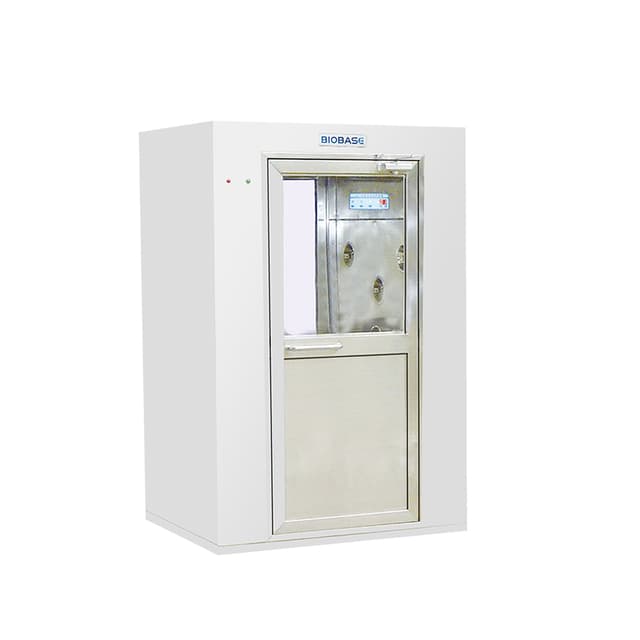
Laminar Air Flow Pass Box For Clean Room
Stainless steel pass-through chamber with laminar airflow and UV sterilization for sterile material transfer between cleanroom zones.
| Automation Level | semi-automated |
| External Size(W*D*H)mm | 520*460*480 |
| Internal Size(W*D*H)mm | 400*400*400 |
| Interlock | Mechanical |
| UV Lamp | T5, 8W |
| Gross Weight(Kg) | 17 |

The Laminar Air Flow Pass Box provides sterile material transfer between cleanroom environments of different classification levels. Constructed from 304 stainless steel with a 400×400×400mm internal chamber, this pass-through system maintains contamination control during inter-zone transfers through HEPA-filtered laminar airflow and mechanical interlocking doors.
The unit features a T5 8W UV sterilization lamp for surface decontamination between transfer cycles. The mechanical interlock prevents simultaneous opening of both doors, ensuring pressure differentials and air classification integrity are maintained across cleanroom boundaries. The compact external dimensions (520×460×480mm) allow integration into existing cleanroom wall configurations.
How It Works
The pass box operates on laminar airflow principles to maintain sterile conditions during material transfer. HEPA-filtered air creates unidirectional flow within the chamber, sweeping potential contaminants away from transferred materials. The laminar flow pattern minimizes turbulence and cross-contamination risk during the transfer process.
UV sterilization provides additional bioburden reduction through germicidal irradiation at 254nm wavelength. The T5 8W lamp delivers sufficient UV-C energy density for surface decontamination of transferred items and chamber surfaces between cycles.
Mechanical interlocking prevents simultaneous door operation, maintaining pressure differentials between connected spaces. This ensures that air classification levels are preserved and prevents uncontrolled air exchange between environments of different cleanliness standards.
Features & Benefits
Automation Level
- semi-automated
External Size(W*D*H)mm
- 520*460*480
Internal Size(W*D*H)mm
- 400*400*400
Interlock
- Mechanical
UV Lamp
- T5, 8W
Gross Weight(Kg)
- 17
Package Size(W*D*H)mm
- 580*530*830
Brand
- ConductScience
Research Domain
- Cell Biology
- Clinical Diagnostics
- Environmental Monitoring
- Food Science
- Microbiology
- Pharmaceutical QC
Material
- 304 stainless steel
Power/Voltage
- 220V, 50Hz
Weight
- 37.48 kg
Dimensions
- L: 15.75 mm
- W: 15.75 mm
- H: 15.75 mm
Comparison Guide
| Feature | This Product | Typical Alternative | Advantage |
|---|---|---|---|
| Construction Material | 304 Stainless Steel | Entry-level models often use powder-coated steel or aluminum construction | Superior chemical resistance and durability for aggressive cleanroom decontamination protocols. |
| Chamber Volume | 64 liters (400×400×400mm) | Compact units typically offer 20-40 liter capacity | Larger volume accommodates multiple items or larger equipment in single transfer cycles. |
| Sterilization Method | T5 8W UV lamp integrated | Basic models rely solely on airflow filtration | UV sterilization provides additional bioburden reduction for enhanced contamination control. |
| Door Interlock System | Mechanical interlock mechanism | Electronic interlock systems are common in higher-end models | Mechanical system provides reliable operation without dependency on electrical controls or sensors. |
| Footprint Integration | 520×460×480mm external dimensions | Wall-mount units vary significantly in installation requirements | Compact design allows retrofit installation in existing cleanroom wall systems. |
This pass box combines stainless steel durability with integrated UV sterilization and mechanical interlock reliability. The 64-liter chamber capacity and compact wall-mount design provide practical material transfer capabilities for most cleanroom applications.
Practical Tips
Verify UV lamp output annually using UV meters to ensure adequate germicidal irradiation levels.
Why: UV lamp intensity degrades over time, reducing sterilization effectiveness.
Clean stainless steel surfaces with compatible disinfectants following each use cycle to prevent residue buildup.
Why: Regular cleaning maintains surface sterility and prevents contamination of subsequent transfers.
Allow minimum UV exposure time based on material bioburden levels and establish consistent transfer protocols.
Why: Standardized procedures ensure reproducible decontamination results across all transfers.
If doors bind during operation, check for proper alignment and lubricate hinges with cleanroom-compatible lubricants.
Why: Smooth door operation prevents seal damage and maintains proper interlock function.
Document transfer logs including items, UV exposure duration, and any deviations from standard protocols.
Why: Transfer records support contamination investigations and process validation requirements.
Ensure UV exposure cycles complete before door opening and avoid direct eye exposure to UV radiation.
Why: UV-C radiation can cause eye and skin damage during direct exposure.
Pre-clean items before placement in the pass box to maximize UV sterilization effectiveness on surfaces.
Why: Heavy contamination or debris can shield microorganisms from UV irradiation.
Setup Guide
What’s in the Box
- Laminar air flow pass box unit
- T5 8W UV sterilization lamp
- Power connection hardware
- Installation mounting brackets (typical)
- Operating manual
- Performance verification certificate (typical)
Warranty
ConductScience provides a one-year manufacturer warranty covering mechanical components and UV lamp functionality, with technical support for installation guidance and operational troubleshooting.
Compliance
What is the air change rate and filtration efficiency of the laminar airflow system?
Consult product datasheet for specific airflow rates and HEPA filter efficiency specifications, as these parameters determine contamination control effectiveness.
Can the UV lamp intensity be adjusted for different sterilization cycle durations?
The T5 8W lamp operates at fixed intensity; sterilization effectiveness is controlled through exposure duration based on material bioburden requirements.
What maintenance schedule is recommended for the UV lamp and airflow system?
UV lamps typically require annual replacement for maintained germicidal effectiveness, while HEPA filters need periodic integrity testing and replacement based on pressure differential monitoring.
Is the pass box suitable for transferring temperature-sensitive materials?
The unit maintains ambient temperature; materials requiring controlled temperature during transfer may need additional thermal management systems.
How does the mechanical interlock system prevent simultaneous door access?
The mechanical system physically prevents opening of one door when the opposite door is open, maintaining pressure differentials without electronic controls.
Can the internal chamber dimensions accommodate standard laboratory equipment?
The 400×400×400mm chamber accommodates most standard laboratory containers, equipment, and material batches within the specified volume constraints.
Have a question about this product?