Mammalian Diving Response Apparatus
Clear acrylic apparatus with five swim channels for investigating mammalian diving reflex and underwater navigation behavior in rodents through controlled submersion protocols.

Louise Corscadden, PhD
Director of Science · ConductScience
Ask Louise about Mammalian Diving Response Apparatus fit, setup, configuration, or quote prep.
Already working with us? Sign in to connect this with My Scientist.
Key Specifications
Full details →- Model fit
- Mouse, Rat
- SKU family
- CS-958333
- Sizing
- 65.0 x 36.0 x 27.0 cm
- Ordering
- Online checkout and quote request available
- Category
- Behavioral Mazes
- Build notes
- Clear Acrylic
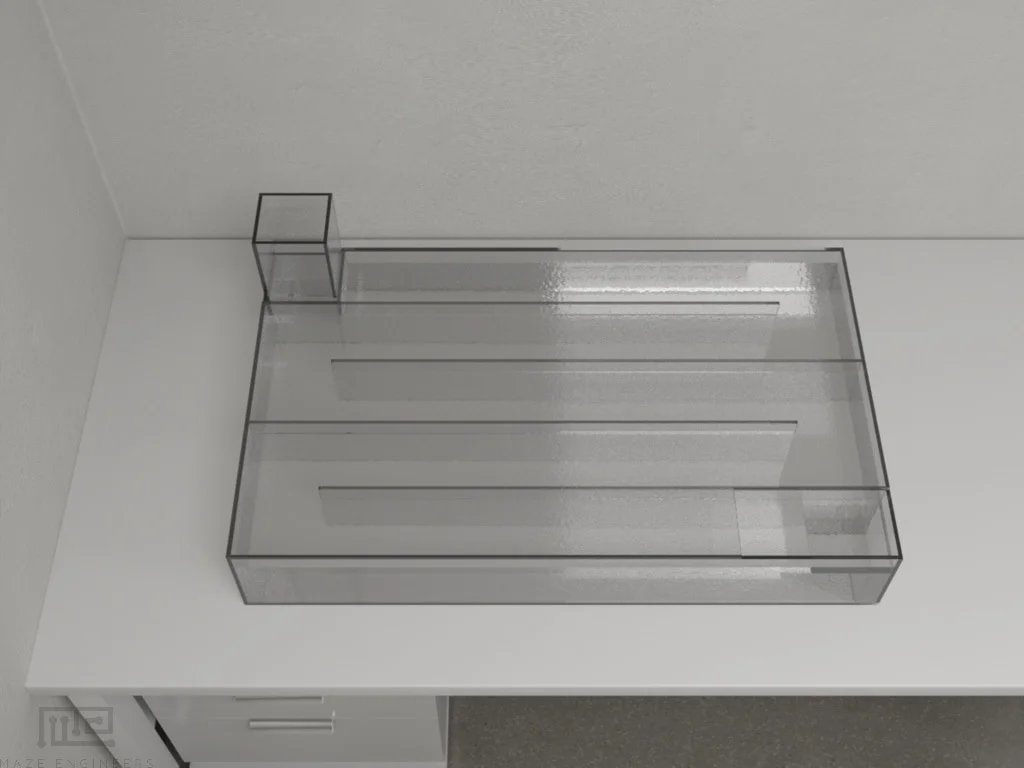
The Mammalian Diving Response Apparatus investigates the physiological diving reflex in rodents, a conserved autonomic response characterized by apnea, bradycardia, and altered blood flow distribution during submersion. This clear acrylic apparatus provides a controlled environment for studying the central integrative aspects of diving behavior through underwater swimming tasks.
The system features five individual swim channels with removable dividers, allowing researchers to test multiple subjects simultaneously or modify channel configurations for experimental protocols. Subjects are trained progressively from open water swimming to navigating underwater tunnels, ultimately swimming submerged to reach an escape platform at the diagonal opposite end of the maze. This protocol enables quantitative assessment of diving-induced physiological responses and adaptive behaviors in mice and rats.
How It Works
The mammalian diving response represents an evolutionarily conserved physiological mechanism that optimizes oxygen utilization during submersion. When subjects enter the water-filled channels and submerge, trigeminal nerve stimulation triggers vagal activation, resulting in immediate bradycardia, apnea, and peripheral vasoconstriction that redirects blood flow to vital organs including the brain and heart.
The apparatus exploits this reflex by requiring subjects to swim underwater through confined channels to reach an escape platform. The clear acrylic construction allows direct observation of swimming behavior while the removable dividers enable modification of channel width and complexity. The platform elevator in the start chamber provides controlled entry conditions, while the diagonal placement of the escape platform ensures consistent swimming distance and submersion duration across trials.
Physiological monitoring during these trials captures the magnitude and kinetics of diving response parameters, while behavioral measures assess navigation performance, escape latency, and adaptive learning under hypoxic stress conditions.
Features & Benefits
Number of Swim Channels
- 5
Channel Width
- 8 cm
Divider Type
- Removable acrylic dividers
Lid Type
- Clear acrylic lid with openings
Start Chamber
- Removable chamber with platform elevator
Escape Platform
- Platform at diagonal opposite end
Behavioral Construct
- diving reflex
- underwater navigation
- escape behavior
- spatial learning
- stress response
- bradycardia response
Automation Level
- manual
Material
- Clear Acrylic
Dimensions
- 67 cm x 40 cm x 10 cm
Research Domain
- Anxiety and Depression
- Behavioral Pharmacology
- Cardiovascular Research
- Learning and Memory
- Neuroscience
- Pain Research
Compatible Tracking Software
- ConductVision
Weight
- 6.06 kg
Dimensions
- L: 65.0 mm
- W: 36.0 mm
- H: 27.0 mm
| Feature | This Product | Typical Alternative | Advantage |
|---|---|---|---|
| Number of Test Channels | 5 individual swim channels | Single chamber or 2-3 channel systems | Higher experimental throughput while maintaining individual subject tracking and reduced between-subject variability |
| Channel Width Standardization | Consistent 8 cm lane width across all channels | Variable or wider channel dimensions | Ensures uniform swimming conditions and comparable physiological stress levels across all subjects |
| Platform Configuration | Diagonal escape platform with elevator start chamber | Fixed platform placement or manual subject introduction | Standardized swimming distance and controlled trial initiation reduces protocol variability |
| Visual Monitoring Access | Clear acrylic construction with transparent lid | Opaque materials or limited viewing angles | Complete behavioral observation and video recording capabilities for comprehensive data collection |
| Configuration Flexibility | Removable dividers for channel modification | Fixed chamber designs | Adaptable to multiple experimental protocols and research questions within single apparatus investment |
This apparatus combines multi-channel efficiency with standardized diving protocols through clear acrylic construction and flexible configuration options. The diagonal platform placement and controlled entry system provide consistent experimental conditions while accommodating both mouse and rat studies in species-specific dimensions.
| Model | SKU | Listed price | Status | Dimensions |
|---|---|---|---|---|
| Rat | CS-958333 | $3,490.00 | Available | 100 x 60 x 15 cm |
| Mouse | CS-958333 | $2,990.00 | Available | 67 x 40 x 10 cm |
Practical Tips
Verify water level consistency across all channels before each session using a precise depth gauge.
Why: Even small variations in water depth can significantly affect submersion requirements and diving response magnitude.
Clean acrylic surfaces with non-abrasive cleaners and inspect divider seals regularly for watertight integrity.
Why: Scratched surfaces impair visual monitoring while seal failures create uneven water levels between channels.
Establish consistent inter-trial intervals of 24-48 hours to prevent habituation of diving responses.
Why: Repeated exposure can diminish physiological response magnitude and alter behavioral performance patterns.
If subjects avoid submersion, gradually reduce water level over training sessions rather than forcing immediate deep water exposure.
Why: Sudden depth changes can induce excessive stress responses that confound diving reflex measurements.
Record ambient temperature, humidity, and lighting conditions as these environmental factors influence diving behavior.
Why: Environmental variables can affect baseline physiological parameters and swimming performance consistency.
Position emergency retrieval tools and establish maximum trial duration limits based on subject size and experimental protocol.
Why: Rapid intervention capability prevents hypoxic injury while predetermined endpoints ensure ethical compliance.
Use species-appropriate water temperature ranges and monitor continuously throughout testing sessions.
Why: Temperature deviations can alter metabolic demand and confound interpretation of diving response adaptations.
Setup Guide
What’s in the Box
- Clear acrylic apparatus frame (species-specific dimensions)
- Five removable acrylic dividers
- Clear acrylic lid with access openings
- Removable start chamber with platform elevator
- Escape platform assembly
- Assembly hardware and fittings
- User manual with protocol guidelines (typical)
Warranty
ConductScience provides a standard one-year manufacturer warranty covering structural defects and component failure under normal laboratory use conditions. Technical support includes protocol consultation and troubleshooting assistance for experimental setup optimization.
Compliance
What water depth is required for proper diving reflex activation?
Optimal water depth is typically 8-10 cm for mice and 12-15 cm for rats, sufficient to require full submersion for platform access while maintaining subject safety. Depth should be adjusted based on subject size and experimental requirements.
How do I control water temperature throughout extended testing sessions?
Maintain water temperature at 22-25°C using external heating/cooling systems or temperature-controlled water baths. Monitor continuously as temperature variations can significantly affect diving response magnitude and duration.
What physiological parameters can be monitored during diving trials?
Primary measurements include heart rate for bradycardia quantification, respiratory patterns, and swimming behavior. ECG telemetry or pulse oximetry can capture cardiovascular responses while underwater video tracking documents navigation performance.
How should subjects be trained before experimental testing?
Begin with open water swimming in shallow conditions, gradually introduce channel constraints, then reduce water levels to require submersion. Training typically requires 5-7 sessions over 1-2 weeks for consistent performance.
Can the channel configuration be modified for different experimental designs?
Yes, removable dividers allow creation of wider channels for group testing, maze configurations for spatial learning studies, or single large chamber for open water controls. All configurations maintain the escape platform requirement.
What safety considerations are essential for diving reflex studies?
Limit submersion duration to prevent hypoxic injury, maintain constant observation during trials, ensure rapid access to emergency intervention, and establish clear endpoint criteria for trial termination based on subject behavior.
How does this compare to forced swim test protocols?
Unlike forced swim tests focused on immobility and despair behavior, this apparatus specifically targets diving reflex physiology through goal-directed underwater navigation, providing distinct cardiovascular and respiratory measurements.
Have a question about this product?
Have a question? Just ask.
Send it over and we'll email you a personalized answer — no call, no scheduling.
Prefer to talk it through?
Accessories
Enhance your setup with compatible accessories