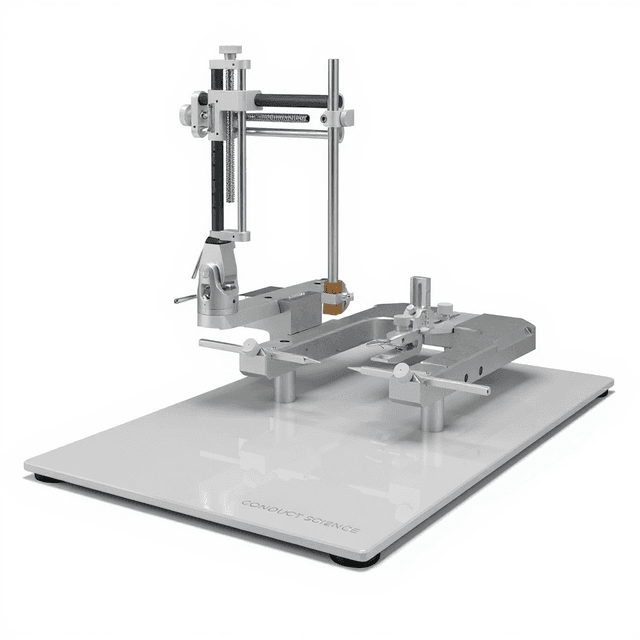
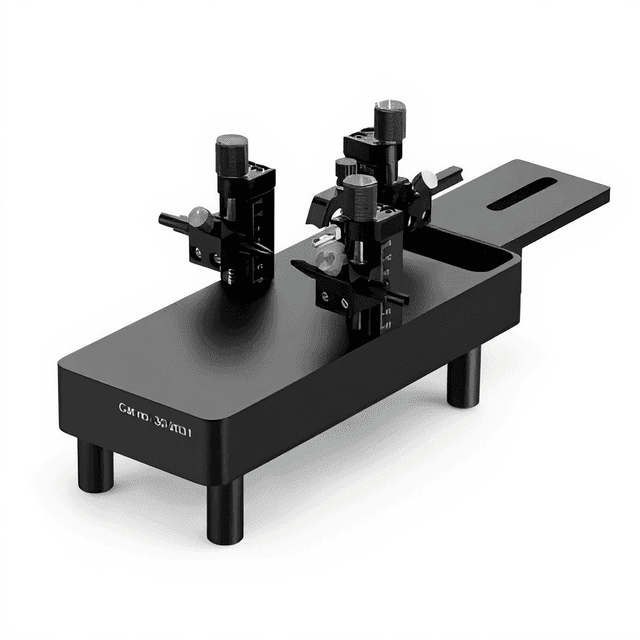
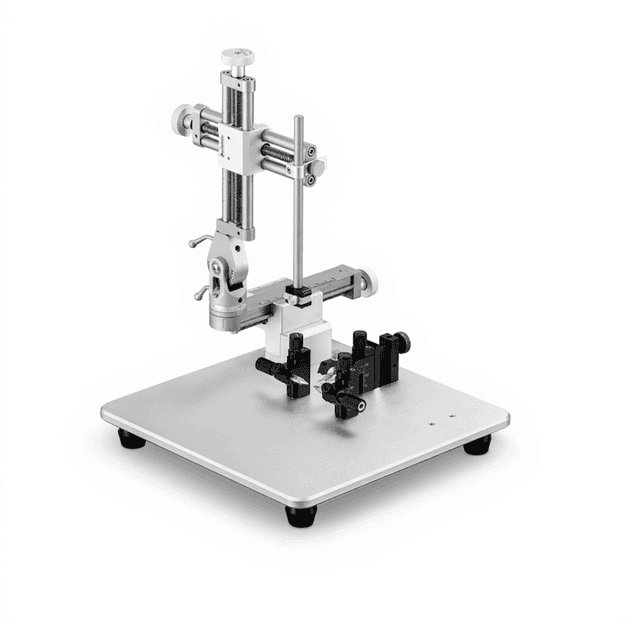
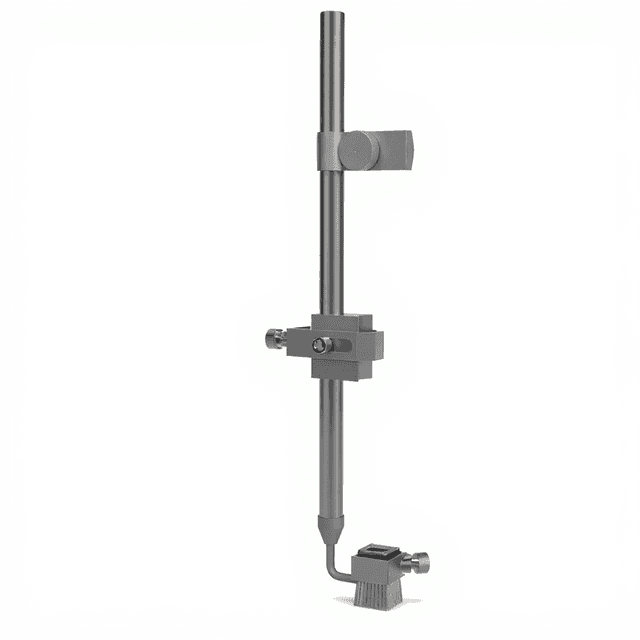
Manual Micro-Push Stereotaxic Injector (Holder Incl.)
Manual micro-push injector for precise stereotaxic delivery of 0-416.9 μL volumes with 0.167 μL resolution, compatible with 0-1000 μL syringes.
| micro-injection-stroke | 25mm |
| syringe_compatibility | 0-1000ul syringes |
| micro_push_stroke | 25mm |
| injection_extraction_volume | 0-416.9ul |
| volume_per_small_grid_movement | 0-0.167ul |
| Automation Level | manual |

The Manual Micro-Push Stereotaxic Injector is a precision mechanical injection system designed for accurate delivery of small volumes during stereotaxic procedures. This holder accommodates syringes ranging from 0 to 1000 μL capacity and provides controlled micro-injection with a 25 mm stroke length. The system enables precise volume delivery from 0 to 416.9 μL with fine adjustment capability of 0.167 μL per small grid movement.
The injector integrates with standard stereotaxic frames to facilitate targeted delivery of drugs, viral vectors, tracers, or other experimental compounds to specific brain coordinates. The manual micro-push mechanism allows researchers to control injection speed and pressure, critical factors for maintaining tissue integrity and ensuring accurate substance placement in neural structures.
How It Works
The manual micro-push stereotaxic injector operates through a precision mechanical advancement system that provides controlled linear movement of the syringe plunger. The 25 mm stroke mechanism allows for graduated volume delivery by translating rotational input into precise linear displacement. Each small grid movement corresponds to 0.167 μL volume change, enabling fine control over injection parameters.
The holder secures syringes of various sizes (0-1000 μL capacity) within the stereotaxic coordinate system, maintaining stable positioning during injection procedures. The manual operation allows researchers to control injection speed and pressure in real-time, adapting to tissue resistance and ensuring optimal substance delivery. This mechanical approach eliminates electrical artifacts that could interfere with concurrent electrophysiological recordings.
Features & Benefits
micro-injection-stroke
- 25mm
syringe_compatibility
- 0-1000ul syringes
micro_push_stroke
- 25mm
injection_extraction_volume
- 0-416.9ul
volume_per_small_grid_movement
- 0-0.167ul
Automation Level
- manual
Research Domain
- Addiction Research
- Anxiety and Depression
- Behavioral Pharmacology
- Learning and Memory
- Neurodegeneration
- Neuroscience
Species
- Gerbil
- Hamster
- Mouse
- Rat
- Guinea pig
Weight
- 2.87 kg
Dimensions
- L: 30.0 mm
- W: 25.0 mm
- H: 25.0 mm
Comparison Guide
| Feature | This Product | Typical Alternative | Advantage |
|---|---|---|---|
| Volume Resolution | 0.167 μL per grid movement | Basic holders often lack fine volume control | Enables precise dose-response studies and nanoliter-level experimental protocols |
| Syringe Compatibility Range | 0-1000 μL syringes | Limited to specific syringe sizes | Single system handles diverse experimental volume requirements without accessory changes |
| Maximum Injection Volume | 0-416.9 μL delivery range | Entry-level systems offer smaller volume ranges | Supports both small tracer studies and larger drug delivery protocols |
| Operation Mode | Manual micro-push control | Basic holders require manual syringe operation | Provides controlled advancement without full automation costs |
| Stroke Length | 25 mm advancement range | Shorter stroke lengths limit volume delivery | Accommodates complete volume delivery from larger syringes |
This injector combines precise volume control with versatile syringe compatibility in a mechanical system that eliminates electrical interference. The 0.167 μL resolution and 416.9 μL maximum volume range address most stereotaxic injection requirements.
Practical Tips
Verify volume accuracy by performing test injections with known volumes and measuring delivered amounts gravimetrically.
Why: Ensures accurate dose delivery for experimental reproducibility.
Clean the micro-push mechanism with appropriate solvents after each use to prevent solution buildup.
Why: Maintains smooth operation and prevents volume delivery errors.
Pre-wet the injection system with vehicle solution before loading experimental compounds.
Why: Eliminates dead volume effects and ensures accurate initial dose delivery.
Allow 1-2 minutes after needle insertion before beginning injection to minimize tissue displacement artifacts.
Why: Permits tissue settling and reduces substance backflow along needle track.
If injection resistance increases suddenly, stop and check for needle blockage or tissue compression.
Why: Prevents needle damage and ensures proper substance delivery to target site.
Always verify syringe clamp security before beginning injection procedures.
Why: Prevents syringe displacement that could cause inaccurate dosing or needle movement.
Record injection parameters including volume, rate, and any resistance changes for each animal.
Why: Enables identification of technical variables that might affect experimental outcomes.
Setup Guide
What’s in the Box
- Manual micro-push stereotaxic injector unit
- Syringe holder assembly
- Mounting hardware for stereotaxic frame attachment (typical)
- User manual and operating instructions (typical)
- Calibration reference guide (typical)
Warranty
ConductScience provides a standard one-year manufacturer warranty covering defects in materials and workmanship, with technical support for setup and operation guidance.
Compliance
What is the minimum injectable volume this system can accurately deliver?
The system provides 0.167 μL resolution per grid movement, making it suitable for precise small volume applications requiring nanoliter-level control.
Can this injector be used with Hamilton syringes of different sizes?
Yes, the holder accommodates syringes ranging from 0 to 1000 μL capacity, including standard Hamilton microsyringes commonly used in stereotaxic procedures.
How does manual operation affect injection consistency compared to automated systems?
Manual operation allows real-time adjustment of injection speed and pressure based on tissue resistance, potentially reducing mechanical trauma while requiring operator skill for consistent delivery.
What maintenance is required for the micro-push mechanism?
Regular cleaning of the advancement mechanism and periodic calibration verification ensure continued accuracy; consult product datasheet for specific maintenance intervals.
Is this injector compatible with concurrent electrophysiological recordings?
Yes, the mechanical operation eliminates electrical artifacts that could interfere with neural recording systems, making it suitable for combined injection-recording protocols.
What injection speeds are recommended for different tissue types?
Injection speed should be adjusted based on tissue density and experimental requirements; typical rates range from 0.1-1.0 μL/min for neural tissue to minimize damage.
Can the system handle viscous solutions like viral vectors?
The manual micro-push mechanism can accommodate viscous solutions, though injection speed may need adjustment and larger gauge needles may be required for optimal flow.
Have a question about this product?
Accessories
Enhance your setup with compatible accessories
Frequently Bought Together
Upgrade Options