ConductVision
$1,490 per yearA 5-year license is $3,990 in total.
The same license also scores standard tests such as the open field, the elevated plus maze, the Y-maze and the Morris water maze. Results export as CSV files.
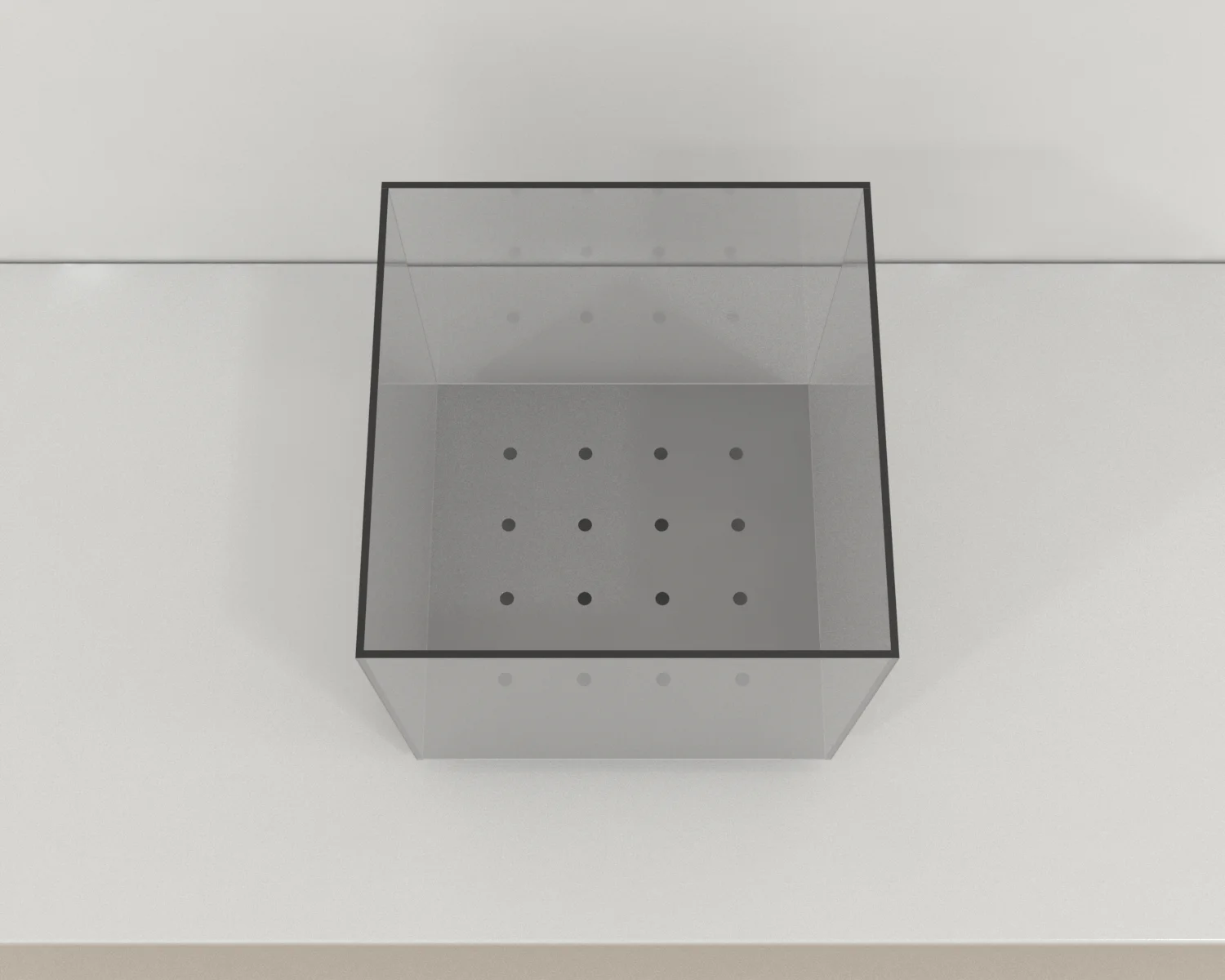
Behavioral apparatus combining hole-board exploration and open field testing to assess cognitive abilities, spatial discrimination, and anxiety-like behaviors in mice and rats across developmental stages.

Director of Science · ConductScience
Ask Louise about Neuwirth Hole Board Test fit, setup, configuration, or quote prep.
Already working with us? Sign in to connect this with My Scientist.
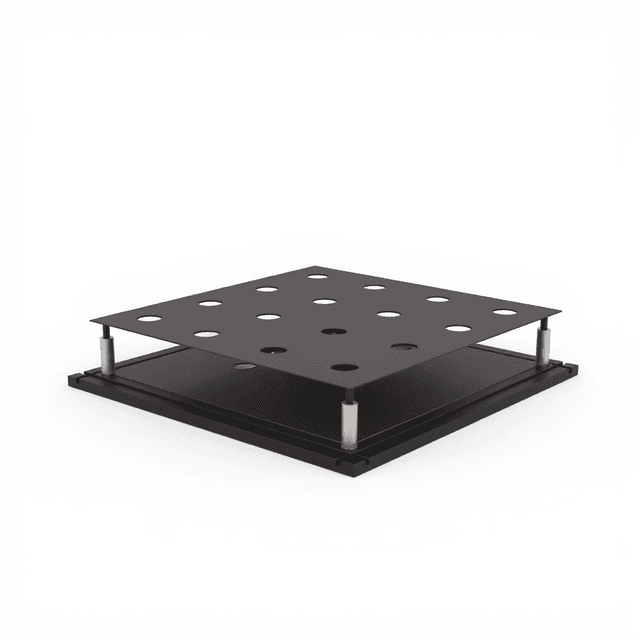
The Neuwirth Hole Board Test™ is an advanced behavioral apparatus designed to study spatial navigation strategies, including allocentric and egocentric orientation systems. It expands conventional rodent hole-board testing to examine anxiety-like behaviors and exploratory responses across different ages, strains, and sexes. The apparatus features sixteen holes positioned equally throughout the floor, with hole diameters optimized for different animal ages.
The system includes removable hole inserts to accommodate different experimental protocols and age groups, enabling measurement of spatial discrimination, learning, memory, and exploratory behaviors through systematic observation of head-poke frequencies, latencies, and freezing behaviors.
| Feature | Description |
|---|---|
| Dual-Day Protocol | First day for anxiety/fear assessment; second day for exploratory behaviors |
| Odor Discrimination | Incorporates contextual odor cues for spatial learning |
| Flexible Floor Inserts | Multiple floor types with varying hole sizes for developmental stages (1-inch for mature rats PND 55+; ½-inch for younger animals PND 22–55) |
| Cognitive Range | Tests learning, memory, habituation, risk assessment, and arousal |
| Pharmacological Use | Sensitive to drug manipulations, brain lesions, and neurodevelopmental models |
| Easy Maintenance | Odor-free design; simple cleaning with 70% ethanol |
| Configuration | Dimensions | Hole Diameter |
|---|---|---|
| Mouse Neuwirth Hole Board™ | 25 × 25 × 25 cm | 2 cm |
| Rat Neuwirth Hole Board™ | 50 × 50 × 50 cm | 2.54 cm |
Both configurations include removable hole inserts.
Professor Lorenz Neuwirth
Neuwirth, L. S., Volpe, N. P., Corwin, C., Ng, S., Madan, N., Ferraro, A. M., Furman, Y., & El Idrissi, A. (2017). Taurine Recovery of Learning Deficits Induced by Developmental Pb2+ Exposure. Advances in Experimental Medicine and Biology, 975 Pt 1, 39–55. https://doi.org/10.1007/978-94-024-1079-2_4
The Neuwirth Hole Board Test operates on the principle that rodents exhibit natural exploratory behaviors when presented with novel environments containing accessible openings. The apparatus exploits the inherent drive of rodents to investigate holes through head-poking behaviors, which serve as quantifiable measures of curiosity, spatial cognition, and anxiety states. The sixteen equally-spaced holes create a standardized spatial array that allows for systematic assessment of exploration patterns and spatial memory formation.
During testing, animals are placed in the center of the apparatus under controlled 300 Lux illumination. The standardized lighting conditions ensure consistent behavioral responses while avoiding extreme light levels that could induce stress or reduce exploration. Behavioral measures include latency to first head poke (reflecting initial anxiety or motivation), total frequency of head pokes (indicating overall exploratory drive), and freezing behaviors (demonstrating fear or anxiety responses). The two-day protocol allows for assessment of both initial novel exploration and subsequent familiar environment behavior.
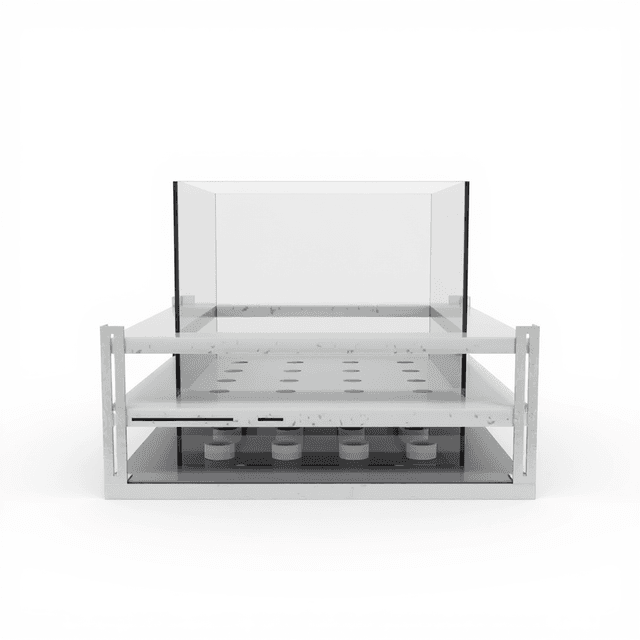
The removable hole insert system enables experimental flexibility by allowing researchers to modify hole accessibility or introduce spatial memory tasks. Petri dishes positioned beneath corner holes can accommodate food rewards, olfactory cues, or other experimental stimuli, transforming the basic exploration paradigm into more complex cognitive assessment protocols.
| Measurement | Mouse Neuwirth Hole-board™ | Rat Neuwirth Hole Board™ |
|---|---|---|
| Height | 25 cm | 50 cm |
| Width | 25 cm | 50 cm |
| Length | 25 cm | 50 cm |
| Diameter holes | 2 cm | 2.54 cm |
| Feature | This Product | Typical Alternative | Advantage |
|---|---|---|---|
| Hole Size Adaptability | Dual sizing system with ½-inch and 1-inch diameter holes plus removable inserts | Fixed hole dimensions requiring separate apparatus for different age groups | Enables longitudinal developmental studies and multi-age experimental designs with single apparatus investment. |
| Species Compatibility | Optimized dimensional scaling for mice (25cm) and rats (50cm) with age-appropriate hole spacing | Single-size models often compromise spatial scaling for one species | Provides natural exploration distances appropriate to each species' behavioral repertoire and body size. |
| Protocol Flexibility | Integrated corner petri dish positioning and removable hole insert system | Basic hole board designs without reward integration capabilities | Supports transition from simple exploration paradigms to complex spatial learning and memory protocols. |
| Cleaning Compatibility | 70% ethanol cleaning compatibility with odor-free construction materials | Materials may retain odors or require specialized cleaning protocols | Ensures consistent experimental conditions and prevents olfactory confounds that could bias behavioral results. |
This apparatus combines developmental adaptability through dual hole sizing, species-specific dimensional optimization, and integrated reward system compatibility. The modular design supports both basic exploration assessment and complex spatial cognitive protocols within a single platform.
| Model | Size | SKU | Listed price | Status | Shipping box |
|---|---|---|---|---|---|
| Mouse Neuwirth Hole-board™ | Height 25 cm · Width 25 cm · Length 25 cm · Diameter holes 2 cm | CS-958353 | $3,290.00 | Available | 25 x 25 x 25 cm |
| Rat Neuwirth Hole Board™ | Height 50 cm · Width 50 cm · Length 50 cm · Diameter holes 2.54 cm | CS-958353 | $3,690.00 | Available | 50 x 50 x 50 cm |
Verify 300 Lux illumination uniformity across the apparatus surface using a calibrated light meter before each experimental session.
Why: Uneven lighting creates environmental gradients that can bias exploration patterns and confound spatial behavior analysis.
Inspect hole insert alignment weekly and ensure all holes remain clear of debris or cleaning residue.
Why: Partially blocked holes alter exploration patterns and can create artificial location preferences in spatial memory tasks.
Allow animals 2-3 minutes of acclimation in a holding area adjacent to the apparatus before testing begins.
Why: Reduces initial stress responses that can mask natural exploratory behaviors and improve data reliability.
Randomize hole locations for reward placement across subjects to prevent location bias in spatial learning protocols.
Why: Prevents inadvertent training effects where specific apparatus areas become associated with rewards across the colony.
Record ambient room temperature and humidity during testing sessions as these can influence exploratory activity levels.
Why: Environmental conditions affect rodent activity patterns and should be documented for data interpretation and replication.
If animals show reduced exploration, verify that previous ethanol cleaning has completely dried and that room ventilation is adequate.
Why: Residual ethanol vapors or poor air circulation can suppress natural exploratory behaviors through olfactory irritation.
Ensure hole insert is properly secured before each session to prevent displacement during vigorous exploration.
Why: Loose inserts can shift during testing, creating safety hazards and invalidating spatial memory paradigms dependent on consistent hole positions.
Establish baseline exploration patterns for each animal strain and age group in your facility before beginning experimental manipulations.
Why: Strain and facility-specific behavioral baselines improve interpretation of treatment effects and experimental reproducibility.
ConductScience provides a standard one-year manufacturer warranty covering materials and workmanship defects. Technical support includes protocol consultation and troubleshooting assistance for optimal experimental implementation.
What behavioral parameters can be measured with this apparatus?
The system measures latency to first head poke, total frequency of head pokes, freezing behaviors, and spatial exploration patterns. Additional measures include locomotor activity and time spent in different apparatus regions for comprehensive behavioral phenotyping.
How do I select appropriate hole sizes for different age groups?
Use ½-inch diameter holes for mice or rats aged postnatal day 22-55 to prevent animals from falling through or becoming stuck. Standard 1-inch diameter holes are appropriate for mature rats beyond postnatal day 55.
What is the recommended test duration and protocol structure?
Standard protocol involves two-day testing under 300 Lux illumination. Session length varies by research question but typically ranges from 5-15 minutes per session to capture exploratory behavior without habituation effects.
Can this apparatus be used for spatial memory training paradigms?
Yes, the petri dish positioning beneath corner holes enables reward-based training protocols. Researchers can create spatial discrimination tasks by associating specific hole locations with food rewards or other reinforcement.
How should I clean the apparatus between subjects?
Clean all surfaces thoroughly with 70% ethanol and allow complete air drying before introducing the next animal. This eliminates olfactory cues that could influence exploratory behavior patterns.
What recording setup is recommended for behavioral analysis?
Position overhead video recording to capture the entire apparatus with clear visibility of all holes. Ensure adequate resolution to detect head-poke behaviors and sufficient frame rate for accurate temporal analysis.
Can I modify the apparatus for specific experimental needs?
The removable hole insert system allows protocol customization, and corner petri dish positions accommodate various experimental stimuli. Consult product datasheet for modification specifications and structural limitations.
How does this compare to standard open field testing?
This apparatus combines open field locomotor assessment with directed exploratory behavior measurement through hole investigation. This provides more comprehensive cognitive and anxiety-related behavioral phenotyping in a single test session.
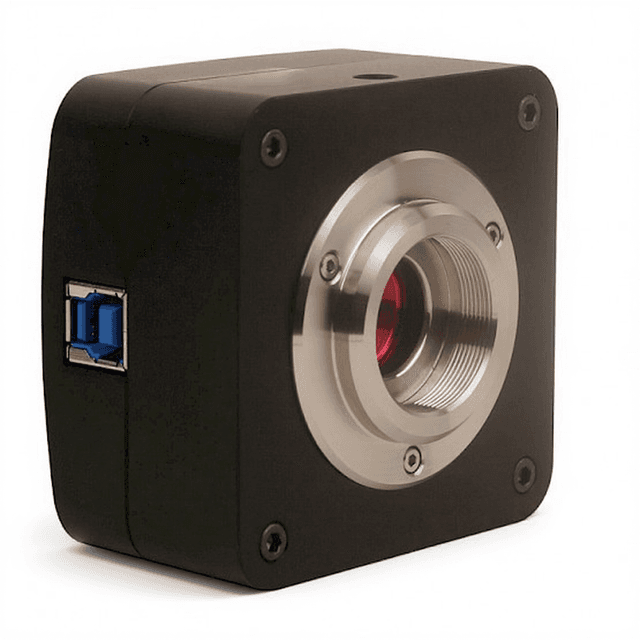
ConductVision is our video-tracking software. Record your sessions on video, and it reports the measures listed below.
A 5-year license is $3,990 in total.
The same license also scores standard tests such as the open field, the elevated plus maze, the Y-maze and the Morris water maze. Results export as CSV files.
Send it over and we'll email you a personalized answer — no call, no scheduling.
Prefer to talk it through?
Enhance your setup with compatible accessories
Creator Insights
Lorenz S. Neuwirth is a professor of biopsychology and developmental behavioral neuroscience at SUNY Old Westbury, where he is affiliated with the SUNY Neuroscience Research Institute. His research centers on developmental behavioral neurotoxicology — in particular how early-life lead (Pb2+) exposure disrupts the developmental GABA shift from excitatory to inhibitory signaling, and the consequences for learning, memory, and anxiety-related behavior. Working initially with his doctoral advisor Abdeslem El Idrissi, Neuwirth introduced a modified hole-board apparatus that adds spatial odor-discrimination locations to the standard exploratory holes, allowing anxiety-related behavior and spatial learning to be assessed in a single session. He has applied the apparatus across studies of lead neurotoxicity and the neuroprotective effects of taurine in rodent models.
To view Lorenz S. Neuwirth’s publications, visit PubMed.
Are you Lorenz S. Neuwirth? to review your photo and bio, and find out how to submit Creator Insights.
ConductScience celebrates method creators: researchers who, through rigorous and often ingenious experiments, develop the tools that reveal how the brain and body work. These are real scientific discoveries that become everyday instruments for the labs that follow.