Optogenetics Ceramic Ferrule & Fiber Optic
Precision ceramic ferrule fiber optic cannulae for optogenetics light delivery, featuring customizable core diameters (100-400μm), numerical apertures (0.22-0.39 NA), and wavelength compatibility from 400-2200nm.
| applicable_wavelength | 400-2200nm |
| core_diameter_options | 100um, 200um, 300um, 400um |
| numerical_aperture_options | 0.22, 0.37 |
| outer_diameter_125mm_length | 6.4mm long |
| outer_diameter_25mm_length | 10.5mm long |
| core_inserting_length | 10.5mm (customized) |
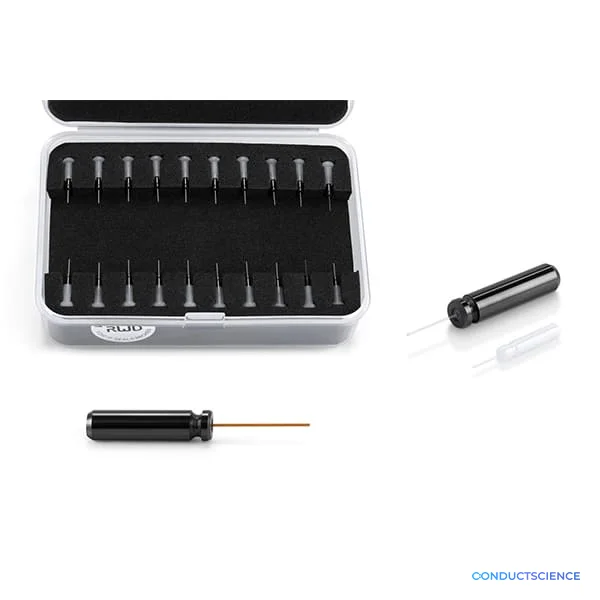
The Optogenetics Ceramic Ferrule & Fiber Optic provides precision light delivery for optogenetics experiments, combining ceramic ferrule technology with customizable fiber optic configurations. Available in White and Black series with core diameters ranging from 100-400μm and numerical apertures of 0.22, 0.37, and 0.39 NA, these cannulae support wavelengths from 400-2200nm for comprehensive optogenetics applications.
The ceramic ferrule design offers two outer diameter options (1.25mm and 2.5mm) with corresponding lengths of 6.4mm and 10.5mm respectively. Optical fiber length is customizable from 2-20mm in 0.5mm increments, while core-inserting length can be customized to 10.5mm to accommodate specific experimental requirements. This flexibility enables precise targeting of neural circuits across various anatomical locations and experimental paradigms.
How It Works
The ceramic ferrule fiber optic system delivers precise light transmission through step-index multimode optical fibers with defined numerical apertures. Light coupling efficiency depends on the numerical aperture match between the light source and fiber core, with higher NA values (0.37-0.39) providing greater light gathering capability but reduced spatial precision, while lower NA values (0.22) offer more focused light delivery.
The ceramic ferrule provides mechanical stability and optical alignment, maintaining consistent light transmission during chronic implantation. The ferrule's outer diameter (1.25mm or 2.5mm) determines the surgical footprint and mechanical properties, while the customizable fiber length allows optimization of light intensity at the target tissue. Core diameter selection (100-400μm) balances light transmission capacity with spatial resolution of photostimulation.
Wavelength compatibility from 400-2200nm accommodates various optogenetic tools including channelrhodopsins (460-470nm), halorhodopsins (570-590nm), and archaerhodopsins (540-570nm), as well as near-infrared applications for deeper tissue penetration and reduced light scattering.
Features & Benefits
Series
- White
- Black
applicable_wavelength
- 400-2200nm
core_diameter_options
- 100um, 200um, 300um, 400um
numerical_aperture_options
- 0.22, 0.37
outer_diameter_125mm_length
- 6.4mm long
outer_diameter_25mm_length
- 10.5mm long
core_inserting_length
- 10.5mm (customized)
optical_fiber_length
- 2mm-20mm, step 0.5mm (customized)
Outer Diameter
- 1.25mm
- 2.5mm
Numerical Aperature
- 0.22NA
- 0.37NA
- 0.39NA
Core Diameter
- 100um
- 200um
- 300um
- 400um
Automation Level
- manual
Material
- Ceramic
Color
- Black
- White
Research Domain
- Anxiety and Depression
- Behavioral Pharmacology
- Learning and Memory
- Motor Function
- Neuroscience
- Pain Research
Species
- Mouse
- Rat
Weight
- 6.06 kg
Dimensions
- L: 65.0 mm
- W: 36.0 mm
- H: 27.0 mm
Comparison Guide
| Feature | This Product | Typical Alternative | Advantage |
|---|---|---|---|
| Wavelength Range | 400-2200nm broad spectrum compatibility | Many fibers limited to visible spectrum (400-700nm) | Supports both standard optogenetic tools and emerging near-infrared applications for deeper tissue penetration |
| Core Diameter Options | Four diameter choices: 100, 200, 300, 400μm | Limited selection often restricted to 200μm standard | Enables optimization between light transmission capacity and spatial targeting precision |
| Numerical Aperture Selection | Three NA options: 0.22, 0.37, 0.39 | Fixed NA values with fewer choices | Allows matching of light gathering efficiency to experimental requirements and beam divergence needs |
| Ferrule Material | Ceramic construction with biocompatible properties | Metal ferrules with potential biocompatibility concerns | Reduces tissue inflammatory response and provides stable long-term implantation |
| Length Customization | Fiber length 2-20mm in 0.5mm steps, core-inserting length customizable to 10.5mm | Standard fixed lengths with limited options | Enables precise depth targeting and optimization of light delivery position |
| Ferrule Size Options | Two outer diameters: 1.25mm (6.4mm long) and 2.5mm (10.5mm long) | Single size option requiring compromise in surgical approach | Permits selection of optimal mechanical stability versus surgical invasiveness |
This fiber optic system offers comprehensive customization options across wavelength compatibility, core dimensions, and mechanical specifications. The ceramic ferrule construction and broad wavelength range provide advantages for both standard and advanced optogenetics applications requiring precise light delivery control.
Practical Tips
Select core diameter based on your target structure size - use smaller cores (100-200μm) for precise nuclei targeting and larger cores (300-400μm) for broader region illumination.
Why: Optimizes the balance between spatial precision and light transmission efficiency for your specific experimental design.
Measure light output at the fiber tip before each experimental session using a calibrated power meter to account for coupling losses and fiber degradation.
Why: Ensures consistent photostimulation parameters across experimental sessions and animals.
Inspect the ceramic ferrule for cracks or chips before implantation, as damage can affect light transmission and mechanical stability.
Why: Prevents experimental failures due to compromised optical or mechanical performance during chronic experiments.
Always verify light output is below tissue damage thresholds by calculating irradiance based on core diameter and measuring actual power output.
Why: Prevents thermal damage to neural tissue that could confound experimental results or cause animal welfare issues.
If light transmission decreases over time, check for debris at the connector interface and clean with appropriate optical cleaning solutions.
Why: Maintains consistent light delivery performance throughout chronic experimental protocols.
Document the exact fiber specifications (core diameter, NA, length) used for each animal to enable proper analysis of stimulation parameters and experimental reproducibility.
Why: Allows accurate calculation of light penetration depth and irradiance for data interpretation and protocol sharing.
Use the 0.22 NA option when precise spatial targeting is critical and the 0.37-0.39 NA option when maximum light transmission is needed.
Why: Lower NA provides more collimated beams for targeted stimulation while higher NA maximizes light coupling efficiency.
Store fiber optic cannulae in protective cases to prevent bending damage to the optical fiber, particularly at the ferrule junction.
Why: Preserves optical integrity and prevents microcracks that can cause light loss or complete transmission failure.
Setup Guide
What’s in the Box
- Ceramic ferrule fiber optic cannula (specifications as ordered)
- Installation documentation (typical)
- Handling and storage guidelines (typical)
Warranty
ConductScience provides a one-year manufacturer warranty covering defects in materials and workmanship, with technical support for installation and compatibility questions.
Compliance
How do I select the appropriate core diameter and numerical aperture for my experimental setup?
Core diameter selection depends on the balance between light transmission and spatial precision - larger cores (300-400μm) provide higher light output but less spatial resolution, while smaller cores (100-200μm) offer precise targeting. Higher NA (0.37-0.39) increases light gathering but creates wider beam divergence; lower NA (0.22) provides more collimated output for targeted stimulation.
What is the maximum light power these fibers can handle without damage?
Consult product datasheet for specific power handling specifications, as ceramic ferrule damage thresholds depend on wavelength, pulse duration, and thermal management in your optical system.
Can these fibers be sterilized for surgical implantation?
Ceramic ferrules are compatible with standard sterilization methods, but verify with the manufacturer regarding recommended protocols to maintain optical and mechanical integrity.
How do I calculate the light intensity at the tissue interface?
Light intensity depends on input power, fiber transmission losses, numerical aperture, and distance from fiber tip. Use the beam divergence calculations based on NA to determine illumination area at your target depth.
What is the expected lifetime of chronically implanted fibers?
Ceramic ferrules typically maintain optical properties for months of chronic implantation, though actual lifetime depends on tissue response, mechanical stress, and handling during behavioral experiments.
Are these fibers compatible with all optogenetics light sources?
The 400-2200nm wavelength range covers all common optogenetic applications, but verify connector compatibility and coupling efficiency with your specific LED or laser system.
How precise is the customizable fiber length specification?
Optical fiber length can be customized in 0.5mm increments from 2-20mm, allowing precise targeting of structures at specific depths from the skull surface.
Can I reuse these fibers for multiple animals or experiments?
While technically possible after proper cleaning and sterilization, single-use application is recommended to prevent cross-contamination and ensure consistent optical performance across experiments.
Have a question about this product?
Accessories
Enhance your setup with compatible accessories
Frequently Bought Together
Upgrade Options