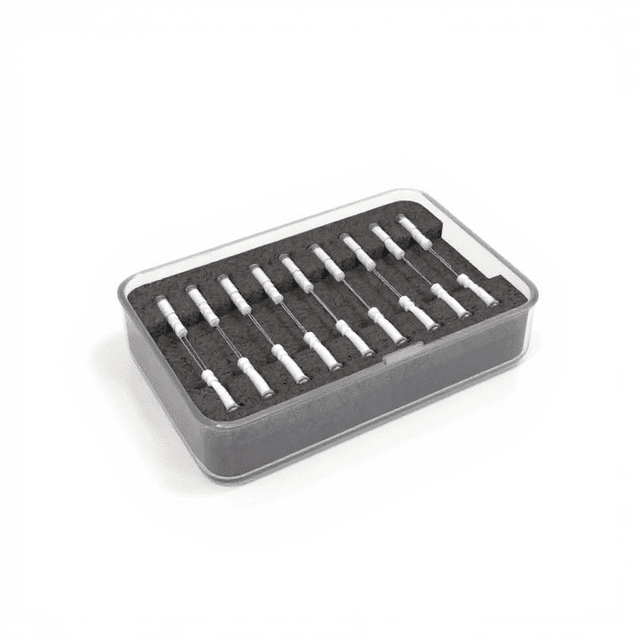
Optogenetics Patchcord
Precision fiber optic patchcord for optogenetic light delivery with low insertion loss and high return loss characteristics, available in multiple core diameter and numerical aperture configurations.

Louise Corscadden, PhD
Director of Science · ConductScience
Ask Louise about Optogenetics Patchcord fit, setup, configuration, or quote prep.
Already working with us? Sign in to connect this with My Scientist.
Key Specifications
Full details →- Model fit
- Non-human Primate, Mouse, Rat
- SKU family
- CS-958438
- Shipping box
- 65.0 x 36.0 x 27.0 cm
- Ordering
- Online checkout and quote request available
- Category
- Optogenetics & Photometry
- Build notes
- Confirm accessories, station layout, and support needs before purchase
The Optogenetics Patchcord delivers precise optical stimulation for neuroscience research applications requiring reliable light transmission to neural tissue. This fiber optic cable system provides low insertion loss transmission with high return loss characteristics, enabling consistent optogenetic stimulation protocols across experimental sessions.
Available in multiple configurations (100μm and 200μm core diameters with 0.22NA and 0.37NA options), the patchcord supports diverse optogenetic experimental requirements from single-cell targeting to broader tissue illumination. The stable temperature performance and good repeatability ensure consistent optical delivery parameters throughout extended experimental protocols.
How It Works
The optogenetics patchcord transmits coherent light from external laser sources through a precision optical fiber to implanted neural tissue. Light propagation occurs through total internal reflection within the fiber core, with the numerical aperture determining the acceptance angle and light-gathering capability of the system.
Low insertion loss characteristics minimize optical power reduction during transmission, while high return loss prevents back-reflection that could destabilize laser output or create interference patterns. The fiber's core diameter and numerical aperture determine the light delivery profile at the tissue interface, with smaller cores providing more focused illumination and larger cores enabling broader tissue coverage.
Temperature stability maintains consistent optical transmission properties across varying experimental conditions, ensuring reproducible light delivery parameters throughout extended protocols. The mutual insertion performance provides reliable coupling efficiency when connecting and disconnecting the patchcord from external optical systems.
Features & Benefits
Insertion Loss
- Low
Repeatability
- Good
Return Loss
- High
Temperature Stability
- Stable
Mutual Insertion Performance
- Good
Automation Level
- manual
Research Domain
- Anxiety and Depression
- Behavioral Pharmacology
- Learning and Memory
- Motor Function
- Neuroscience
- Social Behavior
Species
- Non-human Primate
- Mouse
- Rat
Shipping weight
- 6.06 lb
Shipping box
- L: 65.0 cm
- W: 36.0 cm
- H: 27.0 cm
| Feature | This Product | Typical Alternative | Advantage |
|---|---|---|---|
| Core Diameter Options | Available in 100μm and 200μm core configurations | Many systems offer limited core diameter choices | Enables researchers to select optimal light delivery profile for specific neural targeting requirements |
| Numerical Aperture Selection | Offers both 0.22NA and 0.37NA configurations | Single numerical aperture systems are common | Allows matching to laser source characteristics and experimental geometry for optimal coupling efficiency |
| Temperature Stability | Stable temperature performance specified | Temperature stability varies significantly by model | Maintains consistent optical transmission during extended experiments with thermal variations |
| Return Loss Performance | High return loss characteristics | Return loss specifications vary widely | Minimizes back-reflection that could destabilize laser output or create stimulation artifacts |
This patchcord system provides multiple core diameter and numerical aperture configurations with stable temperature performance and low insertion loss characteristics. The combination of good repeatability and high return loss supports consistent optogenetic stimulation protocols across diverse experimental requirements.
| Model | SKU | Listed price | Status | Shipping box |
|---|---|---|---|---|
| 200um - 0.37NA - 1m | RWD-R-FC-PC-N3-200-L1 | $32.50 | Available | 65.0 x 36.0 x 27.0 cm |
| 200um - 0.22NA - 1m | RWD-R-FC-PC-N2-200-L1 | $32.50 | Available | 65.0 x 36.0 x 27.0 cm |
| 100um - 0.22NA - 1m | RWD-R-FC-PC-N2-100-L1 | $20.90 | Available | 65.0 x 36.0 x 27.0 cm |
Practical Tips
Measure optical power transmission before each experimental session to establish baseline values and detect any degradation in fiber performance.
Why: Power drift can significantly affect optogenetic stimulation effectiveness and experimental reproducibility.
Clean connector end faces with appropriate optical cleaning supplies and store with protective end caps when not in use.
Why: Contamination and scratches on fiber ends dramatically increase insertion loss and reduce light delivery efficiency.
Use gentle handling techniques and avoid sharp bends in the fiber that exceed the minimum bend radius specifications.
Why: Excessive mechanical stress can cause internal fiber damage leading to increased optical losses or complete transmission failure.
If experiencing reduced optical power, inspect both connector ends under magnification for damage or contamination before replacing components.
Why: Most transmission issues result from contaminated or damaged end faces rather than internal fiber degradation.
Document optical power measurements and transmission characteristics for each patchcord to track performance changes over time.
Why: Systematic monitoring enables early detection of performance degradation that could compromise experimental results.
Always verify laser output is disabled before making fiber connections to prevent eye exposure to scattered light.
Why: Even low-power optogenetic lasers can cause permanent eye damage if proper safety procedures are not followed.
Setup Guide
What’s in the Box
- Optogenetics patchcord with specified core diameter and numerical aperture
- Protective fiber end caps (typical)
- Connector cleaning supplies (typical)
- Technical specification sheet (typical)
Warranty
ConductScience provides a 1-year manufacturer warranty covering defects in materials and workmanship, with technical support for installation and operational guidance.
Compliance
What factors should I consider when selecting between different core diameters?
Smaller core diameters (100μm) provide more focused light delivery for precise single-cell or small population targeting, while larger cores (200μm) enable broader tissue illumination for activating larger neural populations. Consider your target tissue volume and required spatial precision.
How does numerical aperture affect light delivery performance?
Higher numerical aperture (0.37NA) provides better light-gathering capability and coupling efficiency with divergent laser sources, while lower NA (0.22NA) offers more collimated light delivery with reduced divergence at the tissue interface.
What maintenance procedures are required for optimal performance?
Regularly inspect fiber ends for damage or contamination, clean connector surfaces with appropriate optical cleaning supplies, and store with protective end caps to prevent contamination or mechanical damage.
How do I verify proper optical transmission before experiments?
Measure optical power at both the input and output ends using a calibrated power meter to calculate insertion loss. Compare values to baseline measurements to detect any degradation in transmission performance.
What is the expected service life under typical experimental conditions?
Service life depends on handling practices and connection frequency. Proper care including gentle handling, clean connections, and protective storage typically provides hundreds of connection cycles with stable optical performance.
Can this patchcord be used with different wavelengths of optogenetic actuators?
The patchcord supports standard optogenetic wavelengths including blue (470nm) for channelrhodopsins and amber/red (590-630nm) for halorhodopsins. Consult specifications for specific wavelength transmission characteristics.
Have a question about this product?
Have a question? Just ask.
Send it over and we'll email you a personalized answer — no call, no scheduling.
Prefer to talk it through?
Accessories
Enhance your setup with compatible accessories
Upgrade Options