Rotameter
Automated behavioral apparatus for quantifying rotational movement patterns and directional preferences in mice and rats using precision rotary sensors and tethered arena design.

Louise Corscadden, PhD
Director of Science · ConductScience
Ask Louise about Rotameter fit, setup, configuration, or quote prep.
Already working with us? Sign in to connect this with My Scientist.
Key Specifications
Full details →- Model fit
- Mouse, Rat
- SKU family
- ME-16101/ME-16102
- Shipping box
- 43.2 x 38.0 x 27.9 cm
- Ordering
- Online checkout and quote request available
- Category
- Behavioral Mazes
- Build notes
- Confirm accessories, station layout, and support needs before purchase
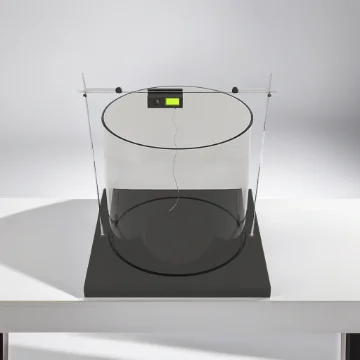
The Rotameter is a specialized behavioral assessment apparatus for quantifying rotational movement patterns in rodents. This system combines a cylindrical arena with precision rotary sensors to measure clockwise and counterclockwise rotations, directional changes, and rotational asymmetry. The low-torque sensor design ensures unimpeded natural movement while providing accurate digital tracking of rotational behavior parameters.
The system supports both mouse (34 x 35 cm) and rat (40 x 40 cm) testing configurations with clear or black acrylic construction for optimal visibility or light control. Each unit includes a stainless steel spring tether system with leather harness for secure yet comfortable animal attachment. The integrated software captures comprehensive rotational data including total rotations, directional changes, and timing information with statistical analysis and graphical output capabilities.
How It Works
The Rotameter operates through precision rotary sensor technology that continuously monitors animal position and movement within a cylindrical arena. The animal is secured using a leather harness connected to a low-torque stainless steel spring tether that permits unrestricted horizontal movement while maintaining connection to the central rotary sensor. The sensor assembly utilizes optical or magnetic encoding to detect rotational displacement with high temporal resolution.
As the animal moves within the arena, the tether rotates the central sensor mechanism, generating digital pulses corresponding to clockwise and counterclockwise movements. The system's software processes these signals in real-time, calculating total rotations, directional changes, rotational velocity, and temporal patterns. The low-torque design ensures the sensor's mechanical resistance does not influence natural movement patterns or create artificial behavioral constraints.
Data acquisition occurs continuously throughout the testing session, with the control box communicating rotation data to the PC via USB connection. The software maintains a complete movement log with timestamp resolution suitable for detailed kinematic analysis and statistical comparison across experimental conditions.
Features & Benefits
Behavioral Construct
- rotational behavior
- motor asymmetry
- directional preference
- locomotor activity
- stereotypic behavior
- rotational bias
Automation Level
- fully-automated
Research Domain
- Addiction Research
- Behavioral Pharmacology
- Motor Function
- Neurodegeneration
- Neuroscience
- Toxicology
Compatible Tracking Software
- ConductVision
Shipping weight
- 21.0 lb
Shipping box
- L: 43.2 cm
- W: 38.0 cm
- H: 27.9 cm
| Feature | This Product | Typical Alternative | Advantage |
|---|---|---|---|
| Arena Size Options | Species-specific configurations: 34x35cm for mice, 40x40cm for rats | Fixed-size arenas often require size adaptation | Optimized spatial scaling ensures appropriate movement range for different species without compromising measurement accuracy. |
| Multi-unit Capacity | Single control box supports up to 8 rotameters | Basic systems typically handle 1-4 units | Higher throughput capability enables larger experimental designs and parallel group comparisons. |
| Sensor Design | Low-torque rotary sensor with bidirectional detection | Standard encoders may introduce movement resistance | Minimal mechanical interference preserves natural behavior patterns while maintaining measurement precision. |
| Tether System | Stainless steel spring with leather harness | Rigid or basic flexible connections | Durable spring design accommodates dynamic movement while maintaining consistent sensor coupling. |
| Data Analysis | Integrated software with statistical analysis and graphical output | Basic counting systems with limited analysis | Comprehensive analysis capabilities reduce need for external data processing and statistical software. |
| Construction Materials | Clear or black acrylic with removable floor | Fixed construction limits experimental flexibility | Material options and removable components facilitate cleaning and adapt to different lighting conditions. |
The Rotameter system combines precision rotary sensing with species-optimized arena design and comprehensive analysis software. The low-torque sensor technology and multi-unit control capability provide advantages for detailed rotational behavior studies with high experimental throughput.
| Model | SKU | Listed price | Status | Shipping box |
|---|---|---|---|---|
| Rat | ME-16102 | $2,490.00 | Available | 43.2 x 38.0 x 27.9 cm |
| Mouse | ME-16101 | $1,990.00 | Available | 43.2 x 38.0 x 27.9 cm |
Practical Tips
Perform baseline rotation tests without animals to verify sensor accuracy and establish mechanical noise thresholds.
Why: Baseline calibration helps distinguish between active animal movement and system artifacts.
Clean the removable arena floor between subjects using standard laboratory disinfectants to prevent cross-contamination.
Why: Proper sanitation maintains hygienic conditions and eliminates potential confounding factors from residual odors.
Allow animals to acclimate to the harness system in their home cage before testing to minimize stress-related behavioral artifacts.
Why: Pre-exposure to the harness reduces novelty effects and ensures rotational measurements reflect true behavioral responses.
Check tether length and attachment points if rotational data appears constrained or shows unusual mechanical patterns.
Why: Improper tether configuration can create artificial movement limitations affecting measurement validity.
Record environmental conditions and arena configuration (clear vs black) as these factors may influence rotational behavior patterns.
Why: Environmental standardization improves data reproducibility and enables proper interpretation of treatment effects.
Monitor animals continuously during initial sessions to ensure harness fit and tether function properly without causing distress.
Why: Proper equipment function and animal welfare are essential for valid behavioral measurements and ethical research conduct.
Establish session duration based on pilot studies as extended testing may lead to habituation or fatigue effects.
Why: Optimal testing duration maximizes data quality while minimizing potential confounds from prolonged restraint or adaptation.
Setup Guide
What’s in the Box
- Rotameter arena (clear or black acrylic cylinder with removable floor)
- Rotary sensor assembly with mounting hardware
- Control box with USB cable
- Stainless steel spring tether
- Leather harness system
- Rotameter analysis software
- User manual and setup guide
- Calibration verification protocol (typical)
Warranty
ConductScience provides a one-year manufacturer warranty covering hardware components and rotary sensor assembly, with comprehensive technical support for software installation and protocol development.
Compliance
References
Background reading relevant to this product:
What is the temporal resolution for rotation detection and directional change analysis?
The system provides continuous real-time monitoring with software-defined temporal resolution suitable for detailed kinematic analysis. Consult product datasheet for specific sampling rates and detection thresholds.
How does the low-torque sensor design affect measurement accuracy compared to standard rotary encoders?
The low-torque construction minimizes mechanical interference with natural movement patterns while maintaining precision rotation detection. The system balances sensitivity with minimal movement restriction for accurate behavioral assessment.
Can the system distinguish between active rotational movement and passive drift due to tether mechanics?
The software analyzes rotational velocity and directional consistency to differentiate deliberate movement from mechanical artifacts. Baseline calibration helps establish thresholds for active versus passive rotation classification.
What maintenance is required for the rotary sensor assembly and tether system?
Regular cleaning of the removable arena floor, periodic inspection of tether integrity, and sensor calibration verification ensure consistent performance. The stainless steel components resist corrosion with standard laboratory cleaning protocols.
How does arena size selection affect rotational behavior measurement in different species?
Species-specific dimensions provide appropriate spatial scaling with mouse (34x35cm) and rat (40x40cm) configurations optimized for natural movement patterns while maintaining consistent tether geometry across species.
What data export formats are supported for integration with statistical analysis software?
The system provides data export capabilities for rotation counts, timing information, and statistical summaries. Consult software documentation for specific file formats and database compatibility options.
Can multiple rotameters be synchronized for comparative studies across different treatment groups?
The control box supports up to eight rotameters with coordinated data collection, enabling parallel testing and synchronized experimental timelines for comparative behavioral analysis.
Have a question about this product?
Have a question? Just ask.
Send it over and we'll email you a personalized answer — no call, no scheduling.
Prefer to talk it through?
Frequently Bought Together