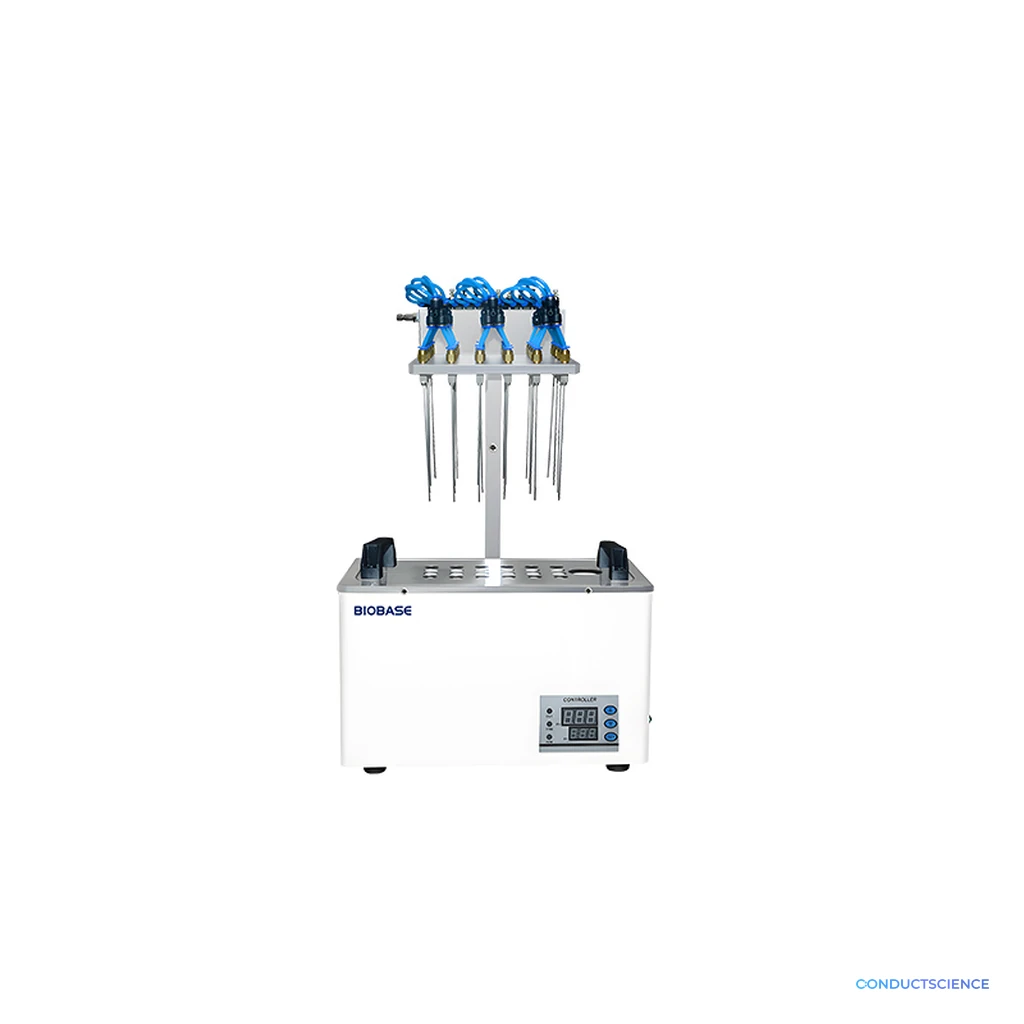
Sample Concentrator
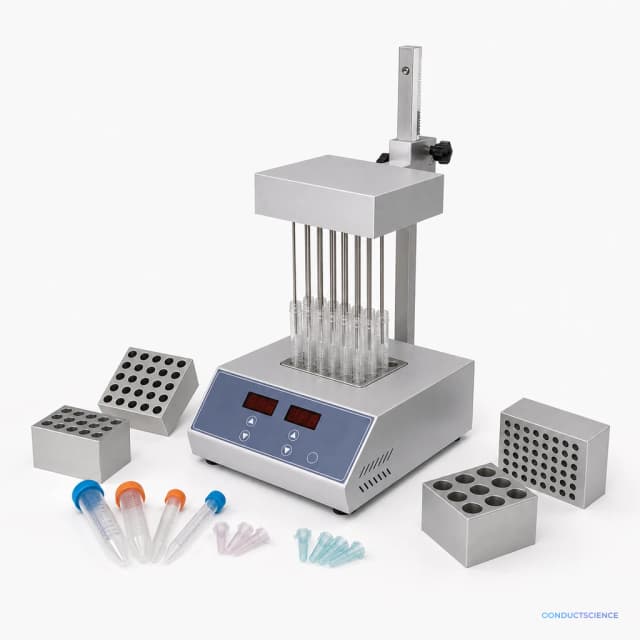
Sample concentrator for controlled evaporation of 12 to 48 liquid samples simultaneously using water bath heating (RT-100 degrees C, plus/minus 1 degree C accuracy) and inert nitrogen gas flow.
Individual channel gas flow adjustment; PID digital temperature control; 316 stainless steel solvent-contact parts. Models: BK-SC12 (12 positions), BK-SC24 (24 positions), BK-SC36 (36 positions), BK-SC48 (48 positions).

Louise Corscadden, PhD
Director of Science · ConductScience
Ask Louise about Sample Concentrator fit, setup, configuration, or quote prep.
Already working with us? Sign in to connect this with My Scientist.
Key Specifications
Full details →- Model fit
- 4 selectable configurations
- SKU family
- BIO-0581
- Shipping box
- 46.0 x 34.0 x 20.0 cm
- Ordering
- Online checkout and quote request available
- Category
- Sample Prep
- Build notes
- Confirm accessories, station layout, and support needs before purchase
The ConductScience Sample Concentrator uses water bath heating and regulated nitrogen gas flow to achieve rapid, controlled concentration of liquid samples. A sweeping needle capture technique minimizes cross-contamination while individual-channel gas flow adjustment enables uniform evaporation across all positions. PID digital temperature control maintains accuracy to plus/minus 1 degree C. Solvent-contact parts are 316 stainless steel; the system is compatible with laboratory fume hoods. Applications include pesticide residue analysis, pharmaceutical testing, environmental monitoring, food and beverage testing, and bio-analysis.
Technical Specifications
| Parameter | BK-SC12 | BK-SC24 | BK-SC36 | BK-SC48 |
|---|---|---|---|---|
| Max Sample Positions | 12 | 24 | 36 | 48 |
| Heating Method | Water bath | |||
| Temperature Control Range | RT to 100 degrees C | |||
| Temperature Accuracy | plus/minus 1 degree C | |||
| Heating Time | 20 to 25 min (25 to 100 degrees C) | |||
| Max Gas Usage | 15 L/min | |||
| Power Consumption | 600 W | |||
| Timing Range | 1 to 999 min | |||
| Needle Length | 150 mm | |||
| Needle Diameter | 1 mm | |||
| External Size (W x D x H) | 340 x 200 x 460 mm | |||
| Packing Size (W x D x H) | 500 x 280 x 410 mm | |||
| Net Weight | 7 kg | 7.5 kg | 7.5 kg | 8 kg |
| Gross Weight | 9 kg | 9.5 kg | 9.5 kg | 10 kg |
| Power Supply | 220V, 50/60 Hz | |||
How It Works
The Sample Concentrator operates on the principle of controlled evaporation using combined water bath heating and nitrogen gas flow. The water bath provides uniform, gentle heating across all sample positions, with temperature regulation maintained through digital control systems. Samples are heated gradually from room temperature to the target temperature (up to 100°C) with ±1°C accuracy, ensuring consistent thermal conditions.
Nitrogen gas is delivered through 150mm needles (1mm diameter) positioned above each sample, creating a controlled atmosphere that facilitates solvent evaporation while preventing oxidation. The inert nitrogen stream removes solvent vapors from the sample surface, driving the evaporation process and preventing vapor recondensation. The gas flow rate can be adjusted up to 15 L/min to optimize evaporation speed while maintaining sample integrity.
The programmable timer (1-999 minutes) allows for reproducible processing protocols, while the water bath heating ensures temperature stability throughout the concentration process. This combination of controlled heating and gas flow enables efficient concentration while minimizing thermal degradation of heat-sensitive compounds.
Features & Benefits
Automation Level
- Semi-automated
Heating Method
- Water bath
Temperature Control Range
- RT~100 degrees C
Temperature Accuracy
- plus/minus 1 degree C
Heating Time
- 20~25 min (25 to 100 degrees C)
Max Gas Usage
- 15 L/min
Power Consumption
- 600 W
Timing Range
- 1~999 min
Needle Length
- 150 mm
Needle Diameter
- 1 mm
External Size (W x D x H)
- 340 x 200 x 460 mm
Packing Size (W x D x H)
- 500 x 280 x 410 mm
Net Weight
- 7 kg (BK-SC12)
- 7.5 kg (BK-SC24/SC36)
- 8 kg (BK-SC48)
Gross Weight
- 9 kg (BK-SC12)
- 9.5 kg (BK-SC24/SC36)
- 10 kg (BK-SC48)
Power/Voltage
- 220V, 50/60 Hz
Brand
- ConductScience
Research Domain
- Analytical Chemistry
- Clinical Diagnostics
- Environmental Monitoring
- Food Science
- Pharmaceutical QC
- Toxicology
Shipping weight
- 7.0 lb
Shipping box
- L: 46.0 cm
- W: 34.0 cm
- H: 20.0 cm
| Feature | This Product | Typical Alternative | Advantage |
|---|---|---|---|
| Sample Capacity | 12 samples simultaneously | Entry-level models often offer 6-8 positions | Higher throughput reduces processing time and ensures uniform conditions across larger sample batches. |
| Temperature Range | Room temperature to 100°C with ±1°C accuracy | Basic models may offer limited temperature control | Wide temperature range accommodates various solvents while precise control ensures reproducible concentration conditions. |
| Heating Method | Water bath heating | Some models use direct heating elements | Water bath provides more uniform temperature distribution and reduces hot spot formation that can degrade samples. |
| Gas Flow Control | Variable flow up to 15 L/min | Fixed flow systems are common in basic models | Adjustable flow allows optimization for different solvents and sample types, balancing concentration speed with sample integrity. |
| Programming Capability | 1-999 minute programmable timing | Manual timing control only | Automated timing ensures consistent processing and allows for extended protocols without operator supervision. |
| Needle Configuration | 150mm needles with 1mm diameter | Varies by model in length and diameter | Optimal needle geometry provides efficient gas distribution while accommodating various tube sizes and sample volumes. |
This concentrator combines high sample throughput with precise temperature control and flexible programming, making it well-suited for analytical laboratories requiring reproducible sample concentration with gentle heating conditions. The water bath heating system and programmable parameters provide advantages for processing thermolabile compounds.
| Model | SKU | Listed price | Status | Shipping box |
|---|---|---|---|---|
| BK-SC48 | BIO-0581 | $1,990.00 | Available | 46.0 x 34.0 x 20.0 cm |
| BK-SC36 | BIO-0581 | $1,890.00 | Available | 46.0 x 34.0 x 20.0 cm |
| BK-SC24 | BIO-0581 | $1,790.00 | Available | 46.0 x 34.0 x 20.0 cm |
| BK-SC12 | BIO-0581 | $1,690.00 | Available | 46.0 x 34.0 x 20.0 cm |
Practical Tips
Verify temperature accuracy at 25°C, 50°C, 75°C, and 100°C using a calibrated thermometer placed in a test tube filled with mineral oil.
Why: Multiple-point calibration ensures accuracy across the full operating range and meets quality system requirements.
Replace water bath fluid monthly with distilled water and clean the bath quarterly to prevent mineral buildup on heating elements.
Why: Clean water ensures efficient heat transfer and prevents contamination from dissolved minerals or bacterial growth.
Start with lower temperatures and longer times for unknown samples, then optimize based on solvent type and desired concentration ratio.
Why: Conservative initial conditions prevent sample degradation and allow optimization based on actual sample behavior.
If evaporation is slower than expected, check nitrogen gas pressure and verify needle positioning over sample surfaces.
Why: Proper gas flow is critical for efficient evaporation, and needle positioning affects gas distribution over the sample.
Include blank samples processed under identical conditions to monitor for contamination or background interference.
Why: Blank processing helps identify system-related contamination sources and ensures data quality in analytical applications.
Always operate in a fume hood when concentrating organic solvents and ensure nitrogen gas supply is properly regulated.
Why: Fume hood containment protects against solvent vapors while regulated gas pressure prevents excessive flow that could cause sample loss.
Allow the water bath to equilibrate for 15-20 minutes after reaching set temperature before starting concentration protocols.
Why: Temperature equilibration ensures stable conditions throughout the process and improves reproducibility between runs.
If samples foam excessively, reduce nitrogen flow rate and consider using anti-foam agents compatible with your analytical method.
Why: Excessive foaming can cause sample loss and interfere with uniform concentration across all sample positions.
Setup Guide
What’s in the Box
- Sample Concentrator main unit
- 12-position sample holder rack
- Nitrogen gas inlet connection
- Power cord (220V)
- Needle assembly with 150mm needles
- User manual and operating instructions
- Temperature calibration certificate (typical)
Warranty
ConductScience provides a standard one-year manufacturer warranty covering defects in materials and workmanship, with comprehensive technical support for setup, calibration, and troubleshooting assistance.
Compliance
References
Background reading relevant to this product:
What types of solvents can be concentrated using this water bath system?
The system is suitable for most organic solvents and aqueous solutions with boiling points below 100°C. Avoid highly volatile solvents that may evaporate too rapidly or corrosive solvents that could damage the water bath components.
How do I optimize concentration conditions for thermolabile compounds?
Use lower temperatures (40-60°C) with increased nitrogen flow rates and longer processing times. Monitor temperature stability and consider using reduced gas flow initially to prevent sample splashing.
What sample volumes can be processed effectively?
The system accommodates various sample volumes depending on tube size and holder configuration. Typical volumes range from 1-50 mL, with concentration ratios of 2:1 to 20:1 achievable depending on solvent type and processing time.
How often should temperature calibration be performed?
Temperature calibration should be verified quarterly or after any maintenance involving the heating system. Use a certified thermometer and document calibration at multiple temperature points across the operating range.
Can the system handle samples with high salt content or viscous solutions?
Yes, but monitor for salt precipitation or viscosity increases during concentration. Consider diluting highly concentrated samples or using modified processing parameters to prevent sample handling difficulties.
What nitrogen purity level is required for optimal operation?
Use high-purity nitrogen (>99%) to prevent introduction of contaminants and ensure consistent gas flow. Lower purity grades may introduce water vapor or other gases that could affect concentration results.
How does this compare to rotary evaporation or freeze concentration methods?
This system provides gentler heating than rotary evaporation while offering better throughput than single-sample methods. It's particularly advantageous for batch processing of multiple samples under identical conditions.
What maintenance is required for the water bath heating system?
Replace water bath fluid monthly with distilled water, clean bath periodically to prevent mineral buildup, and verify heating element function during routine calibration checks.
Have a question about this product?
Have a question? Just ask.
Send it over and we'll email you a personalized answer — no call, no scheduling.
Prefer to talk it through?