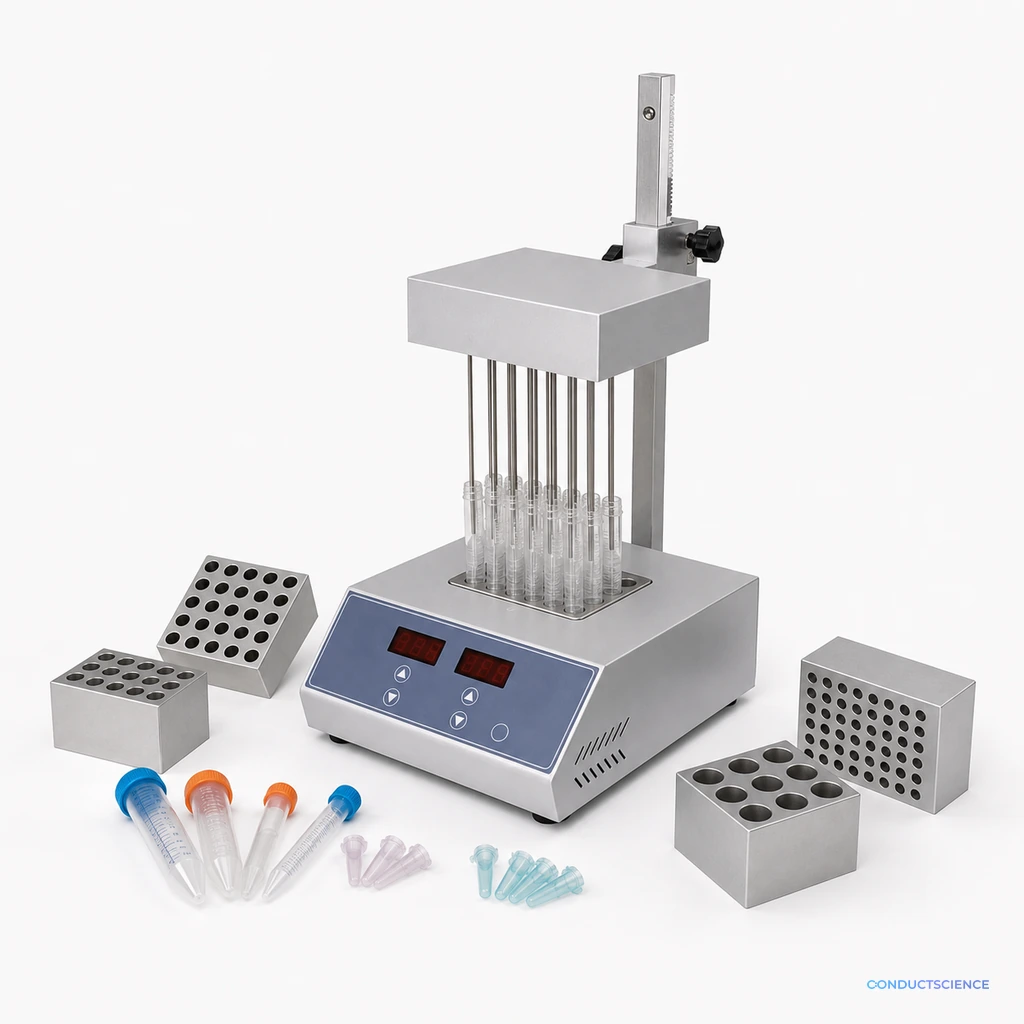
Thermal Sample Concentrator with Gas Flow, 300W, 160°C
Precision thermal evaporation system with temperature control from RT+5°C to 160°C for controlled sample concentration with adjustable gas flow and needle positioning.

Louise Corscadden, PhD
Director of Science · ConductScience
Ask Louise about Thermal Sample Concentrator with Gas Flow, 300W, 160°C fit, setup, configuration, or quote prep.
Already working with us? Sign in to connect this with My Scientist.
Key Specifications
Full details →- Model fit
- Configured during quote
- SKU family
- BIO-0924
- Shipping box
- 39.37 x 7.87 x 5.91 cm
- Ordering
- Online checkout and quote request available
- Category
- Sample Prep
- Build notes
- Confirm accessories, station layout, and support needs before purchase
The Sample Concentrator is a precision thermal evaporation system designed for controlled concentration of liquid samples in research and analytical laboratories. This instrument combines precise temperature control with adjustable gas flow and needle positioning to enable controlled evaporation of solvents while preserving sample integrity. The system features a temperature range from RT+5°C to 160°C with ±1°C accuracy at 120°C and uniformity within ±0.5°C across the heating block.
The concentrator utilizes a single heating block with 200mm vertical travel capability and 150mm needle length for flexible sample positioning. With programmable timing from 1 minute to 99 hours 59 minutes or continuous operation, the system accommodates diverse evaporation protocols. The 15L/min maximum gas flow rate enables efficient solvent removal while the 300W heating capacity provides rapid thermal equilibration, reaching 160°C from 25°C in 15 minutes or less.
How It Works
The Sample Concentrator operates through controlled thermal evaporation under an inert gas atmosphere. The heating block maintains precise temperatures through feedback control, with the temperature sensor providing 0.1°C display resolution and maintaining uniformity within ±0.5°C across the block surface. This ensures consistent heating conditions for reproducible evaporation rates.
During operation, samples are positioned using the adjustable needle system with 200mm vertical travel, allowing optimization of the gas-liquid interface distance. The inert gas flow, controllable up to 15L/min, creates a gentle sweep across the sample surface to remove evaporated solvent vapors and prevent sample oxidation. The combination of controlled temperature and gas flow enables selective removal of volatile solvents while concentrating non-volatile analytes.
The programmable timing system allows for unattended operation with precise control over evaporation duration. Temperature ramping capabilities and the 300W heating element provide rapid thermal response, while the temperature accuracy of ±1°C at 120°C ensures reproducible concentration protocols across sample batches.
Features & Benefits
Shipping weight
- 12.06 lb
Shipping box
- L: 39.37 cm
- W: 7.87 cm
- H: 5.91 cm
| Feature | This Product | Typical Alternative | Advantage |
|---|---|---|---|
| Temperature Control Range | RT+5°C to 160°C with ±1°C accuracy | Basic hot plates often provide ambient to 120°C with ±5°C accuracy | Extended range enables processing of higher-boiling solvents with superior precision for reproducible concentration protocols |
| Temperature Uniformity | ≤±0.5°C across heating block | Standard heating blocks typically show ±2-5°C variation | Eliminates hot spots that could cause sample degradation or uneven evaporation rates |
| Gas Flow Control | Up to 15L/min with adjustable control | Many systems lack integrated gas flow control | Integrated flow control eliminates need for external regulators and enables optimized evaporation conditions |
| Needle Positioning System | 200mm vertical travel with 150mm needle length | Fixed-height systems or manual adjustment only | Accommodates various container sizes and allows optimization of gas-liquid interface distance throughout concentration |
| Programmable Timing | 1-99h59min or continuous operation | Basic models often require manual monitoring | Enables unattended operation and precise control over evaporation duration for protocol standardization |
| Display Resolution | 0.1°C temperature display accuracy | Entry-level models typically show 1°C resolution | Enhanced monitoring precision supports method development and regulatory documentation requirements |
This Sample Concentrator combines precise temperature control with integrated gas flow management and programmable operation, offering superior uniformity and automation compared to basic heating blocks while providing simpler operation than complex rotary evaporation systems. The combination of accuracy, programmability, and compact design addresses routine analytical concentration requirements.
Practical Tips
Verify temperature accuracy monthly using a calibrated reference thermometer placed on the heating block surface under operating conditions.
Why: Temperature accuracy directly impacts evaporation reproducibility and method validation requirements.
Clean the heating block surface weekly with appropriate solvents and inspect needle alignment to prevent sample contamination.
Why: Residue buildup can cause temperature variations and needle misalignment affects gas flow efficiency.
Start with lower gas flow rates and temperatures, then optimize based on solvent properties and concentration requirements.
Why: Gentle initial conditions prevent sample loss through splashing while allowing protocol optimization.
If evaporation is too rapid, reduce temperature by 10-20°C and increase gas flow rather than decreasing flow rate.
Why: Higher gas flow at lower temperature provides better control and prevents superheating that causes sample bumping.
Record initial sample volume, final volume, concentration time, and all operating parameters for each batch.
Why: Complete documentation enables method reproducibility and supports analytical data traceability.
Ensure adequate ventilation and use appropriate gas connections with leak-tight fittings for all operations.
Why: Proper ventilation removes solvent vapors while secure gas connections prevent leaks that could affect concentration efficiency.
Allow 30 minutes thermal equilibration after power-on before beginning sample processing for optimal temperature stability.
Why: Thermal equilibration ensures the heating block reaches uniform temperature distribution for consistent results.
Document gas flow rate using a calibrated flowmeter annually to verify flow control accuracy.
Why: Flow rate accuracy affects evaporation kinetics and method reproducibility across different sample types.
Setup Guide
What’s in the Box
- Sample Concentrator main unit
- Power cord for specified voltage
- Gas inlet fitting and tubing (typical)
- Needle assembly with height adjustment mechanism
- User manual and operating instructions
- Temperature calibration certificate (typical)
Warranty
ConductScience provides a standard one-year manufacturer warranty covering defects in materials and workmanship, with technical support available for method development and troubleshooting assistance.
Compliance
References
Background reading relevant to this product:
What types of solvents can be concentrated using this system?
The temperature range of RT+5°C to 160°C accommodates most common laboratory solvents including water, alcohols, acetone, dichloromethane, and other organics with boiling points up to 160°C. Use appropriate gas flow rates for different solvent volatilities.
How do I prevent sample bumping during concentration?
Maintain appropriate needle height (2-5mm above sample surface), use moderate gas flow rates initially, and consider lower temperatures for viscous samples. The precise temperature control helps maintain gentle evaporation conditions.
What gas should I use for sample concentration?
Nitrogen is recommended for most applications to provide inert atmosphere and prevent oxidation. Compressed air may be suitable for non-oxidative samples, while argon can be used for highly sensitive compounds.
Can this system handle multiple samples simultaneously?
This model features a single heating block design for individual sample processing. The 200mm needle travel accommodates various container sizes for sequential sample concentration.
How accurate is the temperature control for method validation?
The system provides ±1°C accuracy at 120°C with ±0.5°C uniformity and 0.1°C display resolution, meeting precision requirements for analytical method development and validation protocols.
What maintenance is required for optimal performance?
Regular cleaning of the heating block, periodic needle inspection, gas line leak checks, and annual temperature calibration verification are recommended to maintain performance specifications.
How does this compare to rotary evaporators for sample concentration?
This system offers precise temperature control and programmable timing without vacuum requirements, making it suitable for gentle concentration of thermolabile compounds and routine sample preparation workflows.
Have a question about this product?
Have a question? Just ask.
Send it over and we'll email you a personalized answer — no call, no scheduling.
Prefer to talk it through?