Scanning UV/VIS Spectrophotometer - 190-1100nm Range
Dual-beam UV/VIS spectrophotometer with 190-1100 nm range, 2.0 nm bandwidth, and 7-inch color display for quantitative analysis in analytical chemistry and research applications.

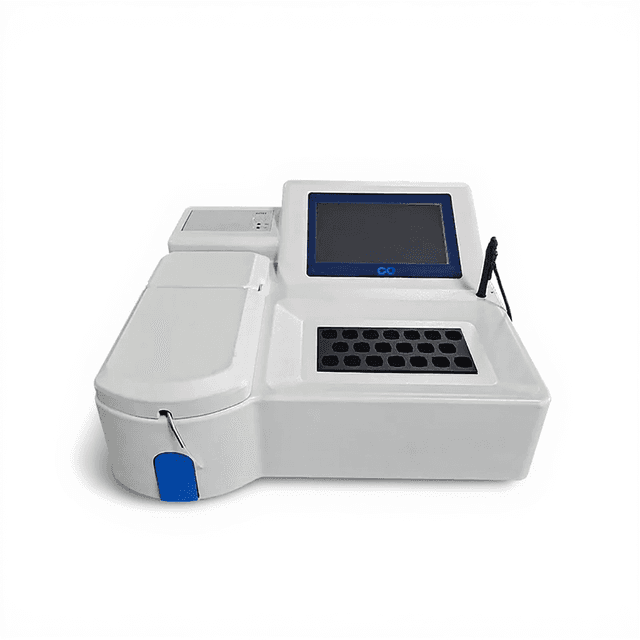
The Scanning UV/VIS Spectrophotometer (BIO-0421) is a proportional double beam instrument designed for quantitative and qualitative analysis across the ultraviolet and visible spectrum. The system employs a 1200 lines/mm grating optical configuration with deuterium and tungsten lamp sources, providing wavelength coverage from 190 to 1100 nm with 2.0 nm bandwidth and ±0.3 nm accuracy.
This benchtop spectrophotometer features a 7-inch color LCD display and supports multiple data output formats including RS-232C, USB drive, and USB host connectivity. The instrument delivers photometric measurements across 0-200%T, -3 to 3A, and 0-9999 concentration units, with ±0.3%T accuracy and baseline flatness of ±0.001 Abs. The dual-beam design provides stable baseline correction for reliable quantitative measurements in analytical and research applications.
How It Works
The spectrophotometer operates on the principle of molecular absorption spectroscopy, where molecules absorb specific wavelengths of electromagnetic radiation corresponding to electronic transitions. The instrument uses a proportional double beam configuration where light from deuterium (UV) and tungsten (visible) sources passes through a monochromator containing a 1200 lines/mm diffraction grating.
The monochromated light is split into two beams: one passes through the sample cell while the reference beam passes through a blank or reference cell. Both beams reach separate detectors, and the instrument calculates the ratio of sample to reference intensities. This dual-beam design compensates for lamp intensity fluctuations and drift, providing stable baseline measurements.
Absorbance values are calculated using A = -log(I/I₀), where I is the transmitted light intensity and I₀ is the incident intensity. The system can display results in transmittance (%T), absorbance (A), or concentration units (C) based on pre-programmed calibration curves or user-defined methods.
Features & Benefits
Model
- BIO-0421 — Standard Configuration
- BIO-0402 — Standard Configuration
- BIO-0403 — Enhanced Connectivity & Double Beam
Weight
- 21.0 kg
Dimensions
- L: 21.0 mm
- W: 58.0 mm
- H: 45.0 mm
Comparison Guide
| Feature | This Product | Typical Alternative | Advantage |
|---|---|---|---|
| Wavelength Range | 190-1100 nm (UV and visible coverage) | Many entry-level models offer narrower ranges or separate UV/visible instruments | Single instrument covers complete UV-visible spectrum, eliminating need for multiple units and simplifying method development. |
| Bandwidth | 2.0 nm spectral bandwidth | Basic instruments often provide 4-8 nm bandwidth | Narrower bandwidth improves spectral resolution for better peak separation and quantitative accuracy in complex mixtures. |
| Optical Design | Proportional double beam with automatic baseline correction | Single beam instruments require manual baseline corrections | Continuous drift compensation reduces measurement errors and extends time between baseline corrections, improving workflow efficiency. |
| Display Interface | 7-inch color LCD display | Smaller monochrome displays or basic digital readouts | Large color display enables real-time spectrum visualization and simplified parameter adjustment during measurements. |
| Data Connectivity | RS-232C, USB drive, and USB host options | Limited to single interface type or printout only | Multiple connectivity options support diverse laboratory data management systems and enable flexible data export workflows. |
| Photometric Accuracy | ±0.3%T accuracy with ±0.001 Abs baseline flatness | Entry models typically offer ±0.5-1%T accuracy | Higher accuracy specifications support quantitative analysis methods requiring precise absorbance measurements and regulatory compliance. |
The BIO-0421 combines research-grade optical specifications with practical laboratory features including dual-beam stability, comprehensive wavelength coverage, and flexible data connectivity. The 2.0 nm bandwidth and ±0.3 nm accuracy support both routine analytical work and method development applications requiring reliable quantitative measurements.
Practical Tips
Perform wavelength calibration using certified holmium oxide filters, verifying multiple peaks across the UV and visible range rather than single-point calibration.
Why: Multi-point calibration ensures accuracy across the entire spectral range and detects potential monochromator alignment issues.
Clean cuvette compartment weekly with lint-free tissues and appropriate solvents to remove sample residue and prevent optical interference.
Why: Sample contamination in the optical path can cause baseline drift and measurement errors that persist across different analyses.
Allow 30-minute warm-up time for both lamps before critical measurements, and avoid turning the instrument on and off repeatedly during the day.
Why: Lamp stability directly affects measurement precision, and thermal cycling reduces lamp lifetime while degrading baseline performance.
Use matched cuvettes for all measurements and rotate cuvette position to check for optical variations that could affect results.
Why: Cuvette matching errors can introduce systematic bias in quantitative measurements, particularly in low-absorbance samples.
If baseline drift occurs, check lamp intensity levels, verify cuvette cleanliness, and ensure temperature stability in the laboratory environment.
Why: Baseline instability typically results from lamp degradation, optical contamination, or thermal fluctuations affecting the optical system.
Use appropriate eye protection when working with UV sources and ensure proper ventilation when analyzing volatile organic samples.
Why: UV radiation exposure and solvent vapors pose health risks that require standard laboratory safety protocols.
Replace desiccant in the instrument chamber annually or when humidity indicators show saturation to prevent internal condensation.
Why: Moisture can degrade optical components and cause corrosion of internal electronics, leading to measurement instability.
Store frequently used cuvettes in dust-free containers and handle only by the frosted sides to maintain optical surface quality.
Why: Fingerprints and scratches on optical surfaces introduce measurement errors and can permanently damage expensive quartz cuvettes.
Setup Guide
What’s in the Box
- Scanning UV/VIS Spectrophotometer main unit
- Power cord and adapter
- Sample cuvettes (typical)
- USB cable (typical)
- RS-232C communication cable (typical)
- User manual and software CD (typical)
- Wavelength calibration certificate (typical)
Warranty
ConductScience provides a standard one-year manufacturer warranty covering parts and labor, with technical support for installation, calibration, and operational guidance.
Compliance
What cuvette types are compatible with this spectrophotometer?
The instrument accepts standard 10 mm pathlength cuvettes. Use quartz cuvettes for UV measurements below 320 nm, and either quartz or glass cuvettes for visible range measurements. Ensure cuvettes are optically matched for accurate dual-beam operation.
How often should wavelength calibration be performed?
Perform wavelength calibration weekly or after any significant temperature changes, lamp replacement, or if accuracy verification shows drift beyond ±0.3 nm specification. Use certified holmium oxide or didymium filters for traceable calibration.
What is the recommended lamp replacement schedule?
Deuterium lamps typically require replacement after 1000-2000 hours of operation, while tungsten lamps last 2000-5000 hours. Monitor lamp energy output and replace when intensity drops significantly or spectral output becomes unstable.
Can this instrument perform kinetic measurements?
Yes, the spectrophotometer can monitor absorbance changes over time at fixed wavelengths. Consult product datasheet for specific kinetic mode capabilities, time intervals, and data acquisition rates.
What data formats are supported for export?
The instrument supports data export via USB drive, USB host connection, and RS-232C interface. Consult user manual for specific file formats and compatibility with third-party analysis software.
How does this compare to single-beam spectrophotometers?
The double-beam design provides superior baseline stability and drift compensation compared to single-beam instruments, reducing the need for frequent blank measurements and improving measurement precision over extended periods.
What maintenance procedures are required?
Regular maintenance includes cleaning cuvette holders, checking lamp alignment, verifying wavelength accuracy, and cleaning optical surfaces. Schedule annual professional service for internal calibration and optical system inspection.
What is the sample volume requirement?
Sample volume depends on cuvette type used. Standard 10 mm pathlength cuvettes typically require 1-3 mL sample volume. Micro-cuvettes can reduce sample requirements but may affect optical performance.
Have a question about this product?