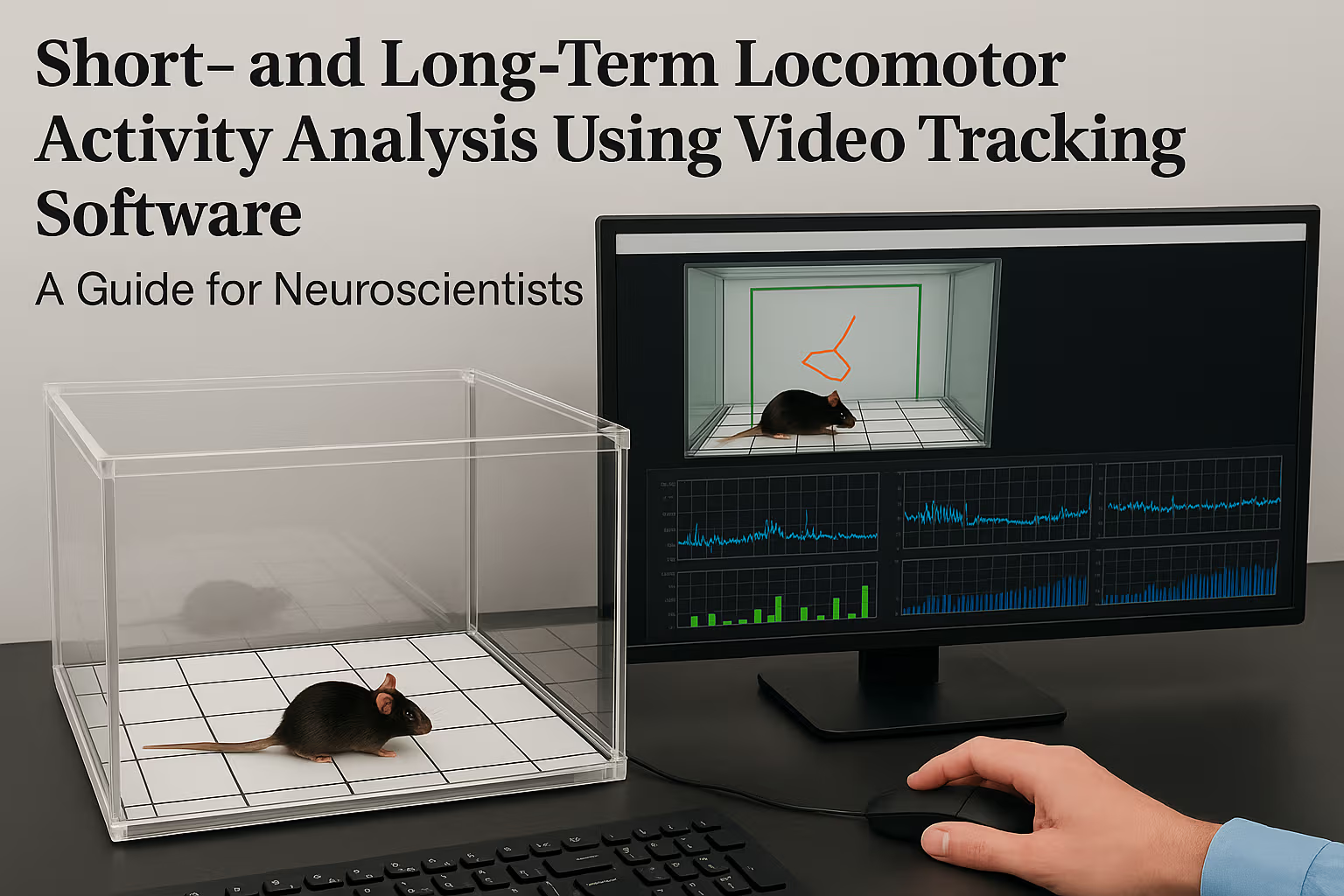
Short- and Long-Term Locomotor Activity Analysis Using Video Tracking Software: A Guide for Neuroscientists
3 min read
Learn More about our Services and how can we help you with your research!
Introduction
Locomotor activity (LMA) analysis has become a cornerstone of behavioral neuroscience, providing critical insights into movement patterns, neurological conditions, and responses to interventions. With advancements in video tracking software (VTS), researchers can now achieve higher specificity and scalability for both short- and long-term studies. This article offers a comprehensive guide to setting up and conducting LMA experiments.
Why Analyze Locomotor Activity?
1. Behavioral Biomarkers
LMA is widely used as an indicator of health and disease states in animal models, reflecting neurological, immunological, and psychological conditions.
2. Applications
-
Short-Term Studies: Examine acute effects of drugs, stress, or environmental changes.
-
Long-Term Studies: Assess circadian rhythms, chronic behavioral changes, and neurodegenerative disease progression.
Experimental Setup
1. Short-Term LMA
Short-term experiments typically focus on behavior over minutes to hours. Key setup considerations include:
-
Environment: Use red light to simulate the dark phase of the light cycle, as rodents are more active during this period.
-
Tracking Region: Define the entire cage floor as the region of interest (ROI) to capture precise movement data.
-
Metrics: Measure parameters such as distance moved, velocity, and activity duration.
2. Long-Term LMA
Long-term studies (hours to days) require additional considerations:
-
Modified Cages: Ensure food and water do not obstruct the view of the animal by using side-mounted feeders or transparent lids.
-
Data Management: Large datasets demand software capable of handling extended recording durations efficiently.
Advanced Tools for Locomotor Activity Analysis
1. ConductVision
ConductVision is an advanced video tracking platform optimized for both short- and long-term LMA studies. It excels in:
-
Handling occlusions and maintaining individual identities in multi-animal setups.
-
Customizable metrics for specific experimental needs.
-
Scalability for high-throughput studies.
2. Other Platforms
-
DeepLabCut and SLEAP: Machine-learning-based tools for precise pose tracking, suitable for short-term studies with detailed behavior classification.
-
Open-Source Systems (e.g., PiRATeMC): Cost-effective solutions for single-cage tracking, best suited for simpler setups.
Representative ResultsExample Figure: Comparison of Short- and Long-Term LMA Metrics
The table below summarizes typical metrics obtained from short- and long-term LMA studies:
| Content | Distance Moved (cm) | 500 ± 50 | 12,000 ± 1,200 | Content | Velocity (cm/sec) | 2.5 ± 0.3 | 1.2 ± 0.2 | Content | Duration of Activity | 8.0 ± 0.5 min | 6.5 ± 0.3 hours |
Practical Considerations
-
Acclimation: Allow animals at least 24 hours to adapt to the testing environment to minimize stress-induced artifacts.
-
Lighting and Noise: Ensure consistent lighting conditions and low noise levels to prevent behavioral disruptions.
-
Quality Control: Conduct pilot studies to validate tracking parameters and refine experimental conditions.
Future Directions
1. Real-Time Feedback
Emerging systems like ConductVision offer real-time data processing, enabling immediate adjustments during experiments.
2. Machine Learning Integration
Advanced algorithms are automating behavior classification, allowing for the analysis of complex interactions and patterns.
3. High-Throughput Scalability
Platforms capable of tracking multiple cages simultaneously are becoming essential for large-scale genetic or pharmacological studies.
Conclusion
Short- and long-term locomotor activity analysis using video tracking software is a powerful tool for understanding behavior in animal models. With advancements in software capabilities and experimental setups, researchers can now achieve unprecedented accuracy and depth in their studies. Platforms like ConductVision exemplify the integration of robustness, scalability, and precision, making them indispensable for modern neuroscience research.
References
-
York, J. M., et al. “Mouse Short- and Long-term Locomotor Activity Analyzed by Video Tracking Software.” Journal of Visualized Experiments, 2013(jove-76-50252).
-
Goulding, E. H., et al. “A robust automated system elucidates mouse home cage behavioral structure.” Proc. Natl. Acad. Sci. U.S.A., 2008.
-
Jennings, M., et al. “Refining rodent husbandry: the mouse.” Lab Anim., 1998.
-
Godbout, J. P., et al. “Exaggerated neuroinflammation and sickness behavior in aged mice following activation of the peripheral innate immune system.” FASEB J., 2005.
-
Dantzer, R., et al. “From inflammation to sickness and depression: when the immune system subjugates the brain.” Nat. Rev. Neurosci., 2008.
See more of Our Posts
Video tracking and animal behavior
All Resources
Never miss our posts!
Author:

Louise Corscadden, PhD
Dr Louise Corscadden acts as Conduct Science’s Director of Science and Development and Academic Technology Transfer. Her background is in genetics, microbiology, neuroscience, and climate chemistry.