Behavioral Tracking for Domestic Chick
Gallus gallus domesticus
Imprinting, visual cognition, and developmental learning in Gallus gallus domesticus. ConductVision delivers automated tracking and quantitative parameter extraction across the full assay catalog below.
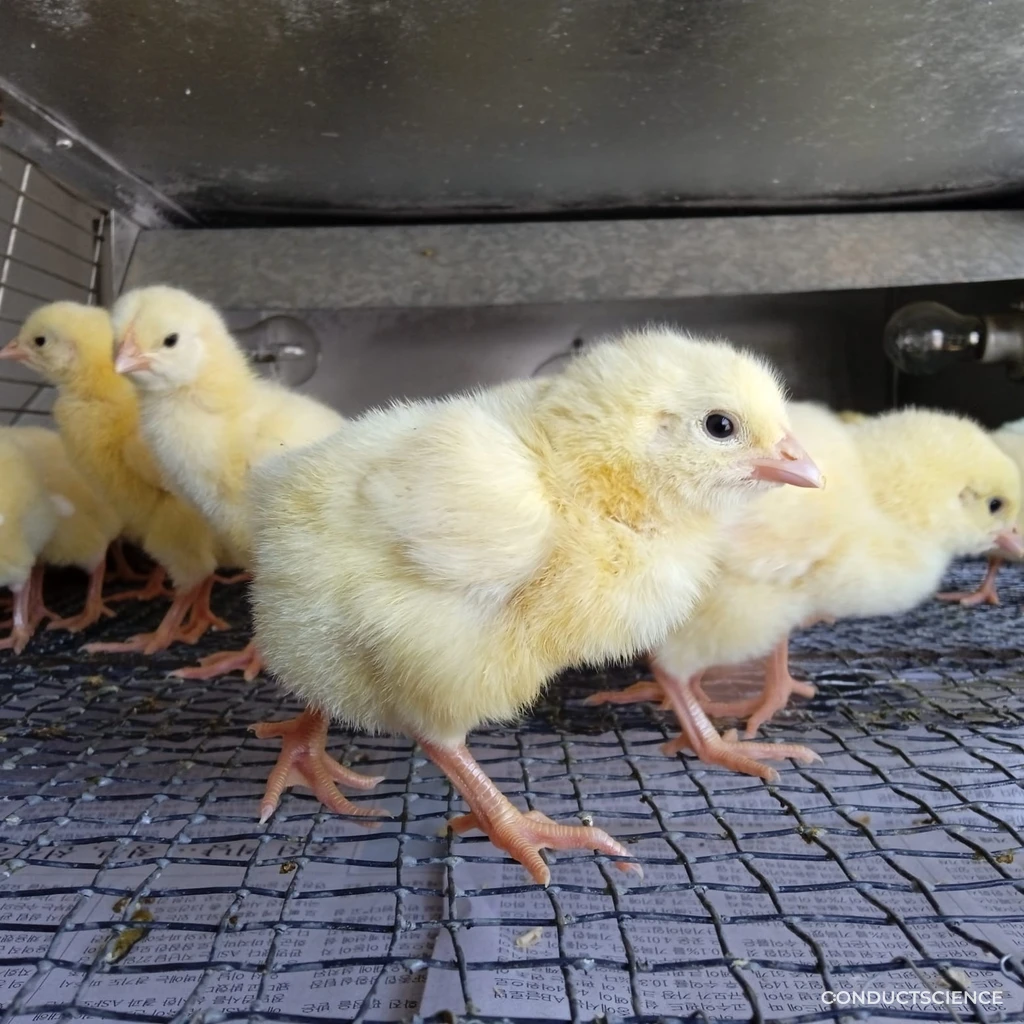
Why Domestic Chick in Behavioral Research
The domestic chick is a classical model for imprinting, social attachment, and rapid one-trial learning. Its precocial development and visually driven behavior make it ideal for studying the ontogeny of cognition, lateralization, and number sense in vertebrates.
Horn G. (2004). Pathways of the past: the imprint of memory. Nat Rev Neurosci, 5(2), 108-120. PMID: 14735114
Vallortigara G, Versace E. (2017). Filial imprinting. In: Encyclopedia of Animal Cognition and Behavior. Springer.
What We Measure in Domestic Chick
Validated assays with quantitative parameter tracking for Gallus gallus domesticus.
Newly hatched chicks form strong preferences for an imprinting object during a sensitive period in the first 24-72 h. Approach time and preference index vs novel objects measure imprinting strength.
| Parameter | Unit | Description |
|---|---|---|
| Approach time to imprint object | s | Affiliative response |
| Preference index | ratio | Imprint vs novel choice |
| Distress calls when separated | calls/min | Attachment strength |
| Sensitive-period window | h post-hatch | Acquisition timing |
Bateson PPG. (1966). The characteristics and context of imprinting. Biol Rev, 41(2), 177-217. PMID: 5329272
Chicks navigate around a transparent barrier to reach an imprint object or food. Detour latency and error rate index goal-directed cognition and frontal-equivalent forebrain function.
| Parameter | Unit | Description |
|---|---|---|
| Detour latency | s | Barrier to goal |
| Error rate | count | Wrong-side approaches |
| Persistence (push attempts) | count | Direct-line bias |
| Side bias | ratio | Left vs right detour |
Regolin L, et al. (1995). Detour behaviour in the domestic chick: searching for a disappearing prey or a disappearing social partner. Anim Behav, 50(1), 203-211.
Chicks discriminate small numbers and perform proto-arithmetic operations after imprinting on object groups. Choice accuracy across ratios reveals an approximate number system in a vertebrate brain.
| Parameter | Unit | Description |
|---|---|---|
| Choice accuracy | % | Correct numerosity |
| Weber fraction | ratio | Discrimination threshold |
| Addition/subtraction success | % | Proto-arithmetic |
| Set-size effect | slope | Accuracy vs N |
Rugani R, et al. (2009). Arithmetic in newborn chicks. Proc R Soc B, 276(1666), 2451-2460. PMID: 19364746
Isolated chicks emit distress calls and approach conspecific cues. The runway-reinstatement test indexes social motivation, anxiety, and pharmacological effects.
| Parameter | Unit | Description |
|---|---|---|
| Distress call rate | calls/min | Isolation response |
| Approach latency | s | Time to enter goal box |
| Time near conspecifics | s | Reinstatement strength |
| Locomotor activity | cm/min | Background activity |
Panksepp J, et al. (1980). Endogenous opioids and social behavior. Neurosci Biobehav Rev, 4(4), 473-487.
Chicks display strong eye-use lateralization for visual tasks (left eye for novelty, right for grain selection). Eye preference and side bias quantify hemispheric specialization.
| Parameter | Unit | Description |
|---|---|---|
| Eye preference index | ratio | Left vs right eye use |
| Pebble-grain success | % | Right-eye-mediated task |
| Predator detection latency | s | Left-eye-mediated task |
| Lateralization strength | index | Magnitude of bias |
Rogers LJ, Andrew RJ. (2002). Comparative Vertebrate Lateralization. Cambridge.
More Behavioral Tests for Domestic Chick
Pebble-and-Grain Test
Key Parameters: Grain pecks vs pebble pecks
Rogers LJ. (1997). Anim Behav, 53(4), 803-811.
Novel Object / Novel Arena
Predator Response (Hawk Model)
Key Parameters: Freezing duration, alarm calls
Mench JA. (2009). Welfare of the laying hen.
Color Preference
Key Parameters: Initial peck distribution
Ham AD, Osorio D. (2007). Behaviour, 144(8), 879-900.
Tonic Immobility
Key Parameters: Duration as fear measure
Jones RB. (1996). World Poult Sci J, 52(1), 71-91.
ConductScience Hardware for Domestic Chick Research
Imprinting Arena (Running Wheel or Runway)
Filial preference testing
Transparent Barrier Detour Apparatus
Goal-directed cognition
Numerical Discrimination Box
Quantity choice
Automated Chick Vocalization Recorder
Distress and contact calls
Pebble-Grain Discrimination Plate
Visual lateralization
Citations & Further Reading
- Horn G. (2004). Pathways of the past: the imprint of memory. Nat Rev Neurosci, 5(2), 108-120. PMID: 14735114
- Vallortigara G, Versace E. (2017). Filial imprinting. In: Encyclopedia of Animal Cognition and Behavior. Springer.
- Bateson PPG. (1966). The characteristics and context of imprinting. Biol Rev, 41(2), 177-217. PMID: 5329272
- Regolin L, et al. (1995). Detour behaviour in the domestic chick: searching for a disappearing prey or a disappearing social partner. Anim Behav, 50(1), 203-211.
- Rugani R, et al. (2009). Arithmetic in newborn chicks. Proc R Soc B, 276(1666), 2451-2460. PMID: 19364746
- Panksepp J, et al. (1980). Endogenous opioids and social behavior. Neurosci Biobehav Rev, 4(4), 473-487.
- Rogers LJ, Andrew RJ. (2002). Comparative Vertebrate Lateralization. Cambridge.
Other Model Systems
Discuss Your Chick Research
Tell us about your models, assays, and experimental goals — we’ll show you how ConductVision fits your workflow.