Behavioral Tracking for Japanese Quail
Coturnix japonica
Sexual behavior, reproductive endocrinology, and avian neuroscience in Coturnix japonica. ConductVision delivers automated tracking and quantitative parameter extraction across the full assay catalog below.
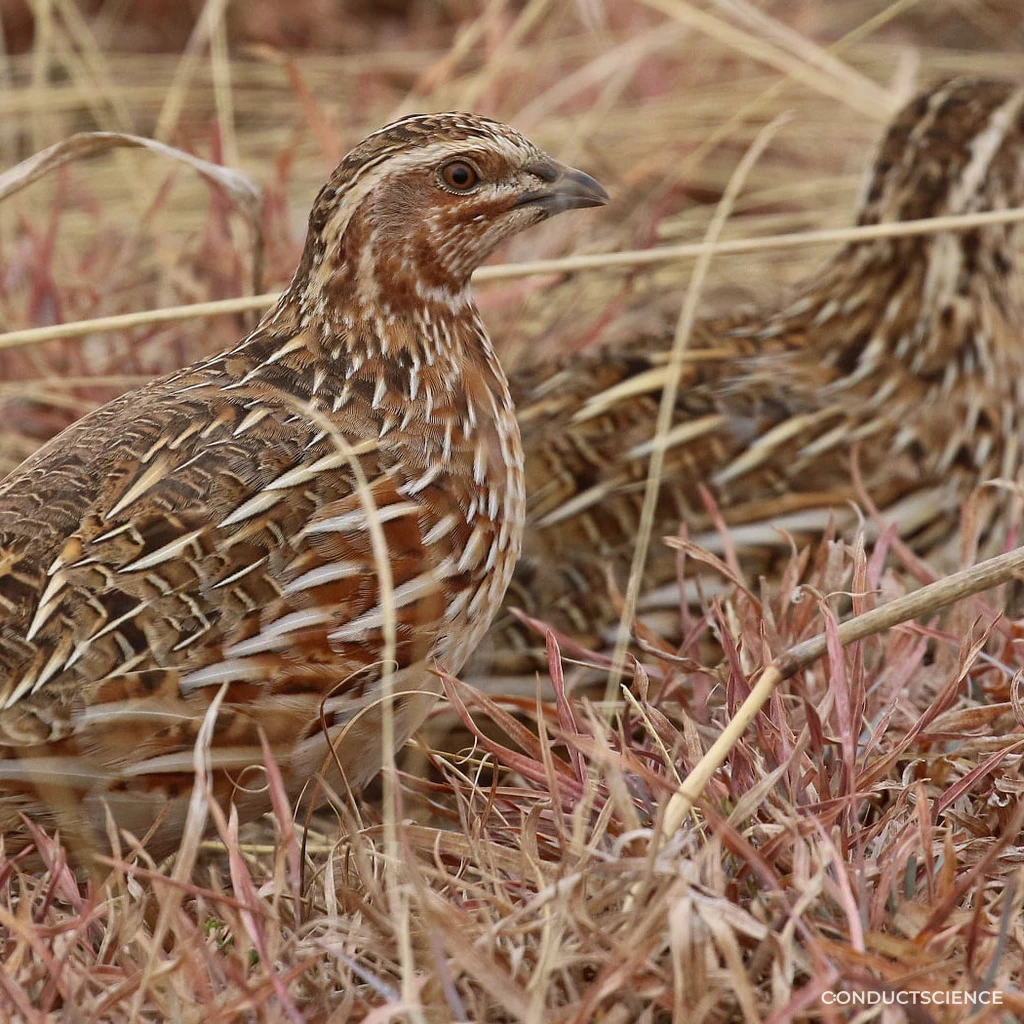
Why Japanese Quail in Behavioral Research
The Japanese quail is a workhorse for avian behavioral endocrinology, sexual behavior research, and developmental neurobiology. Short generation time, robust reproductive behavior, and well-mapped neural circuits make it a uniquely tractable bird model.
Balthazart J, Ball GF. (2007). Topography in the preoptic region: differential regulation of appetitive and consummatory male sexual behaviors. Front Neuroendocrinol, 28(4), 161-178. PMID: 17624419
Ottinger MA, Bakst MR. (1995). Endocrinology of the avian reproductive system. J Avian Med Surg, 9(4), 242-250.
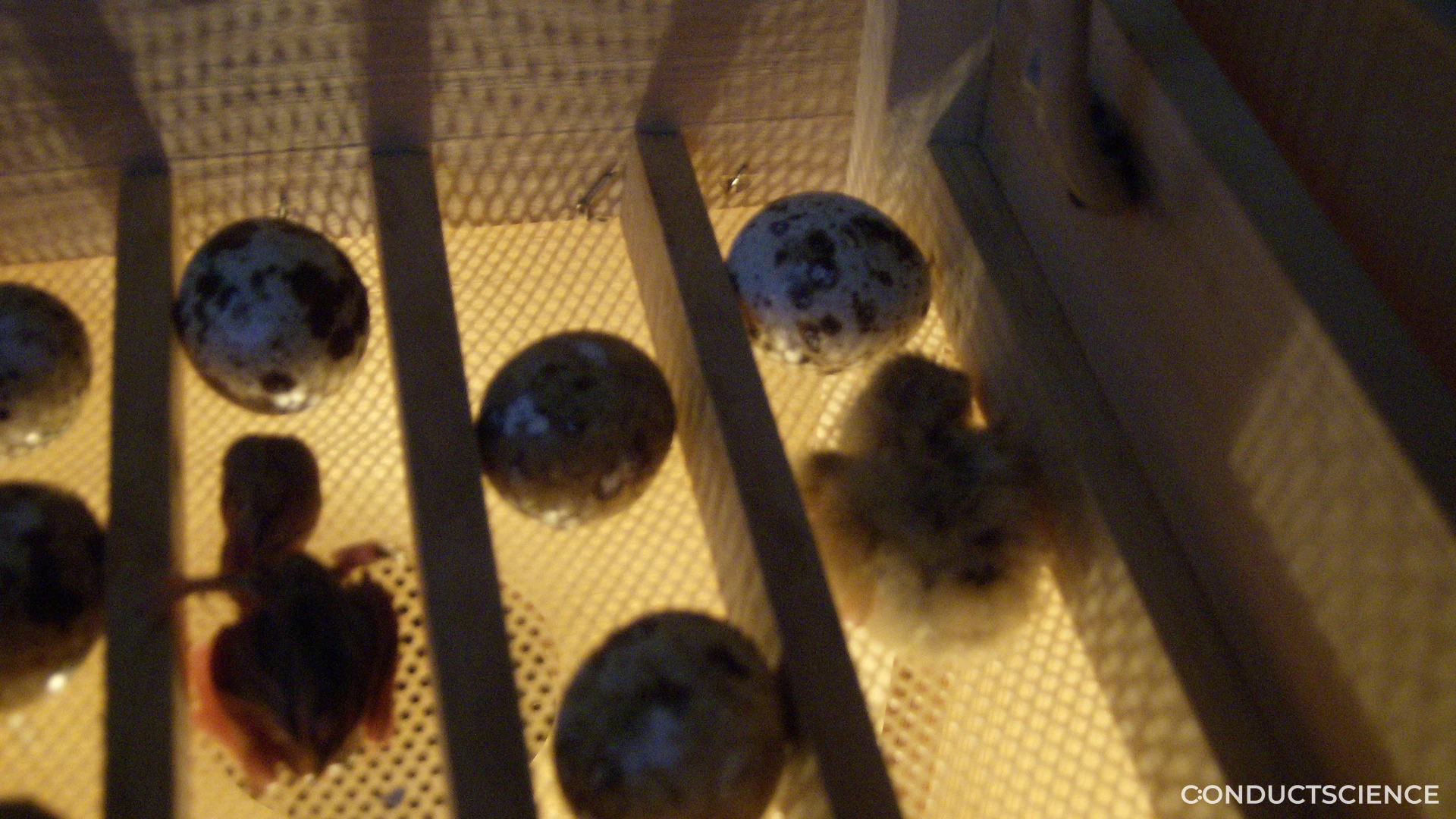
What We Measure in Japanese Quail
Validated assays with quantitative parameter tracking for Coturnix japonica.
Sexually mature males display a stereotyped sequence (neck-grab, mount, cloacal contact) toward receptive females. Latencies and frequencies index appetitive and consummatory motivation.
| Parameter | Unit | Description |
|---|---|---|
| Mount latency | s | Onset of sexual sequence |
| Mount frequency | count/test | Appetitive motivation |
| Cloacal contact movements | count | Consummatory output |
| Female-directed approach | % | Sexual choice |
Adkins-Regan E. (1989). Sex hormones and sexual orientation in animals. Psychobiology, 16, 335-347.
Open-field testing measures locomotor activity, thigmotaxis, and freezing in a novel arena. Standardized for selection of high- and low-stress lines.
| Parameter | Unit | Description |
|---|---|---|
| Distance traveled | m | Locomotion |
| Time in center | s | Anxiety-like |
| Freezing duration | s | Immobility |
| Defecation count | count | Stress index |
Mills AD, Faure JM. (1991). Divergent selection for duration of tonic immobility. Behav Genet, 21(4), 361-371. PMID: 1953609
Tonic immobility, an antipredator freezing response, is a heritable fearfulness index. Duration of induced immobility is used to select divergent lines and test anxiolytics.
| Parameter | Unit | Description |
|---|---|---|
| Tonic immobility duration | s | Latency to first righting |
| Number of inductions | count | Fearfulness index |
| Right latency | s | Time to recover |
| Vocalization during TI | count | Stress indicator |
Jones RB. (1986). The tonic immobility reaction of the domestic fowl: a review. World Poult Sci J, 42(1), 82-96.
Quail seek visual or auditory contact with conspecifics. Approach latency and time near a stimulus group quantify sociality and social-stress responses.
| Parameter | Unit | Description |
|---|---|---|
| Time near conspecifics | s | Sociality |
| Approach latency | s | Affiliation onset |
| Vocalizations | count | Contact calling |
| Aggressive pecks | count | Agonistic behavior |
Mills AD, et al. (1997). Social motivation. Behav Genet, 27(5), 433-441.
Quail learn position and cue-based discriminations in a T-maze. Trials to criterion and reversal performance index spatial cognition.
| Parameter | Unit | Description |
|---|---|---|
| Trials to criterion | count | Acquisition speed |
| Choice latency | s | Decision time |
| Reversal trials | count | Cognitive flexibility |
| Side bias | ratio | Innate preference |
Causse C, et al. (1999). Spatial learning in Japanese quail (Coturnix japonica). Behav Processes, 47(1), 11-22.
More Behavioral Tests for Japanese Quail
Feeding Latency / Pecking Order
Dust Bathing
Key Parameters: Bouts per day, sequence completion
van Liere DW. (1992). Br Poult Sci, 33(1), 25-37.
Egg-Laying Rhythm
Key Parameters: Time of oviposition, intervals
Ottinger MA. (1989). Comp Biochem Physiol A, 92(1), 23-32.
Aggression Toward Mirror
Key Parameters: Pecks, threat displays
Schweitzer C, et al. (2009). PMID: 19501122
Conditioned Place Preference (Sexual)
Key Parameters: Time on copulation-paired side
Domjan M. (2005). Annu Rev Psychol, 56, 179-206. PMID: 15709933
ConductScience Hardware for Japanese Quail Research
Quail Breeding Enclosure
Reproductive behavior testing
Open-Field Arena (Quail-Sized)
Activity and anxiety assays
Tonic-Immobility Test Cradle
Standardized fear measure
T-Maze Apparatus
Spatial learning
Activity / Feed-Intake Monitor
Long-term welfare metrics
Citations & Further Reading
- Balthazart J, Ball GF. (2007). Topography in the preoptic region: differential regulation of appetitive and consummatory male sexual behaviors. Front Neuroendocrinol, 28(4), 161-178. PMID: 17624419
- Ottinger MA, Bakst MR. (1995). Endocrinology of the avian reproductive system. J Avian Med Surg, 9(4), 242-250.
- Adkins-Regan E. (1989). Sex hormones and sexual orientation in animals. Psychobiology, 16, 335-347.
- Mills AD, Faure JM. (1991). Divergent selection for duration of tonic immobility. Behav Genet, 21(4), 361-371. PMID: 1953609
- Jones RB. (1986). The tonic immobility reaction of the domestic fowl: a review. World Poult Sci J, 42(1), 82-96.
- Mills AD, et al. (1997). Social motivation. Behav Genet, 27(5), 433-441.
- Causse C, et al. (1999). Spatial learning in Japanese quail (Coturnix japonica). Behav Processes, 47(1), 11-22.
Other Model Systems

Discuss Your Quail Research
Tell us about your models, assays, and experimental goals — we’ll show you how ConductVision fits your workflow.