Primary Assay — Desert Locust
Walking Locomotion
Schistocerca gregaria
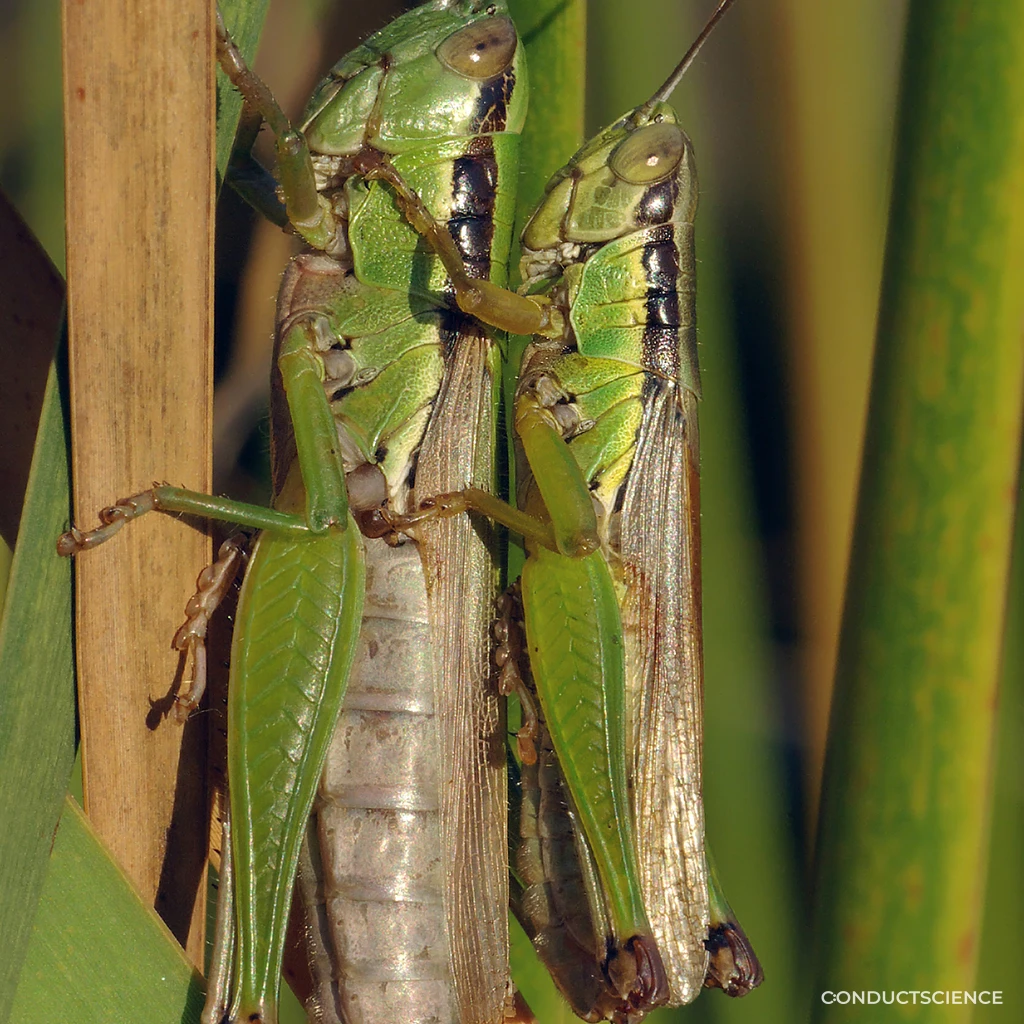
Locusts walk with tripod gait, switchable between solitary and gregarious modes. Step pattern, stride length, and turning quantify motor output and phase state.
Quantitative Output
Measured Parameters
Every parameter is automatically tracked frame-by-frame in the ConductVision pipeline for Schistocerca gregaria.
| Parameter | Unit | Description |
|---|---|---|
| Walking speed | cm/s | Translational velocity |
| Stride frequency | Hz | Step rate |
| Stride length | mm | Per-step distance |
| Turning angle | deg | Heading change |
References
Citations for Walking Locomotion
- Burrows M. (1996). The Neurobiology of an Insect Brain. Oxford.
Compatible Equipment
Hardware for Desert Locust Research
Tethered Flight Arena (Free-Beating Wings)
Flight motor output
Looming-Stimulus Display Rig
Collision detection assays
Walking Belt with Optogenetic Compatibility
Motor control studies
Phase-Conditioning Cage Stack
Crowding manipulation
Tarsal-Contact Olfactometer
PER conditioning
Related Assays
Other Desert Locust Primary Assays
12
Collision Avoidance (LGMD/DCMD)
Schistocerca gregaria
Looming stimuli reliably evoke escape jumps gated by the LGMD-DCMD pathway. Response latency, jump direction, and thresh…
12
Tethered Flight Initiation
Schistocerca gregaria
Tethered locusts initiate flight upon loss of tarsal contact, producing rhythmic wing strokes for many minutes. Latency,…
12
Phase Transition (Solitary↔Gregarious)
Schistocerca gregaria
Crowding shifts solitary locusts to gregarious behavior within hours. Attraction to conspecifics, color, and activity be…
Run Walking Locomotion on ConductVision
Our team will configure the protocol, camera rig, and analysis pipeline for your desert locust facility.