Behavioral Tracking for Desert Locust
Schistocerca gregaria
Phase polyphenism, collision detection, and motor control in Schistocerca gregaria. ConductVision delivers automated tracking and quantitative parameter extraction across the full assay catalog below.
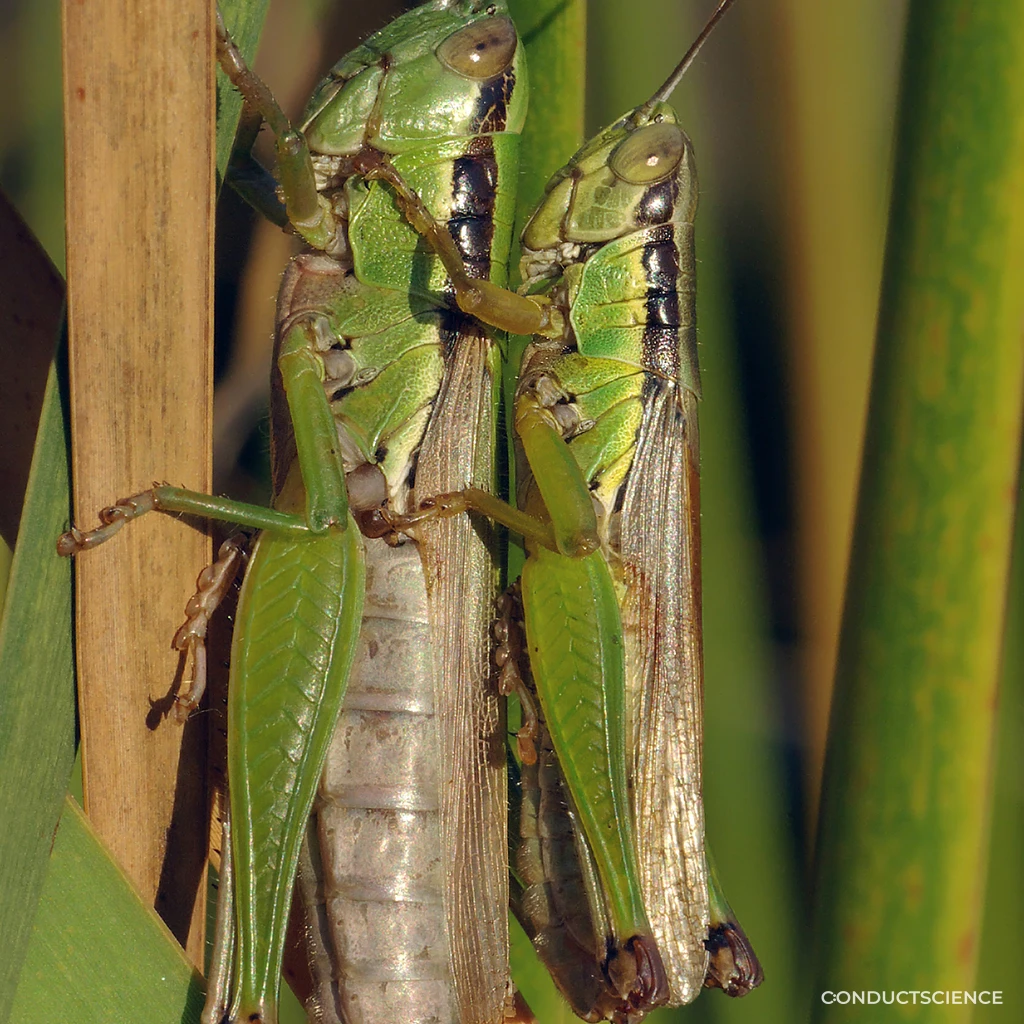
Why Desert Locust in Behavioral Research
The desert locust is a classic model for solitary-to-gregarious phase transition, collision detection by the LGMD/DCMD neurons, and rhythmic motor control. Its size and well-mapped CNS make it a foundational system for invertebrate neuroethology.
Rind FC, Simmons PJ. (1992). Orthopteran DCMD neuron: a reevaluation of responses to moving objects. I. Selective responses to approaching objects. J Neurophysiol, 68(5), 1654-1666. PMID: 1479436
Pener MP, Simpson SJ. (2009). Locust phase polyphenism: an update. Adv Insect Physiol, 36, 1-272.
What We Measure in Desert Locust
Validated assays with quantitative parameter tracking for Schistocerca gregaria.
Looming stimuli reliably evoke escape jumps gated by the LGMD-DCMD pathway. Response latency, jump direction, and threshold to a defined looming velocity profile quantify the circuit.
| Parameter | Unit | Description |
|---|---|---|
| Response latency | ms | Stimulus onset to motor response |
| Jump direction | deg | Heading away from looming |
| Looming threshold | l/v ratio | Critical visual angle/speed |
| Spike rate (DCMD) | spikes/s | Neural readout if recording |
Rind FC, Simmons PJ. (1992). PMID: 1479436
Locusts walk with tripod gait, switchable between solitary and gregarious modes. Step pattern, stride length, and turning quantify motor output and phase state.
| Parameter | Unit | Description |
|---|---|---|
| Walking speed | cm/s | Translational velocity |
| Stride frequency | Hz | Step rate |
| Stride length | mm | Per-step distance |
| Turning angle | deg | Heading change |
Burrows M. (1996). The Neurobiology of an Insect Brain. Oxford.
Tethered locusts initiate flight upon loss of tarsal contact, producing rhythmic wing strokes for many minutes. Latency, duration, and stroke frequency are core measures.
| Parameter | Unit | Description |
|---|---|---|
| Flight initiation latency | s | Tarsal release to first stroke |
| Flight duration | min | Sustained wing beating |
| Wing-stroke frequency | Hz | Beats per second |
| Yaw torque | mNm | Steering output |
Wilson DM. (1961). The central nervous control of flight in a locust. J Exp Biol, 38, 471-490.
Crowding shifts solitary locusts to gregarious behavior within hours. Attraction to conspecifics, color, and activity benchmark phase state.
| Parameter | Unit | Description |
|---|---|---|
| Conspecific attraction index | ratio | Approach to dummies |
| Activity level | cm/min | Locomotion |
| Color score | index | Body coloration shift |
| Aggregation density | individuals/m² | Group cohesion |
Anstey ML, et al. (2009). Serotonin mediates behavioral gregarization underlying swarm formation in desert locusts. Science, 323(5914), 627-630. PMID: 19179529
Restrained locusts learn associations between odors and sucrose reward, expressed as proboscis-extension responses. Acquisition and retention curves quantify olfactory learning.
| Parameter | Unit | Description |
|---|---|---|
| Acquisition rate | % | CR after training |
| Generalization | % | Response to novel odor |
| Memory at 24 h | % | Long-term retention |
| Discrimination accuracy | % | CS+ vs CS- |
Simões PM, Niven JE, Ott SR. (2013). Phenotypic transformation affects associative learning in the desert locust. Curr Biol, 23(23), 2407-2412. PMID: 24268406
More Behavioral Tests for Desert Locust
Feeding (Plant Choice)
Key Parameters: Time on host plant, bites
Bernays EA, Chapman RF. (1994). Host-Plant Selection by Phytophagous Insects.
Jumping (Hindleg Catapult)
Key Parameters: Jump distance, takeoff angle
Bennet-Clark HC. (1975). J Exp Biol, 63, 53-83.
Mating (Male-Female Approach)
Key Parameters: Courtship duration, mounting events
Pener MP. (1991). Annu Rev Entomol, 36, 443-465.
Aggregation (Conspecific Following)
Key Parameters: Distance to neighbor, group cohesion
Buhl J, et al. (2006). Science, 312(5778), 1402-1406. PMID: 16763108
Stridulation / Acoustic Signaling
Key Parameters: Song rate, peak frequency
Ragge DR, Reynolds WJ. (1998). Songs of the Grasshoppers and Crickets of W. Europe.
ConductScience Hardware for Desert Locust Research
Tethered Flight Arena (Free-Beating Wings)
Flight motor output
Looming-Stimulus Display Rig
Collision detection assays
Walking Belt with Optogenetic Compatibility
Motor control studies
Phase-Conditioning Cage Stack
Crowding manipulation
Tarsal-Contact Olfactometer
PER conditioning
Citations & Further Reading
- Rind FC, Simmons PJ. (1992). Orthopteran DCMD neuron: a reevaluation of responses to moving objects. I. Selective responses to approaching objects. J Neurophysiol, 68(5), 1654-1666. PMID: 1479436
- Pener MP, Simpson SJ. (2009). Locust phase polyphenism: an update. Adv Insect Physiol, 36, 1-272.
- Rind FC, Simmons PJ. (1992). PMID: 1479436
- Burrows M. (1996). The Neurobiology of an Insect Brain. Oxford.
- Wilson DM. (1961). The central nervous control of flight in a locust. J Exp Biol, 38, 471-490.
- Anstey ML, et al. (2009). Serotonin mediates behavioral gregarization underlying swarm formation in desert locusts. Science, 323(5914), 627-630. PMID: 19179529
- Simões PM, Niven JE, Ott SR. (2013). Phenotypic transformation affects associative learning in the desert locust. Curr Biol, 23(23), 2407-2412. PMID: 24268406
Other Model Systems

Discuss Your Locust Research
Tell us about your models, assays, and experimental goals — we’ll show you how ConductVision fits your workflow.