Behavioral Tracking for Bearded Dragon
Pogona vitticeps
Reptilian sleep, social cognition, and visual behavior in Pogona vitticeps. ConductVision delivers automated tracking and quantitative parameter extraction across the full assay catalog below.
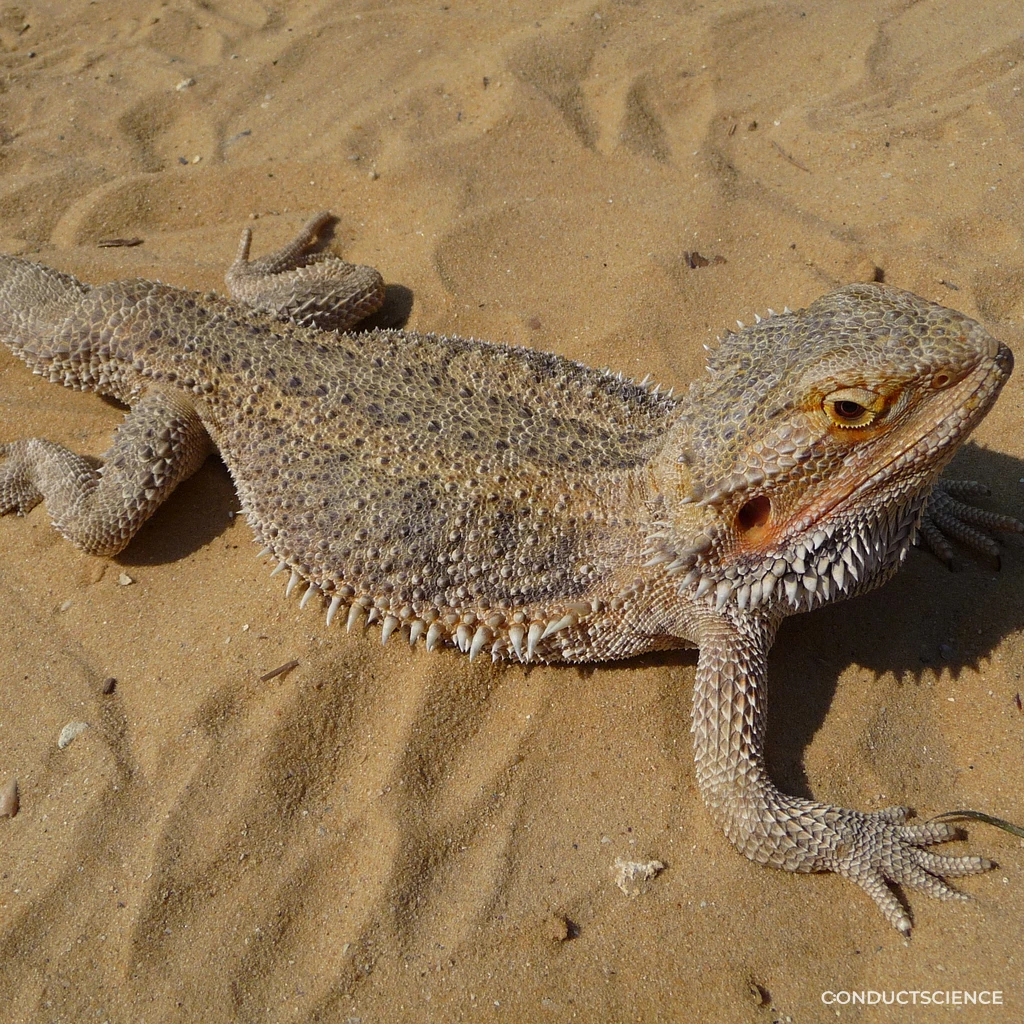
Why Bearded Dragon in Behavioral Research
The Australian bearded dragon is a leading reptile model and the species in which REM-like sleep was first demonstrated outside mammals and birds. Its rich visual and social behaviors, plus tractable handling, make it valuable for comparative neuroscience and sleep research.
Shein-Idelson M, Ondracek JM, Liaw HP, Reiter S, Laurent G. (2016). Slow waves, sharp waves, ripples, and REM in sleeping dragons. Science, 352(6285), 590-595. PMID: 27126045
Doody JS, et al. (2013). Cryptic and complex nesting in the yellow-spotted monitor (parallel finding for reptile sleep complexity).
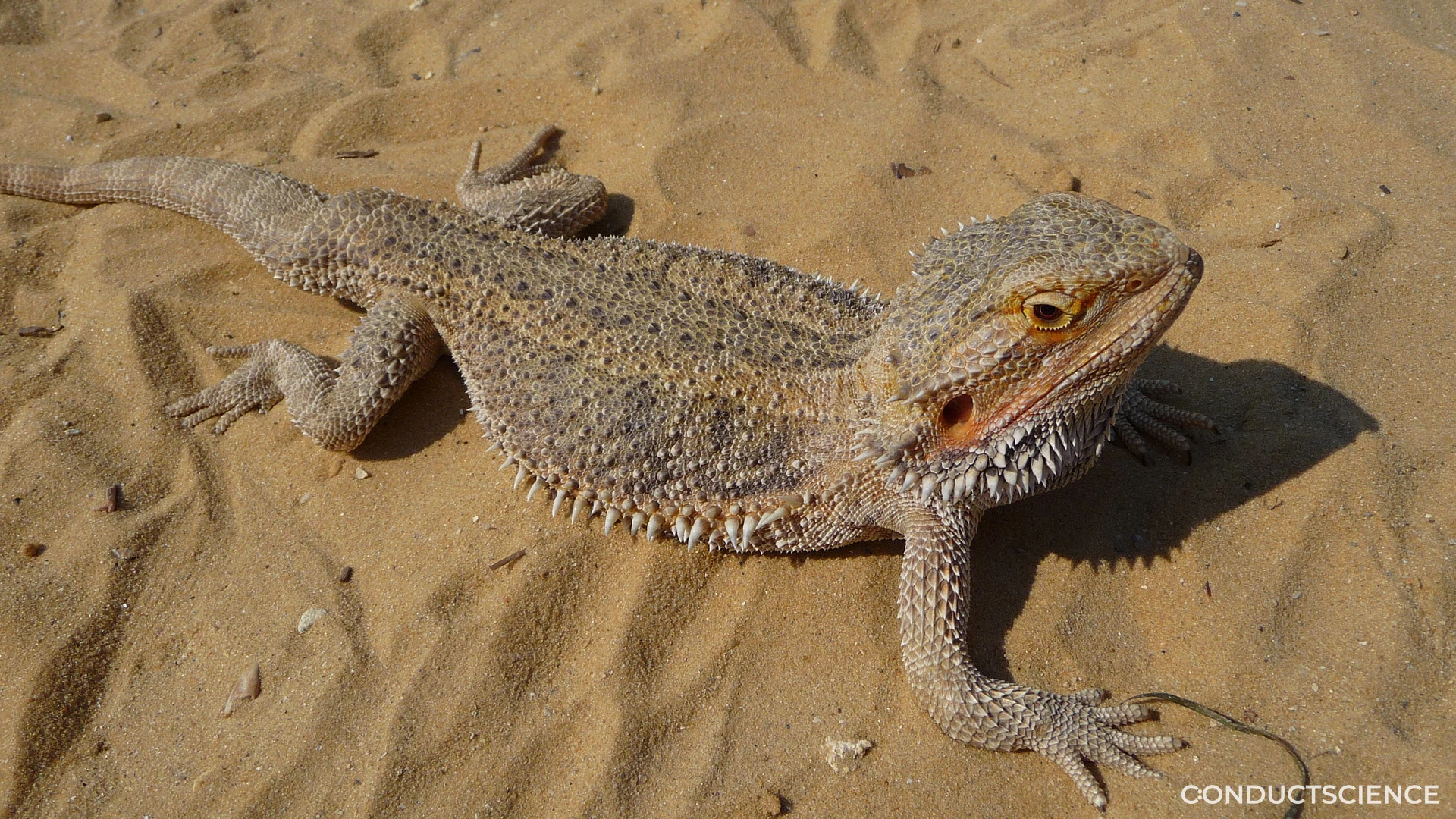
What We Measure in Bearded Dragon
Validated assays with quantitative parameter tracking for Pogona vitticeps.
Bearded dragons exhibit two alternating sleep states reminiscent of mammalian SWS and REM, with rhythmic eye movements and rapid forebrain oscillations. EEG and behavioral state quantification underpin sleep-evolution research.
| Parameter | Unit | Description |
|---|---|---|
| SWS-like duration | min/night | Slow-wave state time |
| REM-like duration | min/night | Rapid forebrain state |
| Cycle period | min | SWS↔REM oscillation |
| Rapid eye movements | events/min | During REM-like state |
Shein-Idelson M, et al. (2016). PMID: 27126045
Bearded dragons learn by observation, opening sliding doors after watching demonstrators. Trials to criterion and side-bias matching quantify social learning in a reptile.
| Parameter | Unit | Description |
|---|---|---|
| Trials to criterion | count | Acquisition speed |
| Demonstrator-side matching | % | Imitation fidelity |
| Latency to first attempt | s | Engagement |
| Success rate | % | Task completion |
Kis A, Huber L, Wilkinson A. (2015). Social learning by imitation in a reptile (Pogona vitticeps). Anim Cogn, 18(1), 325-331. PMID: 25199480
Bearded dragons signal dominance and submission with stereotyped head bobs and arm waves. Display rate and posture index agonistic and reproductive states.
| Parameter | Unit | Description |
|---|---|---|
| Head bobs | count/min | Dominance signaling |
| Arm waves | count/min | Submission signaling |
| Beard darkening | index | Threat coloration |
| Dyadic outcome | win/lose | Encounter resolution |
Brattstrom BH. (1971). Social and thermoregulatory behavior of the bearded dragon, Amphibolurus barbatus. Copeia, 1971(3), 484-497.
Bearded dragons alternate between basking and exploration, with thermoregulatory cycles dominating activity. Time in basking, distance traveled, and substrate temperature index normal behavior.
| Parameter | Unit | Description |
|---|---|---|
| Basking time | min/h | Time at heat lamp |
| Distance traveled | m | Locomotor activity |
| Body temperature (cloacal) | °C | Thermoregulatory target |
| Substrate occupancy | % | Hot vs cool side |
Cadena V, Tattersall GJ. (2009). Body temperature regulation during acclimation to cold and hypoxia in rats. (general thermoreg framework)
Pogona darkens its beard in threat and lightens dorsal coloration when basking. Color changes index motivational and thermoregulatory state.
| Parameter | Unit | Description |
|---|---|---|
| Beard darkness score | index | Threat coloration |
| Dorsal lightness | index | Thermoregulatory state |
| Color-change latency | s | Onset after stimulus |
| Display duration | s | Persistence |
Smith KR, et al. (2016). Colour change for thermoregulation versus camouflage in free-ranging lizards. Biol Lett, 12(9), 20160376. PMID: 27654788
More Behavioral Tests for Bearded Dragon
Prey Strike (Live Insect)
Key Parameters: Strike latency, accuracy
Schwenk K. (2000). Feeding in lepidosaurs.
Courtship Display
Maze Learning (Spatial)
Key Parameters: Trials to criterion, side bias
Wilkinson A, et al. (2010). Anim Cogn, 13(5), 765-769. PMID: 20437078
Threat / Defensive Display
Key Parameters: Beard expansion, gape
Greer AE. (1989). The Biology and Evolution of Australian Lizards.
Cognitive Flexibility (Reversal)
Key Parameters: Reversal trials, perseverative errors
Szabo B, et al. (2019). PMID: 30637553
ConductScience Hardware for Bearded Dragon Research
Reptile Enclosure with EEG Implant
Sleep neurophysiology
Thermal-Gradient Basking Arena
Thermoregulatory behavior
Video Tracking System (Slow-Motion Capable)
Display behavior analysis
Two-Compartment Imitation Apparatus
Social learning
Multi-Cage Climate Control
Long-term housing for chronic studies
Citations & Further Reading
- Shein-Idelson M, Ondracek JM, Liaw HP, Reiter S, Laurent G. (2016). Slow waves, sharp waves, ripples, and REM in sleeping dragons. Science, 352(6285), 590-595. PMID: 27126045
- Doody JS, et al. (2013). Cryptic and complex nesting in the yellow-spotted monitor (parallel finding for reptile sleep complexity).
- Shein-Idelson M, et al. (2016). PMID: 27126045
- Kis A, Huber L, Wilkinson A. (2015). Social learning by imitation in a reptile (Pogona vitticeps). Anim Cogn, 18(1), 325-331. PMID: 25199480
- Brattstrom BH. (1971). Social and thermoregulatory behavior of the bearded dragon, Amphibolurus barbatus. Copeia, 1971(3), 484-497.
- Cadena V, Tattersall GJ. (2009). Body temperature regulation during acclimation to cold and hypoxia in rats. (general thermoreg framework)
- Smith KR, et al. (2016). Colour change for thermoregulation versus camouflage in free-ranging lizards. Biol Lett, 12(9), 20160376. PMID: 27654788
Other Model Systems
Discuss Your Bearded Dragon Research
Tell us about your models, assays, and experimental goals — we’ll show you how ConductVision fits your workflow.